Rosa Ana Clara Arrais, Silva Lorrane Cristine Conceição da, Azevedo Jacyara Christina Carvalho, Oliveira Rhavenna Thais Silva, Ferreira Ruhena Kelber Abrão, Parra Maíra Tristão, Carvalho Heráclito Barbosa, Moraes Augusto César Ferreira de, Nascimento-Ferreira Marcus Vinícius
Universidade Federal do Tocantins. Programa de Pós-Graduação em Ensino em Ciência e Saúde. Palmas, TO, Brasil.
Instituto de Ensino Superior do Sul do Maranhão. Imperatriz, MA, Brasil.
Rev Saude Publica. 2025 Mar 31;59:e4. doi: 10.11606/s1518-8787.2025059005974. eCollection 2025.
We tested the reliability and validity of the Perceived Stress Scale, an online questionnaire, among college students from low-income Brazilian regions.
We assessed 195 college students from a region with a Gini index of 0.56 for the validity study and a subsample of 117 students for the reliability study, where we evaluated the Perceived Stress Scale with the 14 original items. We also applied the shortened version of the Brief Symptom Inventory with 18 items (BSI-18). The psychometric properties analyzed, including temporal stability, internal consistency, and structural and convergent validity, were assessed using Spearman's correlation coefficient, Cronbach's alpha coefficient, unsupervised machine learning, and confirmatory factor analysis.
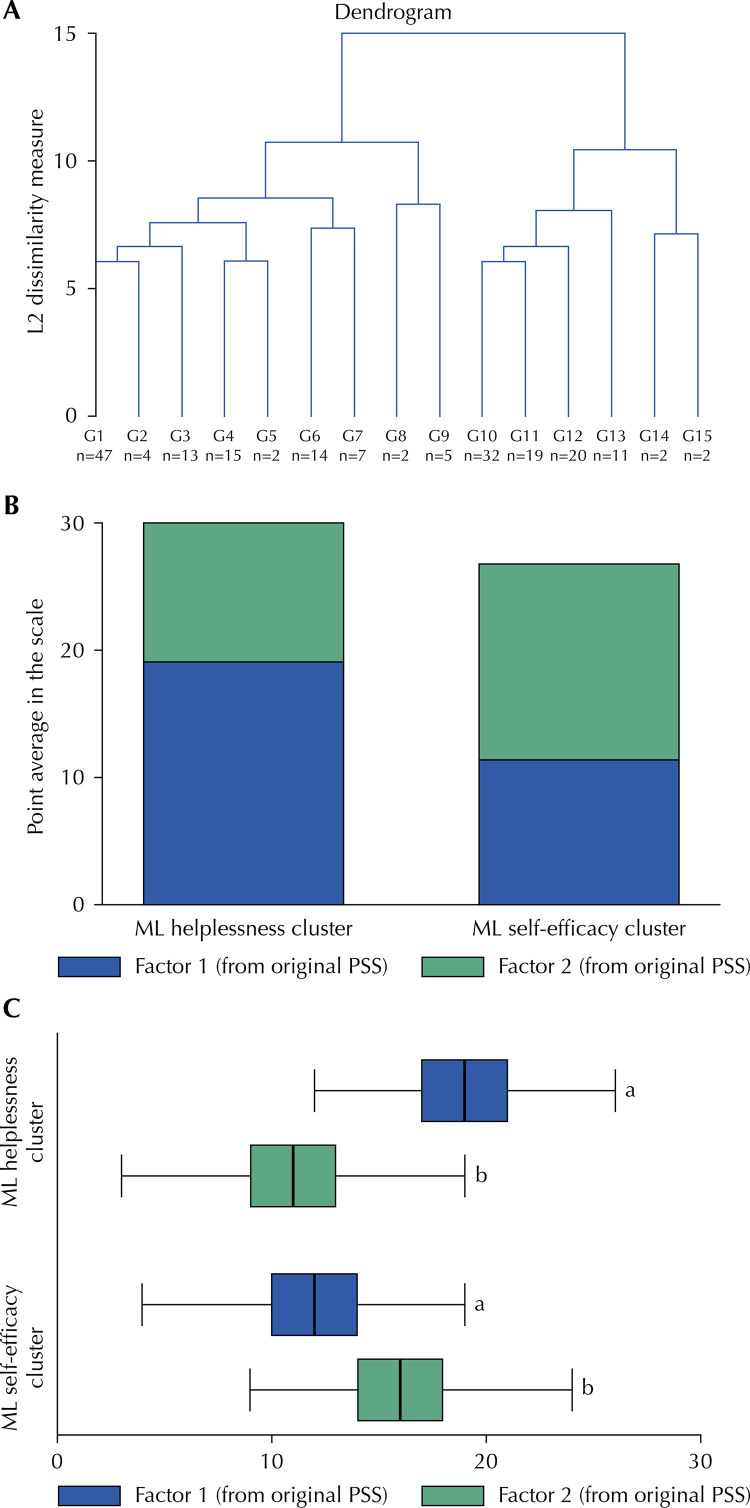
The questionnaire showed acceptable reliability (temporal stability [rho ≥ 0.32] and internal consistency [alpha ≥ 0.79]). In construct validity, we identified two clusters, "helplessness" and "self-efficacy", as structure solutions for our sample via unsupervised machine learning. An acceptable fit for the two-factor structure of the scale was indicated by multiple indices (chi-square/degrees of freedom [χ2/df] = 119/76; Tucker-Lewis Index [TLI] = 0.916; Comparative Fit Index [CFI] = 0.930; root mean square error of approximation [RMSEA] = 0.054; standardized root mean-squared residual [SRMR] = 0.078)) on confirmatory factor analysis. Moreover, convergent validity was supported by significant correlations of the BSI-18 Global Severity Index score with perception of helplessness (rho = 0.71) and self-efficacy (rho = -0.42).
The Perceived Stress Scale, which is an online tool, is a reliable and valid self-report tool for college students.
我们在来自巴西低收入地区的大学生中测试了在线问卷感知压力量表的信度和效度。
我们评估了来自基尼系数为0.56地区的195名大学生用于效度研究,以及117名学生的子样本用于信度研究,在信度研究中我们用14个原始项目评估了感知压力量表。我们还应用了包含18个项目的简明症状量表简版(BSI-18)。使用斯皮尔曼相关系数、克朗巴赫α系数、无监督机器学习和验证性因子分析评估了包括时间稳定性、内部一致性以及结构和收敛效度在内的心理测量特性。
该问卷显示出可接受的信度(时间稳定性[rho≥0.32]和内部一致性[alpha≥0.79])。在结构效度方面,通过无监督机器学习,我们为样本确定了两个聚类,即“无助感”和“自我效能感”作为结构解决方案。验证性因子分析的多个指标表明该量表的两因素结构具有可接受的拟合度(卡方/自由度[χ2/df]=119/76;塔克-刘易斯指数[TLI]=0.916;比较拟合指数[CFI]=0.930;近似误差均方根[RMSEA]=0.054;标准化残差均方根[SRMR]=0.078)。此外,BSI-18全球严重程度指数得分与无助感感知(rho=0.71)和自我效能感(rho=-0.42)的显著相关性支持了收敛效度。
感知压力量表作为一种在线工具,是一种适用于大学生的可靠且有效的自我报告工具。