Lancet Public Health. 2019 Dec;4(12):e645-e657. doi: 10.1016/S2468-2667(19)30189-6. Epub 2019 Nov 20.
Through a comprehensive analysis of Italy's estimates from the Global Burden of Diseases, Injuries, and Risk Factors Study (GBD) 2017, we aimed to understand the patterns of health loss and response of the health-care system, and offer evidence-based policy indications in light of the demographic transition and government health spending in the country.
Estimates for Italy were extracted from GBD 2017. Data on Italy are presented for 1990 and 2017, on prevalence, causes of death, years of life lost, years lived with disability, disability-adjusted life-years (DALYs), life expectancy at birth and at age 65 years, healthy life expectancy, and Healthcare Access and Quality (HAQ) Index. We compared the estimates for Italy with those of 15 other western European countries.
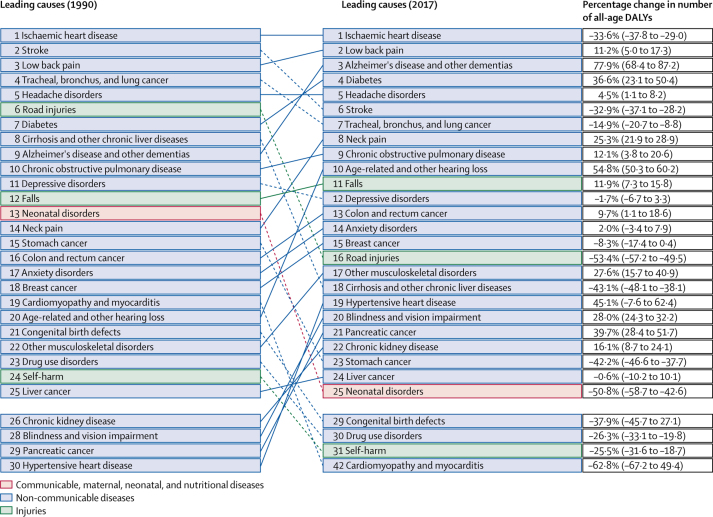
The quality of the universal health system and healthy behaviours contribute to favourable overall health, even in comparison with other western European countries. In 2017, life expectancy and HAQ Index score in Italy were among the highest globally, with life expectancy at birth reaching 85·3 years for females and 80·8 for males in 2017, ranking Italy eighth globally for females and sixth for males, and an HAQ Index score of 94·9 in 2016 compared with 81·54 in 1990, keeping Italy ranked as ninth globally. Between 1990 and 2017 age-standardised death rates for cardiovascular diseases decreased by 53·7% (95% uncertainty interval -56·1 to -51·4), for neoplasms decreased by 28·2% (-32·3 to -24·6), and for transport injuries decreased by 62·1% (-64·6 to -59·2). However, population ageing is causing an increase in the burden of specific diseases, such as Alzheimer's disease and other dementias (DALYs increased by 77·9% [68·4 to 87·2]) and pancreatic (DALYs increased by 39·7% [28·4 to 51·7]) and uterine cancers (DALYs increased by 164·7% [129·7 to 202·5]). Behavioural risk factors, which are potentially modifiable, still have a strong effect, particularly on cardiovascular diseases and neoplasms. For instance, in 2017, 44 400 (41 200 to 47 800) cancer deaths were attributed to smoking, 12 000 (9600 to 14 800) to alcohol use, and 9500 (5400 to 14 200) to high body-mass index, while 47 000 (31 100 to 65 700) deaths due to cardiovascular diseases could be attributed to high LDL cholesterol, 28 700 (19 700 to 38 500) to diets low in whole grains, and 15 900 (8500 to 24 900) to low physical activity.
Italy provides an interesting example of the results that can be achieved by a mix of relatively healthy lifestyles and a universal health system. Two main issues require attention, population ageing and gradual decrease of public health financing, which both pose several challenges to the future of Italy's health status. Our findings should be useful to Italy's policy makers and health system experts elsewhere.
Bill & Melinda Gates Foundation.

通过对意大利全球疾病、伤害和危险因素研究(GBD)2017 年数据的综合分析,我们旨在了解卫生损失模式和卫生保健系统的反应,并根据该国的人口结构变化和政府卫生支出情况,提供循证政策指示。
从 GBD 2017 年中提取了意大利的数据。1990 年和 2017 年的数据分别展示了意大利的患病率、死亡原因、寿命损失年数、残疾生活年数、残疾调整生命年(DALY)、出生时和 65 岁时的预期寿命、健康期望寿命和卫生保健获取和质量(HAQ)指数。我们将意大利的估计值与其他 15 个西欧国家进行了比较。
普遍的卫生系统质量和健康行为有助于实现良好的整体健康,即使与其他西欧国家相比也是如此。2017 年,意大利的预期寿命和 HAQ 指数得分在全球范围内名列前茅,女性出生时预期寿命达到 85.3 岁,男性为 80.8 岁,在全球范围内分别排名第八和第六,2016 年的 HAQ 指数为 94.9,而 1990 年为 81.54,意大利保持着全球第九的排名。1990 年至 2017 年期间,心血管疾病的年龄标准化死亡率下降了 53.7%(95%置信区间为-56.1%至-51.4%),肿瘤下降了 28.2%(-32.3%至-24.6%),交通伤害下降了 62.1%(-64.6%至-59.2%)。然而,人口老龄化正在导致特定疾病负担的增加,如阿尔茨海默病和其他痴呆症(DALY 增加了 77.9%[68.4%至 87.2%])和胰腺癌(DALY 增加了 39.7%[28.4%至 51.7%])和子宫癌(DALY 增加了 164.7%[129.7%至 202.5%])。潜在可改变的行为风险因素仍有很大影响,特别是对心血管疾病和肿瘤。例如,2017 年,44400(41200 至 47800)例癌症死亡归因于吸烟,12000(9600 至 14800)例归因于饮酒,9500(5400 至 14200)例归因于高体重指数,而 47000(31100 至 65700)例心血管疾病死亡可归因于高 LDL 胆固醇,28700(19700 至 38500)例归因于全谷物饮食低,15900(8500 至 24900)例归因于低体力活动。
意大利为一个混合了相对健康的生活方式和全民医疗保健系统的成功例子提供了一个有趣的范例。两个主要问题需要注意,人口老龄化和公共卫生支出的逐渐减少,这都对意大利未来的健康状况提出了挑战。我们的发现应该对意大利的政策制定者和卫生系统专家在其他地方有用。
比尔和梅琳达·盖茨基金会。