Oo Myo Zin, Tint Soe Sandi, Panza Alessio, Pongpanich Sathirakorn, Viwattanakulvanid Pramon, Bodhisane Somdeth, Rerkasem Amaraporn, Rerkasem Kittipan
Environmental - Occupational Health Sciences and Non Communicable Diseases Research Center, Research Institute for Health Sciences, Chiang Mai University, Chiang Mai, 50200, Thailand.
Global Health and Chronic Conditions Research Center, Chiang Mai University, Chiang Mai, Thailand.
BMC Public Health. 2025 Apr 26;25(1):1562. doi: 10.1186/s12889-025-22754-9.
Comprehensive interventions are needed for smoking concerns among industrial workers. This study aimed to evaluate the effectiveness of a Health Belief Model-based integrated health education and mobile phone short message service intervention on improving health knowledge, perception, and self-efficacy toward smoking among industrial workers in Myanmar. This study uniquely integrates Health Belief Model-based health education sessions with short message service over three months, addressing the specific needs of this demographic.
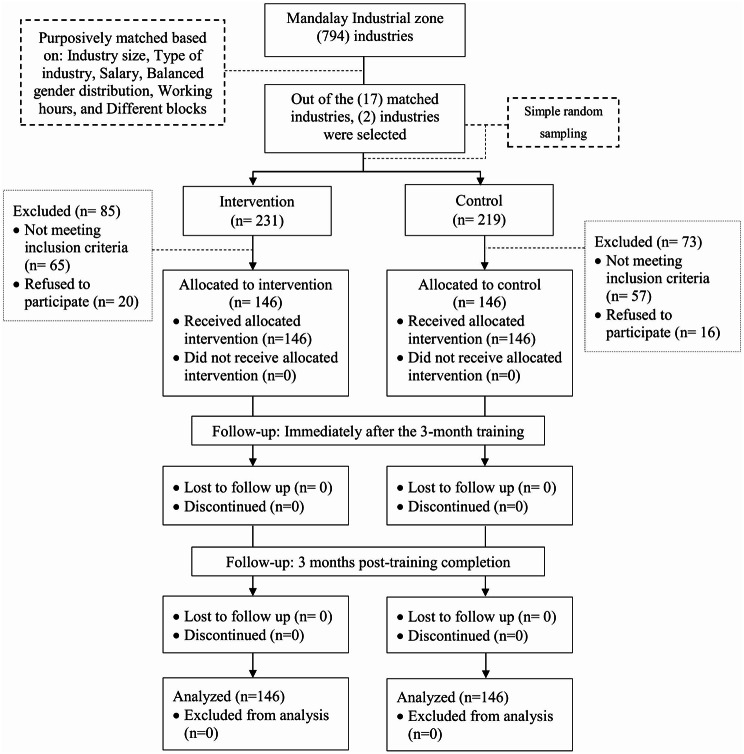
A quasi-experimental study involved 146 workers per group in Mandalay Industrial Zone, Myanmar. A Health Belief Model-based intervention included six health education sessions and daily short message service with weekly repeated content for the intervention group. The outcomes were health knowledge, perception (susceptibility, severity, barriers, and benefits), and self-efficacy, assessed at baseline, immediately after the 3-month training, and 3 months post-training completion in both groups. Homogeneity between groups at baseline was assessed using the chi-square test and the independent t-test. Between-group differences were compared using the independent t-test, and within-group changes were evaluated using repeated measures ANOVA. Generalized Estimating Equations was applied to adjust for baseline differences between groups, accounting for variables such as age, marital status, education status, income, age at first cigarette smoked, and years of smoking cigarettes. Significance level was set at p < 0.05.
Health knowledge in the intervention group significantly increased at immediately after the 3-month training but slightly declined at 3 months post-training completion (p < 0.001). Compared to the control group, perceived susceptibility, severity, barriers, and benefits, as well as self-efficacy, improved significantly immediately after the 3-month training (p < 0.001). Generalized Estimating Equations analysis revealed significant Group × Time interaction effects, showing positive effects on health knowledge (B = 0.991, p < 0.001), and notable improvements in perceived susceptibility (B = 5.091, p < 0.001), severity (B = 3.973, p < 0.001), barriers (B = 3.823, p < 0.001), benefits (B = 1.797, p < 0.001), and self-efficacy (B = 1.742, p < 0.001).
This study's intervention significantly improved the health knowledge, perception, and self-efficacy toward smoking among industrial workers in Myanmar, highlighting the importance of targeted workplace interventions.
工业工人的吸烟问题需要综合干预措施。本研究旨在评估基于健康信念模型的综合健康教育与手机短信服务干预措施对提高缅甸工业工人吸烟相关健康知识、认知及自我效能的效果。本研究独特地将基于健康信念模型的健康教育课程与短信服务在三个月内相结合,以满足这一人群的特定需求。
在缅甸曼德勒工业区进行了一项准实验研究,每组146名工人。基于健康信念模型的干预措施包括为干预组开展六次健康教育课程以及每日短信服务,短信内容每周重复。在基线、三个月培训结束后即刻以及培训结束后三个月对两组的健康知识、认知(易感性、严重性、障碍和益处)和自我效能进行评估。使用卡方检验和独立t检验评估基线时两组之间的同质性。使用独立t检验比较组间差异,使用重复测量方差分析评估组内变化。应用广义估计方程来调整组间的基线差异,考虑年龄、婚姻状况、教育程度、收入、首次吸烟年龄和吸烟年限等变量。显著性水平设定为p < 0.05。
干预组的健康知识在三个月培训结束后即刻显著增加,但在培训结束后三个月略有下降(p < 0.001)。与对照组相比,在三个月培训结束后即刻,感知到的易感性、严重性、障碍和益处以及自我效能均有显著改善(p < 0.001)。广义估计方程分析显示出显著的组×时间交互效应,对健康知识有积极影响(B = 0.991,p < 0.001),在感知易感性(B = 5.091,p < 0.001)、严重性(B = 3.973,p < 0.001)、障碍(B = 3.823,p < 0.001)、益处(B = 1.797,p < 0.001)和自我效能(B = 1.742,p < 0.001)方面有显著改善。
本研究的干预措施显著提高了缅甸工业工人对吸烟的健康知识、认知和自我效能,突出了针对性工作场所干预的重要性。