Rowland Mitchell C, Graham Lucas E, Selby Callie, Forga Aaron J, Hargis Billy M, Vuong Christine N, Graham Danielle
Department of Poultry Science, University of Arkansas Division of Agriculture; Fayetteville AR, 72701, USA.
Department of Poultry Science, University of Arkansas Division of Agriculture; Fayetteville AR, 72701, USA.
Poult Sci. 2025 Jul;104(7):105190. doi: 10.1016/j.psj.2025.105190. Epub 2025 Apr 24.
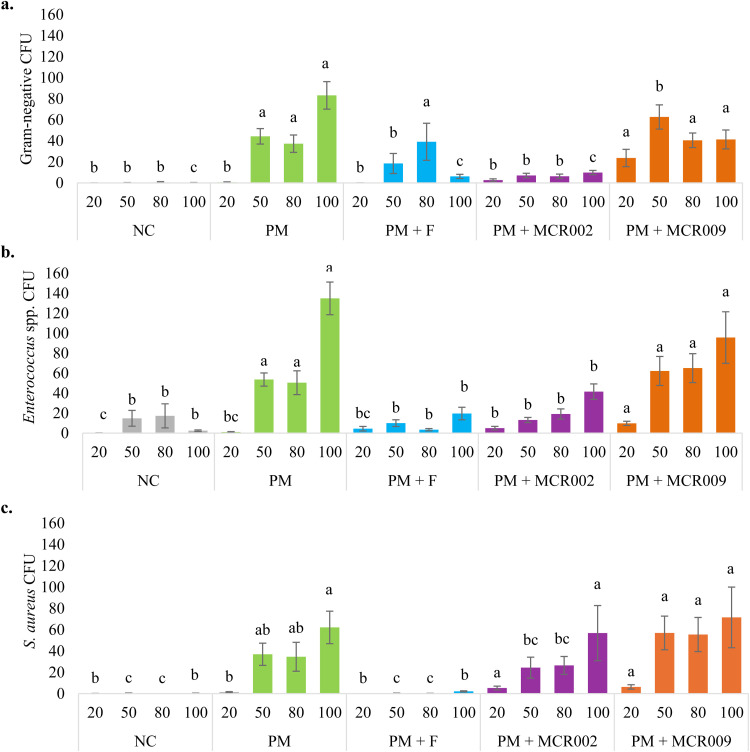
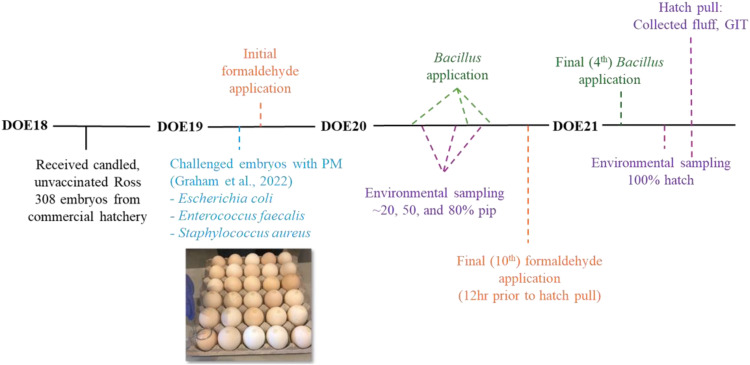
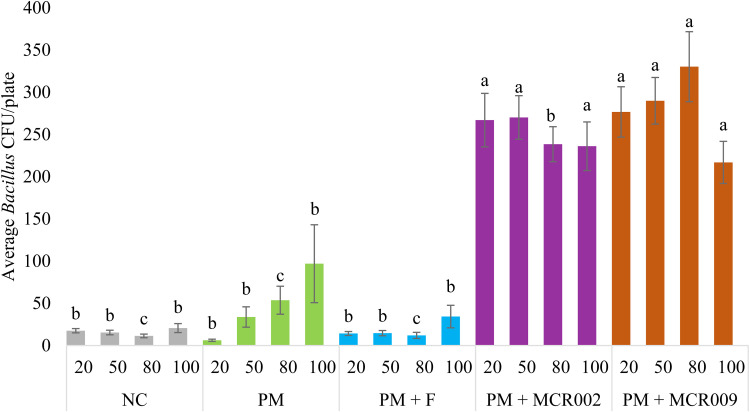
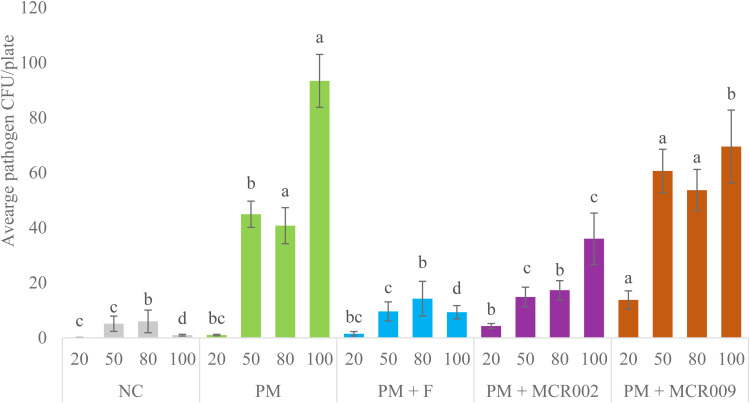
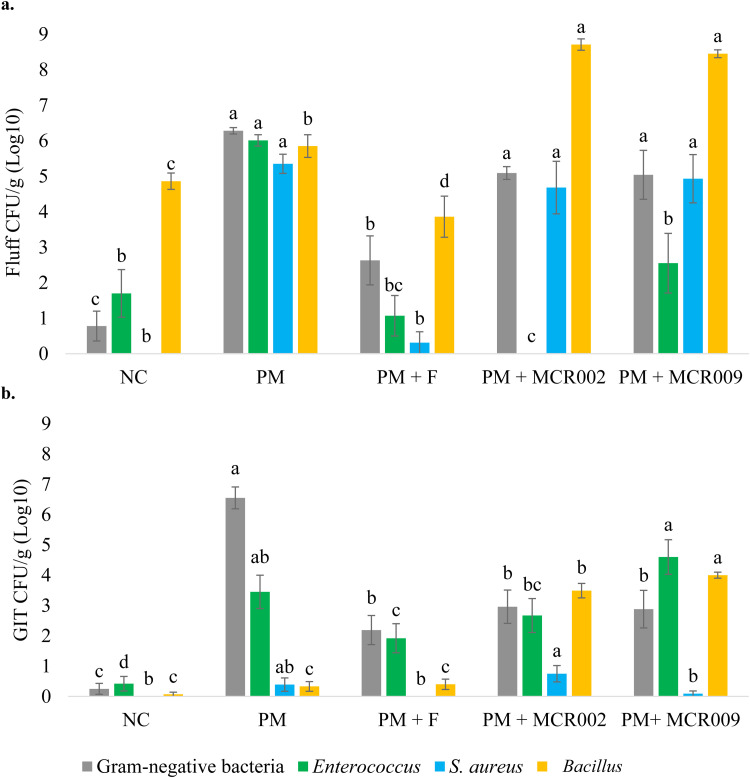
Formaldehyde has been used to control microbial contamination in commercial hatch cabinets. The purpose of the present study was to investigate the effects of spray application of Bacillus amyloliquefaciens solid state fermentation products on the microbial load in the hatch cabinet, pioneer colonization of the gastrointestinal tract (GIT), and early performance compared to formaldehyde fumigation. An environmental challenge model was used to simulate the microbial bloom to compare the application of two B. amyloliquefaciens strains (MCR002, MCR009) to formaldehyde fumigation. Groups included 1) non-challenged control (NC), 2) challenged with pathogen mix (PM) containing Escherichia coli, Enterococcus faecalis, and Staphylococcus aureus at DOE19, 3) PM + formaldehyde treated (PM+F), 4) PM + MCR002 (PM+MCR002), 5) PM + MCR009 (PM+MCR009), and 6) PM+MCR002+MCR009 (PM+Combo). All groups were evaluated in trial 1-3 except PM+Combo. Air samples were collected from the hatch cabinet environment on d20 of embryogenesis (DOE20) at ∼20, 50, 80 % hatch, and immediately prior to hatch pull at DOE21. GIT samples were collected for enumeration of relevant enteric bacteria at hatch (d0). Pen and feed weights were recorded at d0 and d7 for trial 1 and 2 and at d14 for trial 2 to assess BWG and FCR. In summary, there was a significant (P < 0.05) reduction in gram-negative bacterial recovery from the GIT for PM+F, PM+MCR002, and PM+MCR009 compared to PM while the two B. amyloliquefaciens treatments were similar to PM+F. Gram-negative bacteria and Enterococcus recovery from hatch cabinet air samples were significantly reduced in PM+F and PM+MCR002 compared to PM. No significant differences in performance were observed. Spray application of MCR002 or MCR009 alone shifted the microbial load in the hatch cabinet and in the GIT of chicks similar to PM + F without negatively affecting performance at d7 or 14. However, MCR002 was more effective. This suggests that MCR002 could be used to mitigate the microbial bloom during the hatching phase without impacting chick performance.
甲醛已被用于控制商业孵化柜中的微生物污染。本研究的目的是调查与甲醛熏蒸相比,喷雾施用解淀粉芽孢杆菌固态发酵产物对孵化柜中微生物负荷、胃肠道(GIT)的先驱定殖以及早期性能的影响。使用环境挑战模型来模拟微生物大量繁殖,以比较两种解淀粉芽孢杆菌菌株(MCR002、MCR009)与甲醛熏蒸的应用效果。分组包括:1)未受挑战的对照组(NC),2)在胚胎发育第19天(DOE19)用含有大肠杆菌、粪肠球菌和金黄色葡萄球菌的病原体混合物(PM)进行挑战,3)PM + 甲醛处理组(PM+F),4)PM + MCR002组(PM+MCR002),5)PM + MCR009组(PM+MCR009),6)PM+MCR002+MCR009组(PM+组合)。除PM+组合外,所有组在试验1 - 3中进行评估。在胚胎发育第20天(DOE20)孵化率约为20%、50%、80%时以及在DOE21即将出雏前,从孵化柜环境中采集空气样本。在出雏时(第0天)采集GIT样本以计数相关肠道细菌。在试验1和2的第0天和第7天以及试验2的第14天记录栏舍和饲料重量,以评估体重增重(BWG)和饲料转化率(FCR)。总之,与PM组相比,PM+F、PM+MCR002和PM+MCR009组从GIT中回收的革兰氏阴性菌显著减少(P < 0.05),而两种解淀粉芽孢杆菌处理与PM+F组相似。与PM组相比,PM+F和PM+MCR002组从孵化柜空气样本中回收的革兰氏阴性菌和肠球菌显著减少。在性能方面未观察到显著差异。单独喷雾施用MCR002或MCR009可使孵化柜和雏鸡GIT中的微生物负荷发生变化,类似于PM + F组,且在第7天或第14天对性能没有负面影响。然而,MCR002更有效。这表明MCR002可用于减轻孵化阶段的微生物大量繁殖,而不影响雏鸡性能。