Department of Poultry Science, University of Arkansas Division of Agriculture, Fayetteville, AR 72701, USA.
Department of Poultry Science, University of Arkansas Division of Agriculture, Fayetteville, AR 72701, USA.
Poult Sci. 2022 Jun;101(6):101890. doi: 10.1016/j.psj.2022.101890. Epub 2022 Mar 31.
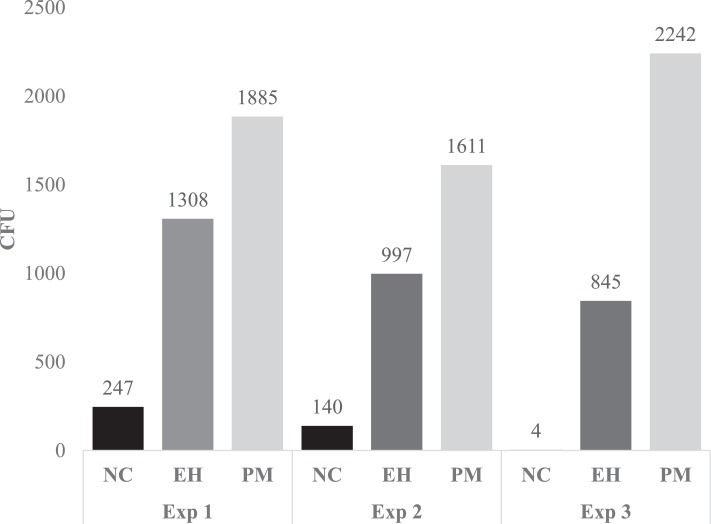
Microbial blooms that emerge in commercial hatch cabinets consist of apathogenic and pathogenic microorganisms, including Escherichia coli, Enterococcus faecalis, and Aspergillus fumigatus. Objectives of the present study included the development of a multipathogen contamination model to mimic commercial conditions and optimization of sampling methods to quantify bacterial or fungal presence within the hatch cabinet. The pathogen challenge mix (PM) was recreated from select bacterial or fungal isolates recovered from an egg homogenate (EH) derived from the contents of infertile eggs and late embryonic mortalities. Isolates selected for PM included Enterococcus faecalis (∼10 CFU/egg), Staphylococcus aureus (∼10 CFU/egg), Staphylococcus chromogenes (∼10 CFU/egg), Aspergillus fumigatus (∼10 spores/egg), and 2 Escherichia coli (∼10 CFU/egg) isolates. Challenge (100 μL of PM or EH) was administered using a sterile loop to a 28 mm area on the blunt end of the eggshell at day 19 of embryogenesis (DOE). In 3 experiments, microbiological data were collected from environmental hatcher samples (open-agar plate method), fluff samples, postmortem whole-body chick rinse samples, and gastrointestinal tract (GIT) samples to evaluate select bacteria and fungi circulating within the hatch cabinet and colonization of GIT. Cumulative bacterial and fungal recovery from the PM hatching environment from DOE20 to hatch was higher than the nonchallenged group (NC) and EH group at ∼860 and ∼1,730 CFU, respectively. Bacterial recovery from GIT, fluff, and chick rinse samples were similar for the PM and EH group in Exp. 1. However, Aspergillus fumigatus recovery from fluff and chick rinse samples for the PM group was significantly (P < 0.001) higher than the NC and EH group. In Exp. 2 and 3, PM challenge significantly (P < 0.05) increased Gram-negative bacterial recovery from the GIT, fluff and chick rinse samples compared to both the NC and EH group. These data suggest this innovative multispecies environmental contamination model using PM could be utilized to evaluate strategies to mitigate microbial contamination in commercial hatch cabinets in a laboratory setting.
商业孵化箱中出现的微生物爆发由无病原体和病原体微生物组成,包括大肠杆菌、粪肠球菌和烟曲霉。本研究的目的包括开发一种多病原体污染模型,以模拟商业条件,并优化采样方法,以量化孵化箱内细菌或真菌的存在。病原体挑战混合物(PM)是从鸡蛋匀浆(EH)中回收的选定细菌或真菌分离物重新创建的,EH 源自不育蛋和晚期胚胎死亡的内容物。为 PM 选择的分离物包括粪肠球菌(约 10 CFU/蛋)、金黄色葡萄球菌(约 10 CFU/蛋)、产色葡萄球菌(约 10 CFU/蛋)、烟曲霉(约 10 个孢子/蛋)和 2 个大肠杆菌(约 10 CFU/蛋)分离物。在胚胎发生第 19 天(DOE),使用无菌环在蛋壳钝端的 28 毫米区域接种 100 μL 的 PM 或 EH 进行挑战。在 3 项实验中,从环境孵化器样品(开放式琼脂平板法)、绒毛样品、死后全鸡冲洗样品和胃肠道(GIT)样品中收集微生物数据,以评估孵化箱内循环的选定细菌和真菌以及 GIT 的定植。从 DOE20 到孵化的 PM 孵化环境中累积的细菌和真菌回收量分别比未受挑战组(NC)和 EH 组高约 860 和 1730 CFU。在实验 1 中,PM 和 EH 组的 GIT、绒毛和小鸡冲洗样品中的细菌回收量相似。然而,PM 组的绒毛和小鸡冲洗样品中烟曲霉的回收量明显(P < 0.001)高于 NC 和 EH 组。在实验 2 和 3 中,与 NC 和 EH 组相比,PM 挑战显着(P < 0.05)增加了 GIT、绒毛和小鸡冲洗样品中的革兰氏阴性菌回收量。这些数据表明,使用 PM 的这种创新的多物种环境污染模型可用于评估在实验室环境中减轻商业孵化箱中微生物污染的策略。