Sołtysiuk Marta, Przyborowska Paulina, Wiszniewska-Łaszczych Agnieszka, Tobolski Dawid
Department of Veterinary Public Health Protection, Faculty of Veterinary Medicine, University of Warmia and Mazury in Olsztyn, Oczapowskiego 14, Olsztyn, 10-957, Poland.
Department of Large Animal Diseases and Clinic, Institute of Veterinary Medicine, Warsaw University of Life Sciences, Warsaw, 02-787, Poland.
BMC Vet Res. 2025 May 10;21(1):333. doi: 10.1186/s12917-025-04792-y.
Listeria spp. contamination in food, particularly antimicrobial-resistant strains, poses an escalating concern for public health. This study investigated the prevalence and antimicrobial resistance profiles of Listeria spp. isolated from raw fish collected from diverse sources in Northern Poland.
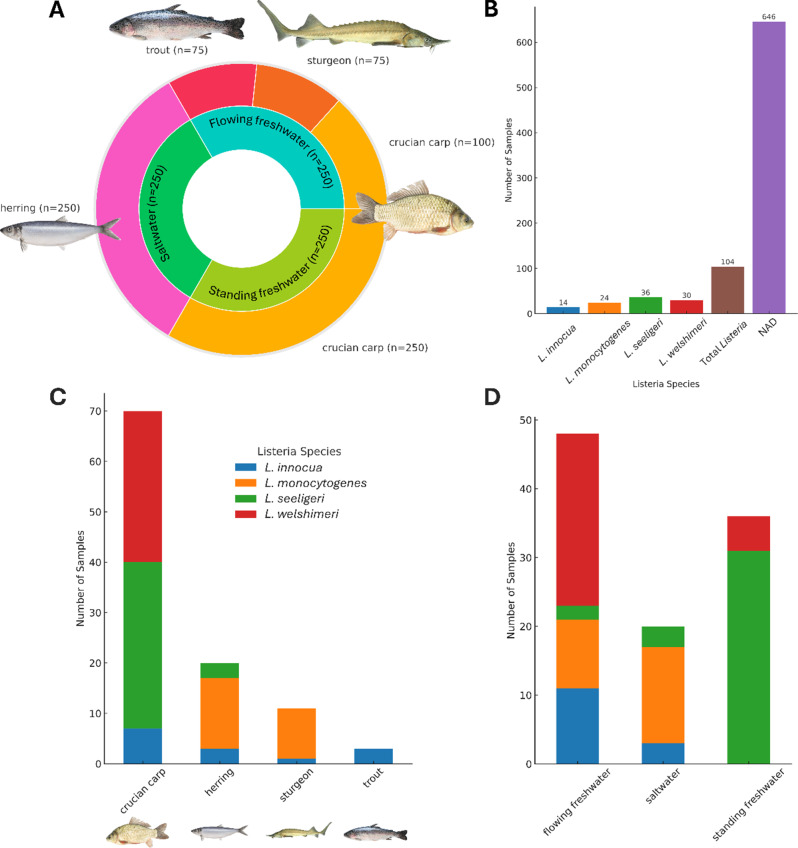
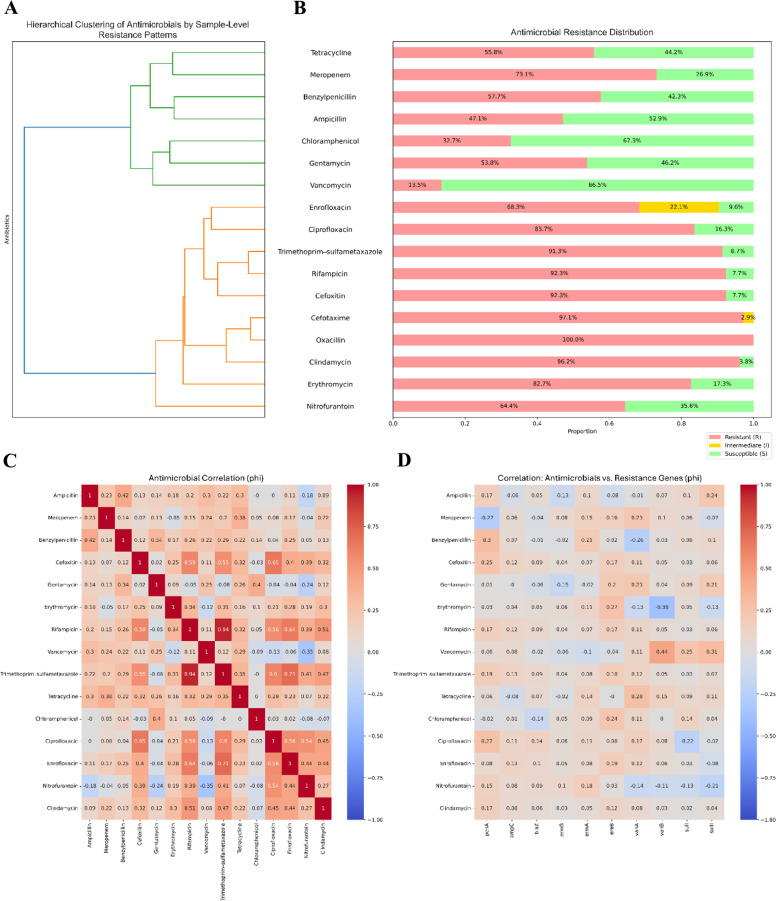
A total of 750 raw fish samples were collected from standing freshwater tanks, flowing freshwater reservoirs, and a saltwater reservoir. Isolation was performed following the standard protocol, which describes the horizontal method for detecting Listeria spp., including Listeria monocytogenes. The antimicrobial resistance profiles of isolated strains were performed using the disk diffusion method. Antimicrobial resistance genes were identified using PCR, targeting 11 genes associated with resistance to β-lactams, macrolides, glycopeptides, and sulfonamides. Statistical analyses included Phi correlation coefficients, hierarchical clustering, and logistic regression to examine associations between phenotypic resistance patterns and antimicrobial resistance genes.
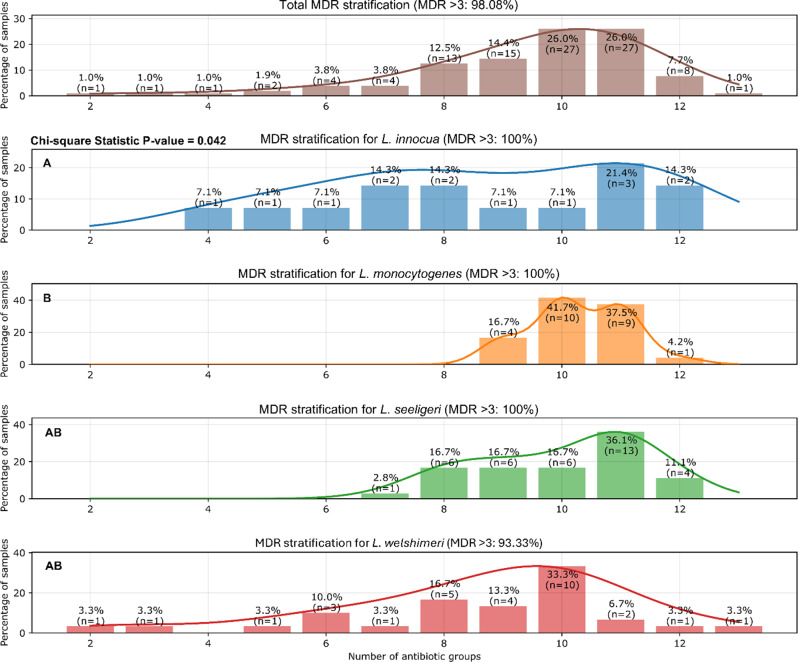
Listeria spp. was isolated from 13.9% of samples (104 positive samples), comprising L. seeligeri (34.6%), L. welshimeri (28.8%), L. monocytogenes (23.1%), and L. innocua (13.5%). Phenotypic antimicrobial susceptibility testing revealed universal resistance to oxacillin (100%) across all Listeria spp. isolates. High resistance levels were also observed for cefotaxime (97.1%), cefoxitin (92.3%), rifampicin (92.3%), clindamycin (96.2%), and trimethoprim-sulfamethoxazole (91.3%). Alarmingly, 98.1% of all Listeria spp. isolates exhibited multidrug resistance (MDR), reaching 100% MDR among L. monocytogenes isolates. Specifically, L. monocytogenes isolates exhibited complete resistance to meropenem, cefoxitin, cefotaxime, rifampicin, and trimethoprim-sulfamethoxazole, and significant resistance to ciprofloxacin (91.7%), clindamycin (83.3%), tetracycline (75.0%), erythromycin (75.0%), benzylpenicillin (70.8%), and nitrofurantoin (70.8%). Molecular analysis identified blaTEM (100%), ampC (37.5%), and ereB (37.5%) as the most prevalent antimicrobial resistance genes in L. monocytogenes.
The exceptionally high prevalence of multidrug-resistant Listeria spp., particularly L. monocytogenes, in raw fish underscores a critical public health risk, suggesting the urgent need for ongoing surveillance and robust risk mitigation strategies in aquaculture and seafood processing. The elevated antimicrobial resistance levels may also indicate aquatic environmental contamination, warranting further investigation into the sources and broader ecological implications of antimicrobial resistance in these ecosystems.
食品中的李斯特菌属污染,尤其是耐药菌株,对公众健康构成了日益严重的威胁。本研究调查了从波兰北部不同来源采集的生鱼中李斯特菌属的流行情况和耐药谱。
从静水淡水水箱、流动淡水水库和海水水库共采集了750份生鱼样本。按照标准方案进行分离,该方案描述了检测李斯特菌属(包括单核细胞增生李斯特菌)的水平方法。使用纸片扩散法对分离菌株进行耐药谱检测。使用聚合酶链反应(PCR)鉴定耐药基因,针对与对β-内酰胺类、大环内酯类、糖肽类和磺胺类耐药相关的11个基因。统计分析包括Phi相关系数、层次聚类和逻辑回归,以检验表型耐药模式与耐药基因之间的关联。
从13.9%的样本(104份阳性样本)中分离出李斯特菌属,包括西尔李斯特菌(34.6%)、威尔斯李斯特菌(28.8%)、单核细胞增生李斯特菌(23.1%)和无害李斯特菌(13.5%)。表型抗菌药敏试验显示,所有李斯特菌属分离株对苯唑西林均具有普遍耐药性(100%)。对头孢噻肟(97.1%)、头孢西丁(92.3%)、利福平(92.3%)、克林霉素(96.2%)和甲氧苄啶-磺胺甲恶唑(91.3%)也观察到高耐药水平。令人担忧的是,所有李斯特菌属分离株中有98.1%表现出多重耐药(MDR),在单核细胞增生李斯特菌分离株中MDR率达到100%。具体而言,单核细胞增生李斯特菌分离株对美罗培南、头孢西丁、头孢噻肟、利福平、甲氧苄啶-磺胺甲恶唑完全耐药,对环丙沙星(91.7%)、克林霉素(83.3%)、四环素(75.0%)、红霉素(75.0%)、苄青霉素(70.8%)和呋喃妥因(70.8%)有显著耐药性。分子分析确定blaTEM(100%)、ampC(37.5%)和ereB(37.5%)是单核细胞增生李斯特菌中最普遍的耐药基因。
生鱼中多重耐药李斯特菌属,尤其是单核细胞增生李斯特菌的异常高流行率凸显了严重的公共卫生风险,表明迫切需要在水产养殖和海产品加工中持续进行监测并采取有力的风险缓解策略。抗菌耐药水平的升高也可能表明水生环境污染,有必要进一步调查这些生态系统中耐药性的来源及其更广泛的生态影响。