Liao Zhiqiang, Zeng Junjian, Chen Yixun, Liu Zhonghua, Zhou Zhidong
Department of Anesthesiology, The Second Affiliated Hospital, Jiangxi Medical College, Nanchang University, Nanchang, China.
Jiangxi Province Key Laboratory of Anesthesiology, Nanchang, China.
Front Nutr. 2025 Apr 28;12:1570403. doi: 10.3389/fnut.2025.1570403. eCollection 2025.
The association between dietary caffeine intake and chronic musculoskeletal pain (CMP) remains unclear, with previous studies yielding conflicting results. This study aims to investigate the association between dietary caffeine intake and CMP.
This cross-sectional study utilized data from the 2009-2010 National Health and Nutrition Examination Survey (NHANES) in the United States. We employed multivariable logistic regression models, restricted cubic spline regression (RCS), stratified analysis, and sensitivity analysis to evaluate the association between dietary caffeine intake and CMP.
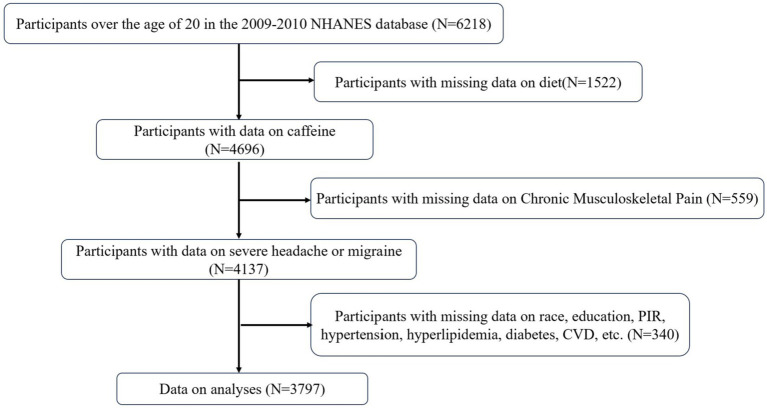
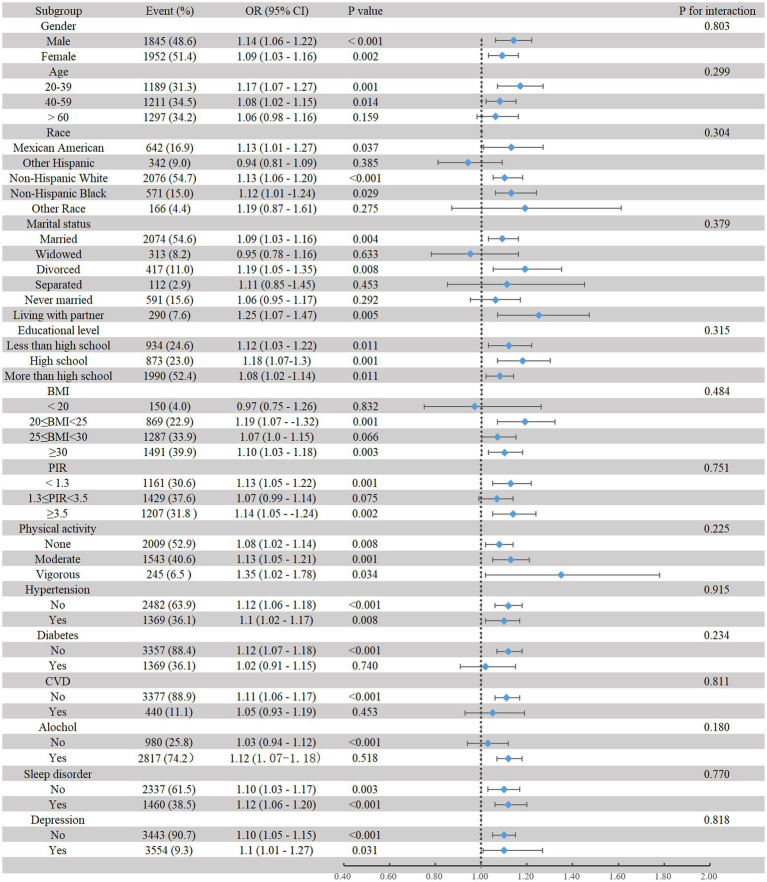
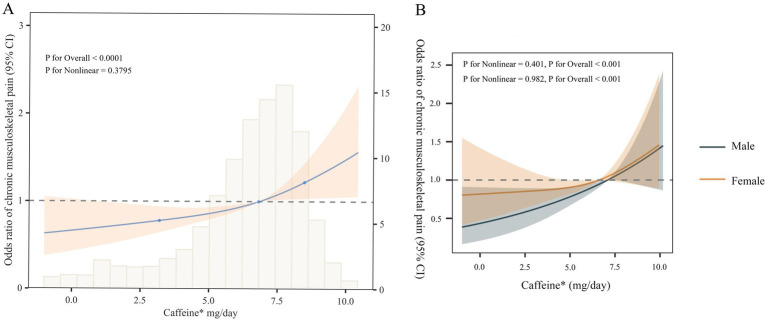
The study comprised 3,797 participants, with a mean age of 50.11 ± 17.57 years and a CMP prevalence of 18.41%. After full adjustment, multivariable logistic regression and RCS regression indicated a linear positive correlation between dietary caffeine intake and CMP. For each one-unit increase in log-transformed dietary caffeine intake, the risk of CMP increased by 8.35% (OR: 1.0835, 95% CI: 1.0351, 1.1358). Compared with the Q1 (-1.00-5.44 mg/d), the ORs for individuals in the Q2 (5.45-6.83 mg/d), Q3 (6.84-7.85 mg/d), and Q4 (7.86-11.48 mg/d) were 1.1556 (95% CI: 0.8866, 1.5075, = 0.2852), 1.4256 (95% CI: 1.1006, 1.8505, = 0.0074), and 1.5238 (95% CI: 1.1685, 1.9920, = 0.0020), respectively. Additionally, stratified and sensitivity analyses yielded similar results.
The study revealed a positive relationship between dietary caffeine intake and CMP, suggesting that higher caffeine consumption may be linked to an increased risk of CMP. Based on these findings, CMP patients may benefit from reducing their caffeine intake.
饮食中咖啡因摄入量与慢性肌肉骨骼疼痛(CMP)之间的关联尚不清楚,先前的研究结果相互矛盾。本研究旨在调查饮食中咖啡因摄入量与CMP之间的关联。
这项横断面研究利用了美国2009 - 2010年国家健康与营养检查调查(NHANES)的数据。我们采用多变量逻辑回归模型、受限立方样条回归(RCS)、分层分析和敏感性分析来评估饮食中咖啡因摄入量与CMP之间的关联。
该研究包括3797名参与者,平均年龄为50.11±17.57岁,CMP患病率为18.41%。经过全面调整后,多变量逻辑回归和RCS回归表明饮食中咖啡因摄入量与CMP之间存在线性正相关。饮食中咖啡因摄入量每增加一个对数单位,CMP风险增加8.35%(OR:1.0835,95%CI:1.0351,1.1358)。与第一四分位数(-1.00 - 5.44毫克/天)相比,第二四分位数(5.45 - 6.83毫克/天)、第三四分位数(6.84 - 7.85毫克/天)和第四四分位数(7.86 - 11.48毫克/天)个体的OR分别为1.1556(95%CI:0.8866,1.5075,P = 0.2852)、1.4256(95%CI:1.1006,1.8505,P = 0.0074)和1.5238(95%CI:1.1685,1.9920,P = 0.0020)。此外,分层分析和敏感性分析得出了相似的结果。
该研究揭示了饮食中咖啡因摄入量与CMP之间存在正相关关系,表明较高的咖啡因摄入量可能与CMP风险增加有关。基于这些发现,CMP患者可能会从减少咖啡因摄入量中受益。