• 文献检索
  • 文档翻译
  • 深度研究
  • 学术资讯
  • Suppr Zotero 插件Zotero 插件
  • 邀请有礼
  • 套餐&价格
  • 历史记录
应用&插件
Suppr Zotero 插件Zotero 插件浏览器插件Mac 客户端Windows 客户端微信小程序
定价
高级版会员购买积分包购买API积分包
服务
文献检索文档翻译深度研究API 文档MCP 服务
关于我们
关于 Suppr公司介绍联系我们用户协议隐私条款
关注我们

Suppr 超能文献

核心技术专利:CN118964589B侵权必究
粤ICP备2023148730 号-1Suppr @ 2026

文献检索

告别复杂PubMed语法,用中文像聊天一样搜索,搜遍4000万医学文献。AI智能推荐,让科研检索更轻松。

立即免费搜索

文件翻译

保留排版,准确专业,支持PDF/Word/PPT等文件格式,支持 12+语言互译。

免费翻译文档

深度研究

AI帮你快速写综述,25分钟生成高质量综述,智能提取关键信息,辅助科研写作。

立即免费体验

基于真实世界研究的血流感染风险早期预测模型的开发与应用

Development and application of an early prediction model for risk of bloodstream infection based on real-world study.

作者信息

Hu Xiefei, Zhi Shenshen, Li Yang, Cheng Yuming, Fan Haiping, Li Haorong, Meng Zihao, Xie Jiaxin, Tang Shu, Li Wei

机构信息

Department of Clinical Laboratory, Chongqing Emergency Medical Center, School of Medicine, Chongqing University Central Hospital, Chongqing University, Chongqing, China.

Peking University Chongqing Big Data Research Institute, Chongqing, China.

出版信息

BMC Med Inform Decis Mak. 2025 May 14;25(1):186. doi: 10.1186/s12911-025-03020-9.

DOI:10.1186/s12911-025-03020-9
PMID:40369550
原文链接:https://pmc.ncbi.nlm.nih.gov/articles/PMC12079808/
Abstract

BACKGROUND

Bloodstream Infection (BSI) is a severe systemic infectious disease that can lead to sepsis and Multiple Organ Dysfunction Syndrome (MODS), resulting in high mortality rates and posing a major public health burden globally. Early identification of BSI is crucial for effective intervention, reducing mortality, and improving patient outcomes. However, existing diagnostic methods are flawed by low specificity, long detection times and high demands on testing platforms. The development of artificial intelligence provides a new approach for early disease identification. This study aims to explore the optimal combination of routine laboratory data and clinical monitoring indicators, and to utilize machine learning algorithms to construct an early, rapid, and universally applicable BSI risk prediction model, to assist in the early diagnosis of BSI in clinical practice.

METHODS

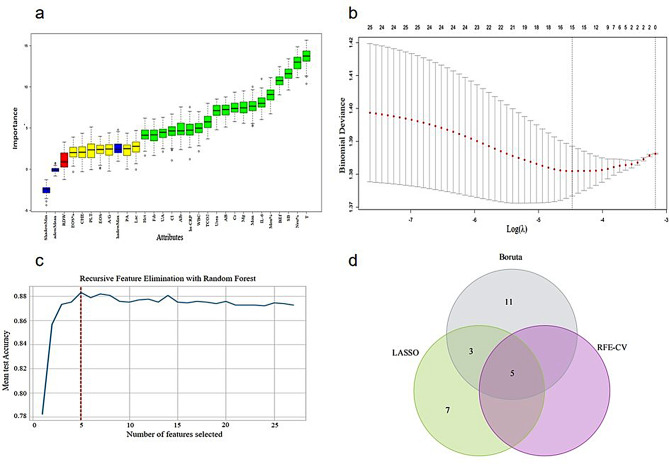
Clinical data of 2582 suspected BSI patients admitted to the Chongqing University Central Hospital, from January 1, 2021 to December 31, 2023 were collected for this study. The data were divided into a modeling dataset and an external validation dataset based on chronological order, while the modeling dataset was further divided into a training set and an internal validation set. The occurrence rate of BSI, distribution of pathogens, and microbial primary reporting time were analyzed within the training set. During the feature selection stage, univariate regression and ML algorithms were applied. First, Univariate logistic regression was used to screen for predictive factors of BSI. Then, the Boruta algorithm, Lasso regression, and Recursive Feature Elimination with Cross-validation (RFE-CV) were employed to determine the optimal combination of predictors for predicting BSI. Based on the optimal combination, six machine learning algorithms were used to construct an early BSI risk prediction model. The best model was selected by models' performance, and the Shapley Additive Explanations (SHAP) method was used to explain the model. The external validation set was used to evaluate the predictive performance and generalizability of the selected model, and the research findings were ultimately applied in clinical practice.

RESULTS

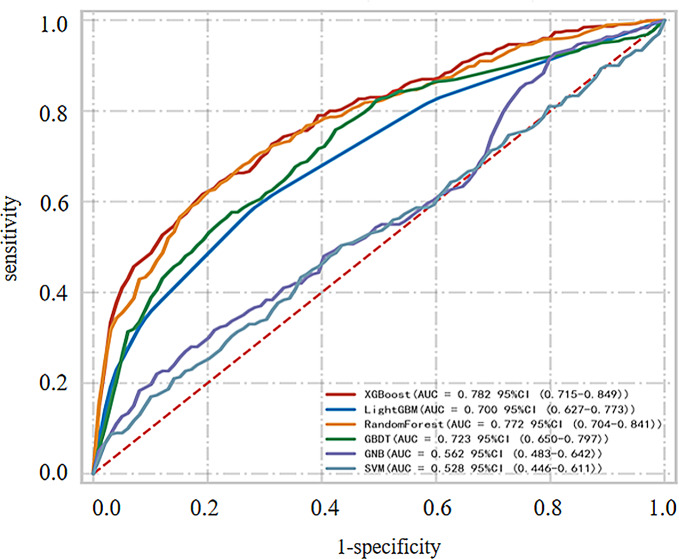
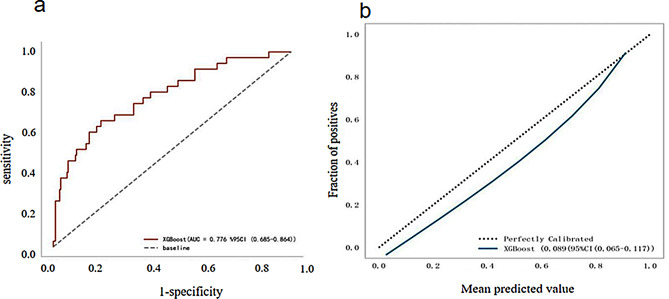
The incidence of BSI among inpatients at the Chongqing University Central Hospital was 12.91%. Following further feature selection, a set of 5 variables was determined, including white blood cell count, standard bicarbonate, base excess of extracellular fluid, interleukin-6, and body temperature. BSI early risk prediction models were constructed using six machine learning algorithms, with the XGBoost model demonstrating the best performance, achieving an AUC value of 0.782 in the internal validation set and an AUC value of 0.776 in the external validation set. This model is made publicly available as an online webpage tool for clinical use.

CONCLUSIONS

This study successfully identified a set of 5 features by analyzing routine laboratory data clinical monitoring indicators among hospitalized patients. Based on this set, a machine learning-based early risk prediction model for BSI was constructed. The model is capable of early and rapid differentiation between BSI and non-BSI patients. The inclusion of minimal risk prediction factors enhances its applicability in clinical settings, particularly at the primary care level. To further improve the model's real-world applicability and more convenient for clinical use, the online application of the model could greatly improve the efficiency of BSI diagnosis and reducing patients' mortality.

摘要

背景

血流感染(BSI)是一种严重的全身性感染性疾病,可导致脓毒症和多器官功能障碍综合征(MODS),死亡率高,给全球公共卫生带来重大负担。早期识别BSI对于有效干预、降低死亡率和改善患者预后至关重要。然而,现有的诊断方法存在特异性低、检测时间长以及对检测平台要求高等缺陷。人工智能的发展为疾病早期识别提供了新方法。本研究旨在探索常规实验室数据与临床监测指标的最佳组合,并利用机器学习算法构建早期、快速且普遍适用的BSI风险预测模型,以协助临床实践中BSI的早期诊断。

方法

本研究收集了2021年1月1日至2023年12月31日重庆大学附属中心医院收治的2582例疑似BSI患者的临床资料。根据时间顺序将数据分为建模数据集和外部验证数据集,同时将建模数据集进一步分为训练集和内部验证集。在训练集内分析BSI的发生率、病原体分布及微生物初步报告时间。在特征选择阶段,应用单变量回归和机器学习算法。首先,使用单变量逻辑回归筛选BSI的预测因素。然后,采用博鲁塔算法、套索回归和带交叉验证的递归特征消除(RFE-CV)来确定预测BSI的预测因子的最佳组合。基于最佳组合,使用六种机器学习算法构建早期BSI风险预测模型。通过模型性能选择最佳模型,并使用夏普利值附加解释(SHAP)方法解释该模型。外部验证集用于评估所选模型的预测性能和可推广性,研究结果最终应用于临床实践。

结果

重庆大学附属中心医院住院患者中BSI的发生率为12.91%。经过进一步的特征选择,确定了一组5个变量,包括白细胞计数、标准碳酸氢盐、细胞外液碱剩余、白细胞介素-6和体温。使用六种机器学习算法构建了BSI早期风险预测模型,其中XGBoost模型表现最佳,在内部验证集中AUC值为0.782,在外部验证集中AUC值为0.776。该模型作为在线网页工具公开提供以供临床使用。

结论

本研究通过分析住院患者的常规实验室数据和临床监测指标,成功识别出一组5个特征。基于此构建了基于机器学习的BSI早期风险预测模型。该模型能够早期、快速地区分BSI患者和非BSI患者。纳入最少的风险预测因素增强了其在临床环境中的适用性,特别是在基层医疗水平。为进一步提高模型在现实世界中的适用性并更方便临床使用,该模型的在线应用可大大提高BSI诊断效率并降低患者死亡率。
https://cdn.ncbi.nlm.nih.gov/pmc/blobs/c400/12079808/5f7767900cf7/12911_2025_3020_Fig6_HTML.jpg
https://cdn.ncbi.nlm.nih.gov/pmc/blobs/c400/12079808/ff3b8fb8aec7/12911_2025_3020_Fig1_HTML.jpg
https://cdn.ncbi.nlm.nih.gov/pmc/blobs/c400/12079808/44a426be564b/12911_2025_3020_Fig2_HTML.jpg
https://cdn.ncbi.nlm.nih.gov/pmc/blobs/c400/12079808/23a01ebe54c4/12911_2025_3020_Fig3_HTML.jpg
https://cdn.ncbi.nlm.nih.gov/pmc/blobs/c400/12079808/95d72ddc6be0/12911_2025_3020_Fig4_HTML.jpg
https://cdn.ncbi.nlm.nih.gov/pmc/blobs/c400/12079808/0014a7e2b832/12911_2025_3020_Fig5_HTML.jpg
https://cdn.ncbi.nlm.nih.gov/pmc/blobs/c400/12079808/5f7767900cf7/12911_2025_3020_Fig6_HTML.jpg
https://cdn.ncbi.nlm.nih.gov/pmc/blobs/c400/12079808/ff3b8fb8aec7/12911_2025_3020_Fig1_HTML.jpg
https://cdn.ncbi.nlm.nih.gov/pmc/blobs/c400/12079808/44a426be564b/12911_2025_3020_Fig2_HTML.jpg
https://cdn.ncbi.nlm.nih.gov/pmc/blobs/c400/12079808/23a01ebe54c4/12911_2025_3020_Fig3_HTML.jpg
https://cdn.ncbi.nlm.nih.gov/pmc/blobs/c400/12079808/95d72ddc6be0/12911_2025_3020_Fig4_HTML.jpg
https://cdn.ncbi.nlm.nih.gov/pmc/blobs/c400/12079808/0014a7e2b832/12911_2025_3020_Fig5_HTML.jpg
https://cdn.ncbi.nlm.nih.gov/pmc/blobs/c400/12079808/5f7767900cf7/12911_2025_3020_Fig6_HTML.jpg

相似文献

1
Development and application of an early prediction model for risk of bloodstream infection based on real-world study.基于真实世界研究的血流感染风险早期预测模型的开发与应用
BMC Med Inform Decis Mak. 2025 May 14;25(1):186. doi: 10.1186/s12911-025-03020-9.
2
Development of machine learning models to predict the risk of fungal infection following flexible ureteroscopy lithotripsy.开发机器学习模型以预测软性输尿管镜碎石术后真菌感染的风险。
BMC Med Inform Decis Mak. 2025 Apr 10;25(1):159. doi: 10.1186/s12911-025-02987-9.
3
Development and internal validation of an interpretable risk prediction model for diabetic peripheral neuropathy in type 2 diabetes: a single-centre retrospective cohort study in China.2型糖尿病患者糖尿病周围神经病变可解释性风险预测模型的开发与内部验证:一项中国单中心回顾性队列研究
BMJ Open. 2025 Apr 3;15(4):e092463. doi: 10.1136/bmjopen-2024-092463.
4
Identification and Validation of an Explainable Prediction Model of Sepsis in Patients With Intracerebral Hemorrhage: Multicenter Retrospective Study.脑出血患者脓毒症可解释预测模型的识别与验证:多中心回顾性研究
J Med Internet Res. 2025 Apr 28;27:e71413. doi: 10.2196/71413.
5
Early prediction of sepsis associated encephalopathy in elderly ICU patients using machine learning models: a retrospective study based on the MIMIC-IV database.使用机器学习模型对老年重症监护病房患者脓毒症相关脑病进行早期预测:一项基于MIMIC-IV数据库的回顾性研究
Front Cell Infect Microbiol. 2025 Apr 17;15:1545979. doi: 10.3389/fcimb.2025.1545979. eCollection 2025.
6
Development and Validation of an Explainable Machine Learning Model for Predicting Myocardial Injury After Noncardiac Surgery in Two Centers in China: Retrospective Study.中国两个中心用于预测非心脏手术后心肌损伤的可解释机器学习模型的开发与验证:一项回顾性研究
JMIR Aging. 2024 Jul 26;7:e54872. doi: 10.2196/54872.
7
Interpretable machine learning for allergic rhinitis prediction among preschool children in Urumqi, China.中国乌鲁木齐学龄前儿童变应性鼻炎预测的可解释机器学习。
Sci Rep. 2024 Sep 27;14(1):22281. doi: 10.1038/s41598-024-73733-w.
8
Development and validation of a machine learning-based predictive model for assessing the 90-day prognostic outcome of patients with spontaneous intracerebral hemorrhage.基于机器学习的预测模型评估自发性脑出血患者 90 天预后结局的开发与验证。
J Transl Med. 2024 Mar 4;22(1):236. doi: 10.1186/s12967-024-04896-3.
9
[Establishment and Validation of a Predictive Model for Gallstone Disease in the General Population: A Multicenter Study].[普通人群胆结石疾病预测模型的建立与验证:一项多中心研究]
Sichuan Da Xue Xue Bao Yi Xue Ban. 2024 May 20;55(3):641-652. doi: 10.12182/20240560501.
10
Application value of the automated machine learning model based on modified CT index combined with serological indices in the early prediction of lung cancer.基于改良CT指标联合血清学指标的自动化机器学习模型在肺癌早期预测中的应用价值
Front Public Health. 2024 Apr 5;12:1368217. doi: 10.3389/fpubh.2024.1368217. eCollection 2024.

引用本文的文献

1
Septic Shock in Hematological Malignancies: Role of Artificial Intelligence in Predicting Outcomes.血液系统恶性肿瘤中的感染性休克:人工智能在预测预后中的作用。
Curr Oncol. 2025 Aug 10;32(8):450. doi: 10.3390/curroncol32080450.

本文引用的文献

1
Early Diagnosis of Bloodstream Infections Using Serum Metabolomic Analysis.利用血清代谢组学分析进行血流感染的早期诊断
Metabolites. 2024 Dec 6;14(12):685. doi: 10.3390/metabo14120685.
2
Comparative performance analysis of Boruta, SHAP, and Borutashap for disease diagnosis: A study with multiple machine learning algorithms.用于疾病诊断的Boruta、SHAP和Borutashap的比较性能分析:一项使用多种机器学习算法的研究。
Network. 2024 Mar 21:1-38. doi: 10.1080/0954898X.2024.2331506.
3
Development and validation a nomogram prediction model for early diagnosis of bloodstream infections in the intensive care unit.
开发和验证 ICU 血流感染早期诊断的列线图预测模型。
Front Cell Infect Microbiol. 2024 Mar 4;14:1348896. doi: 10.3389/fcimb.2024.1348896. eCollection 2024.
4
The Value of Next-Generation Sequencing in Diagnosis and Therapy of Critically Ill Patients with Suspected Bloodstream Infections: A Retrospective Cohort Study.下一代测序在疑似血流感染重症患者诊断与治疗中的价值:一项回顾性队列研究
J Clin Med. 2024 Jan 5;13(2):306. doi: 10.3390/jcm13020306.
5
An emergency department intervention to improve earlier detection of community-onset bloodstream infection among hospitalized patients.一项改善住院患者中社区获得性血流感染早期检测的急诊科干预措施。
Am J Infect Control. 2024 Jun;52(6):664-669. doi: 10.1016/j.ajic.2024.01.003. Epub 2024 Jan 15.
6
Temperature control in sepsis.脓毒症中的体温控制
Front Med (Lausanne). 2023 Oct 31;10:1292468. doi: 10.3389/fmed.2023.1292468. eCollection 2023.
7
Development and validation of artificial intelligence models to predict urinary tract infections and secondary bloodstream infections in adult patients.开发和验证人工智能模型以预测成年患者的尿路感染和继发性血流感染。
J Infect Public Health. 2024 Jan;17(1):10-17. doi: 10.1016/j.jiph.2023.10.021. Epub 2023 Oct 24.
8
PCT, IL-6, and IL-10 facilitate early diagnosis and pathogen classifications in bloodstream infection.降钙素原(PCT)、白细胞介素 6(IL-6)和白细胞介素 10(IL-10)有助于早期诊断血流感染并进行病原体分类。
Ann Clin Microbiol Antimicrob. 2023 Nov 20;22(1):103. doi: 10.1186/s12941-023-00653-4.
9
Society of Critical Care Medicine and the Infectious Diseases Society of America Guidelines for Evaluating New Fever in Adult Patients in the ICU.重症监护病房成人新发热患者评估的危重病医学会和美国传染病学会指南。
Crit Care Med. 2023 Nov 1;51(11):1570-1586. doi: 10.1097/CCM.0000000000006022. Epub 2023 Oct 12.
10
Early identification of bloodstream infection in hemodialysis patients by machine learning.通过机器学习早期识别血液透析患者的血流感染
Heliyon. 2023 Jul 13;9(7):e18263. doi: 10.1016/j.heliyon.2023.e18263. eCollection 2023 Jul.