Arnaud Laurent, Sander Oliver, Rednic Simona, Mertz Philippe, Faria Raquel, Crisafulli Francesca, Silva-Ribeiro Sofia, Kawka Lou, Sztejkowski Cedric, Düsing Christina, Rose Thomas, Lamas Antonio, Vasconcelos Carlos, Fontana Giulia, Semeraro Paolo, Neagu Teodora, Resteu Mihaela, Damian Laura, Pamfil Cristina, Bucsa Camelia, Matthews Lisa J, Talarico Rosaria, Mosca Marta, Turchetti Giuseppe, Thibault Thomas, Devilliers Hervé
Department of Rheumatology, National Reference Center for Rare Autoimmune Diseases (RESO), Hôpitaux Universitaires de Strasbourg, Strasbourg, France.
Department for Rheumatology and Hiller Research Centre for Rheumatology, University Hospital, Düsseldorf, Germany.
Orphanet J Rare Dis. 2025 May 15;20(1):230. doi: 10.1186/s13023-025-03674-8.
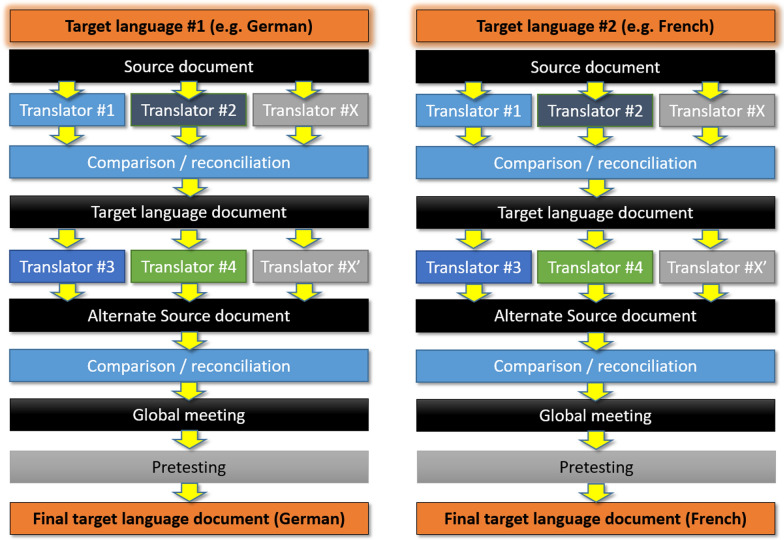
The traditional process of intercultural adaptation, while suitable for one or a few target languages, is not optimal for developing instruments for rare connective tissue diseases (CTDs) in multiple languages simultaneously. The European Reference Network ReCONNET presents the protocol for a novel methodology for cross-cultural adaptation of instruments for research and care in the context of rare CTDs (ReCONNET-CROSSADAPT). It is initiated by the identification of 'key-terms' that are crucial for maintaining the original meaning of the source document. Each language group, led by a senior member and two collaborators, independently assesses the existence and equivalence of these key terms in target languages. Reconciliation meetings are held to establish agreed-upon terms for consistent usage across translations when difficulties arise with key-terms. Subsequently, each language group translates the source document, followed by a reconciliation meeting involving one CTD patient in each group. The purpose of this meeting is to address potential discrepancies among translations, ensuring a comprehensive assessment from a linguistic, cultural and patient perspective. Collective feedback and consensus-based decision-making guide the resolution process. This methodology eliminates the need for backward translation, optimizing time and cost utilization. This new ReCONNET-CROSSADAPT methodology ensures linguistic accuracy, cultural relevance, and contextual appropriateness for the cross-cultural adaptation of instruments for research and care in the context of rare CTDs.
传统的跨文化适应过程虽然适用于一种或几种目标语言,但对于同时开发多种语言的罕见结缔组织病(CTD)研究工具而言并非最佳选择。欧洲罕见病参考网络ReCONNET提出了一种新方法的方案,用于在罕见CTD背景下对研究和护理工具进行跨文化适应(ReCONNET-CROSSADAPT)。该方案首先要确定对保持源文件原意至关重要的“关键术语”。每个语言小组由一名资深成员和两名合作者带领,独立评估这些关键术语在目标语言中的存在情况和等效性。当关键术语出现困难时,会召开协调会议,以确定在所有翻译中一致使用的商定术语。随后,每个语言小组翻译源文件,之后召开一次协调会议,每个小组有一名CTD患者参与。本次会议的目的是解决翻译之间可能存在的差异,确保从语言、文化和患者角度进行全面评估。集体反馈和基于共识的决策指导解决过程。这种方法无需进行回译,优化了时间和成本的利用。这种新的ReCONNET-CROSSADAPT方法确保了在罕见CTD背景下对研究和护理工具进行跨文化适应时的语言准确性、文化相关性和语境适当性。