Blaha Maximilian E, Schwieger Julius, Warias Rico, Das Anish, Polack Matthias, Belder Detlev
Institute for Analytical Chemistry, Leipzig University, Linnéstraße 3, Leipzig 04103, Germany.
Anal Chem. 2025 Jul 1;97(25):13628-13636. doi: 10.1021/acs.analchem.5c02232. Epub 2025 Jun 23.
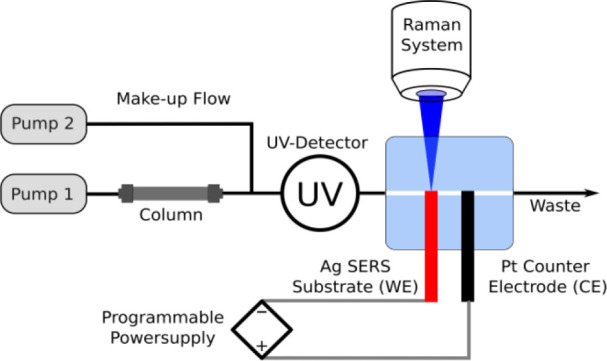
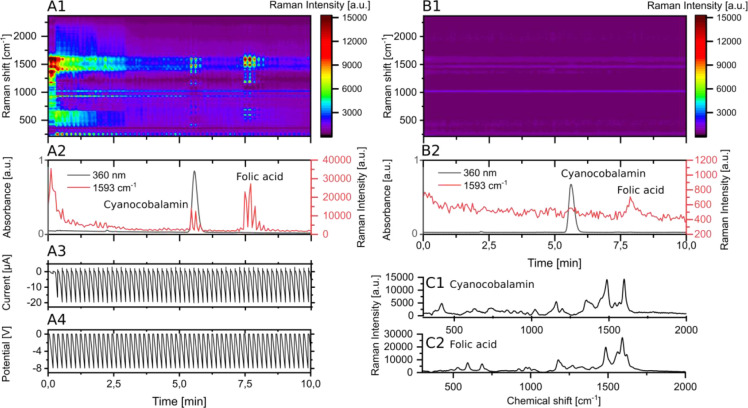
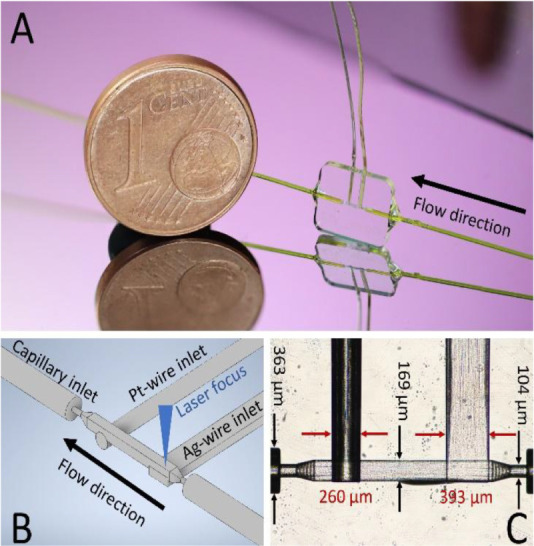
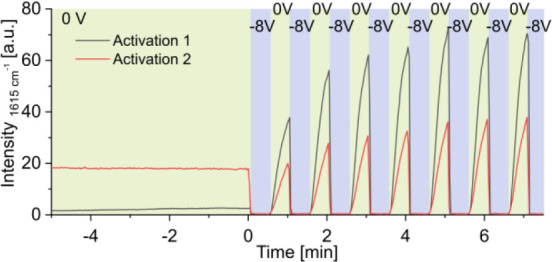
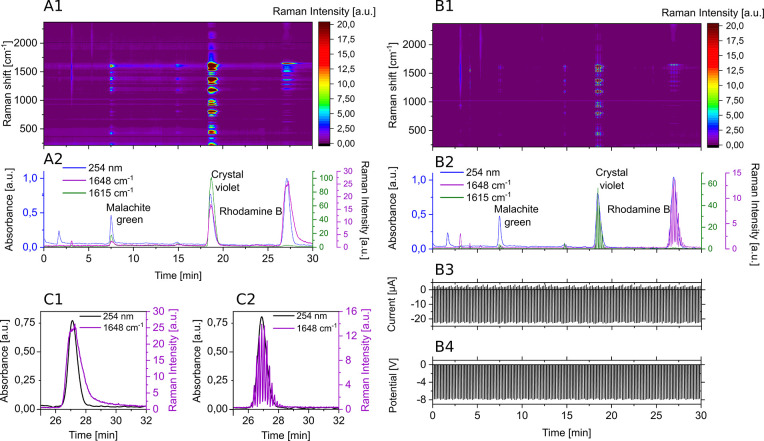
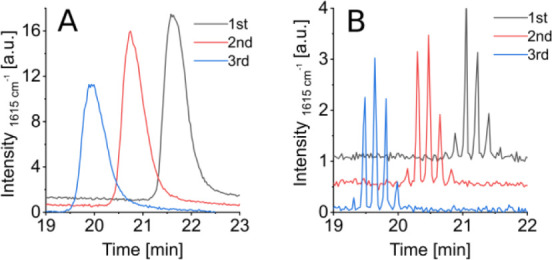
Surface-enhanced Raman spectroscopy (SERS) is a powerful technique for vibrational spectroscopy, but analyzing mixtures in solution remains challenging due to spectral overlap. Integrating SERS with a separation method, such as high-performance liquid chromatography (HPLC), offers a promising solution. However, online coupling has been limited by the compatibility issues between the SERS process and flow-based systems, which can result in either irreversible analyte adsorption on the SERS substrate or insufficient interaction. This can lead to signal carry-over or low sensitivity. In this study, we present the first HPLC-compatible, pressure-stable SERS flow cell designed for real-time analysis under continuous flow. Fabricated entirely from glass using selective laser etching, the monolithic flow cell incorporates a silver-based SERS substrate and a counter electrode, enabling online electrochemical SERS (EC-SERS) experiments. Electrochemical control facilitates on-demand substrate activation, thereby enhancing signal intensity, extending substrate lifetime, and eliminating memory effects. This approach broadens the range of detectable analytes, including those that are traditionally difficult to detect using passive SERS. We demonstrate the performance of the system through HPLC-SERS analyses of model dyes (e.g., crystal violet, malachite green, and rhodamine) and pharmaceutical compounds (e.g., cyanocobalamin and folic acid). This innovation introduces a novel SERS-based HPLC detection method, supporting the seamless integration of SERS into high-throughput analytical workflows.
表面增强拉曼光谱(SERS)是一种强大的振动光谱技术,但由于光谱重叠,分析溶液中的混合物仍然具有挑战性。将SERS与分离方法(如高效液相色谱法(HPLC))相结合,提供了一种很有前景的解决方案。然而,在线耦合受到SERS过程与基于流动的系统之间兼容性问题的限制,这可能导致分析物不可逆地吸附在SERS基底上或相互作用不足。这可能会导致信号残留或灵敏度低。在本研究中,我们展示了首个与HPLC兼容、压力稳定的SERS流通池,设计用于连续流动下的实时分析。该整体式流通池完全由玻璃通过选择性激光蚀刻制成,包含银基SERS基底和对电极,可进行在线电化学SERS(EC-SERS)实验。电化学控制有助于按需激活基底,从而增强信号强度、延长基底寿命并消除记忆效应。这种方法拓宽了可检测分析物的范围,包括那些传统上难以用被动SERS检测的分析物。我们通过对模型染料(如结晶紫、孔雀石绿和罗丹明)和药物化合物(如氰钴胺和叶酸)的HPLC-SERS分析来展示该系统的性能。这一创新引入了一种基于SERS的新型HPLC检测方法,支持将SERS无缝集成到高通量分析工作流程中。