Wang Hui, Wang Chi, Li Yi, Liu Yuran, Yuan Hongxu, Chen Yujie, Ding Hong
Department of Health Service Management, School of Health Management, Anhui Medical University, Hefei, Anhui, China.
Front Public Health. 2025 Jun 11;13:1563505. doi: 10.3389/fpubh.2025.1563505. eCollection 2025.
To explore the influencing factors of individual anxiety in rural older adults in China and analyze the relative importance of each factor, so as to provide scientific basis for the development of intervention measures to improve the mental health of rural older adults. The study also aims to improve the well-being and quality of life of older adults.
A multi-stage cluster random sampling was conducted in rural Anhui Province, China from July 2023 to February 2024, involving a total of 1,546 older adults. T test, ANOVA test, multiple linear regression and random forest algorithm were used for analysis.
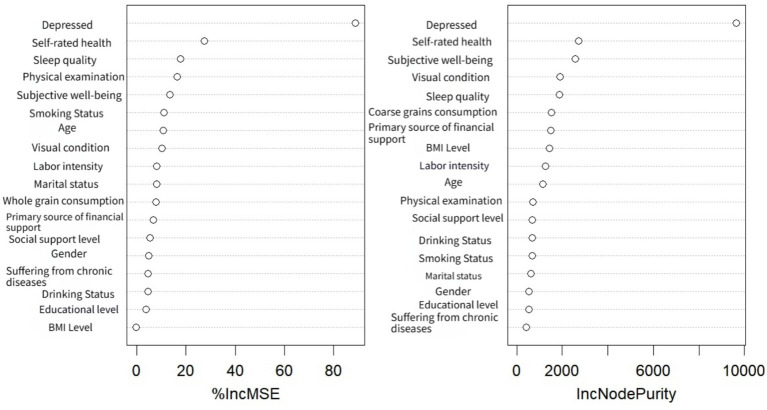
The mean anxiety score among rural older adults was 4.23 ± 5.30, and the detection rate of anxiety was 36.40%. Multiple linear regression results revealed that age, marital status, visual condition, self-rated health, physical examination, consumption of coarse grains, sleep quality, subjective well-being and social support level were the influencing factors of anxiety in the older adults. The results of random forest analysis showed that depression, self-rated health, subjective well-being, sleep quality and visual acuity had great influence on anxiety in the older adults.
This study confirmed the influence of multiple factors on the anxiety of rural older adults. In addition, the study also found that consumption of coarse grains was negatively associated with anxiety in older adults. In order to improve the mental health of the older adults in rural areas, it is recommended to pay more attention to the older adults with depression, poor sleep quality and poor eyesight, and implement multi-dimensional intervention to improve the happiness of the older adults.
探讨我国农村老年人个体焦虑的影响因素,分析各因素的相对重要性,为制定改善农村老年人心理健康的干预措施提供科学依据。该研究还旨在提高老年人的幸福感和生活质量。
于2023年7月至2024年2月在中国安徽省农村地区进行多阶段整群随机抽样,共纳入1546名老年人。采用t检验、方差分析、多元线性回归和随机森林算法进行分析。
农村老年人焦虑得分均值为4.23±5.30,焦虑检出率为36.40%。多元线性回归结果显示,年龄、婚姻状况、视力状况、自评健康、体检、粗粮消费、睡眠质量、主观幸福感和社会支持水平是老年人焦虑的影响因素。随机森林分析结果表明,抑郁、自评健康、主观幸福感、睡眠质量和视力对老年人焦虑有较大影响。
本研究证实了多种因素对农村老年人焦虑的影响。此外,研究还发现粗粮消费与老年人焦虑呈负相关。为改善农村老年人的心理健康,建议更多关注抑郁、睡眠质量差和视力差的老年人,实施多维干预以提高老年人的幸福感。