Pietak Alexis, Levin Michael
Allen Discovery Center, Tufts University, Medford, MA 02155, USA.
Ionovate Inc., Kingston, ON K7P 0L5, Canada.
iScience. 2025 Apr 28;28(6):112536. doi: 10.1016/j.isci.2025.112536. eCollection 2025 Jun 20.
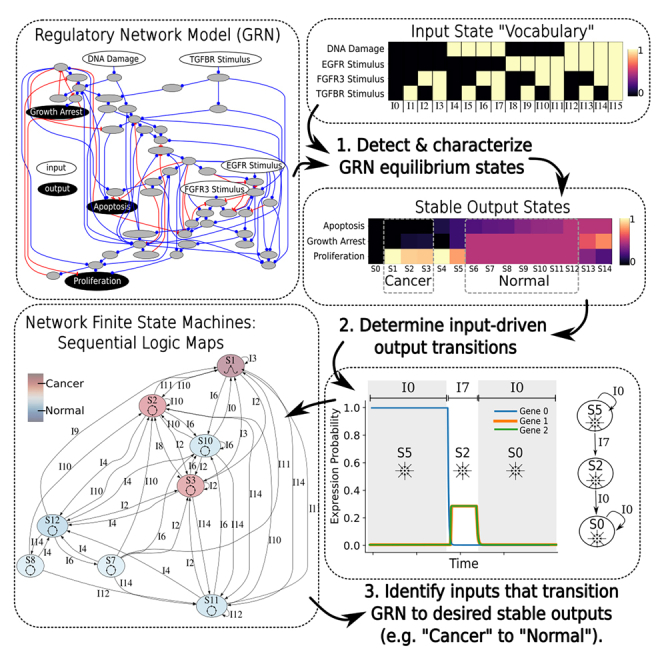
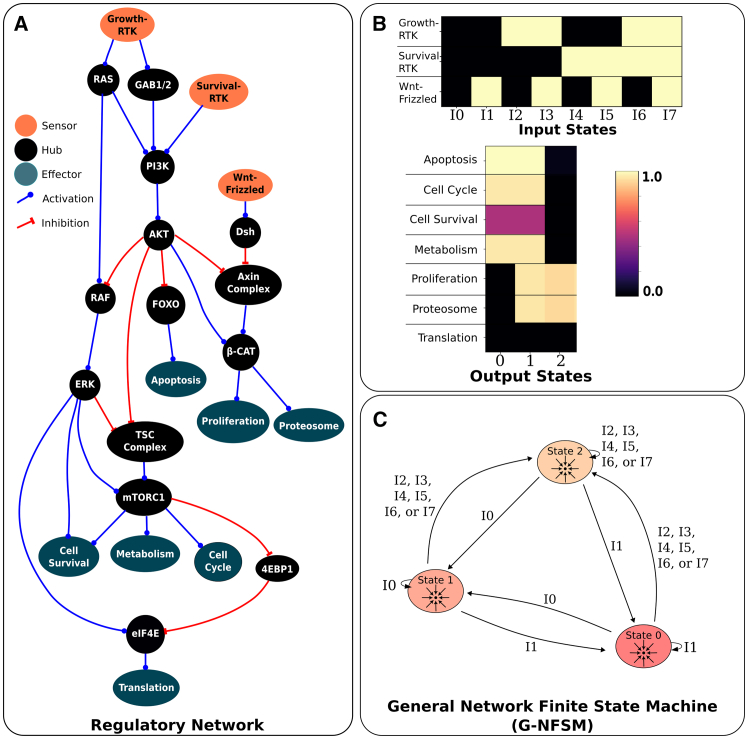
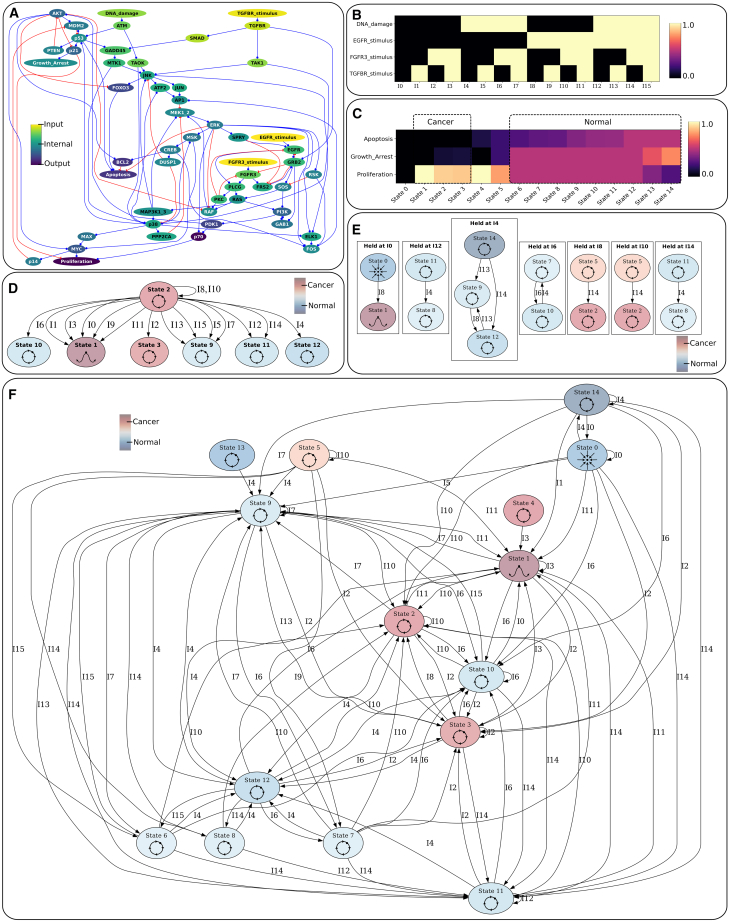
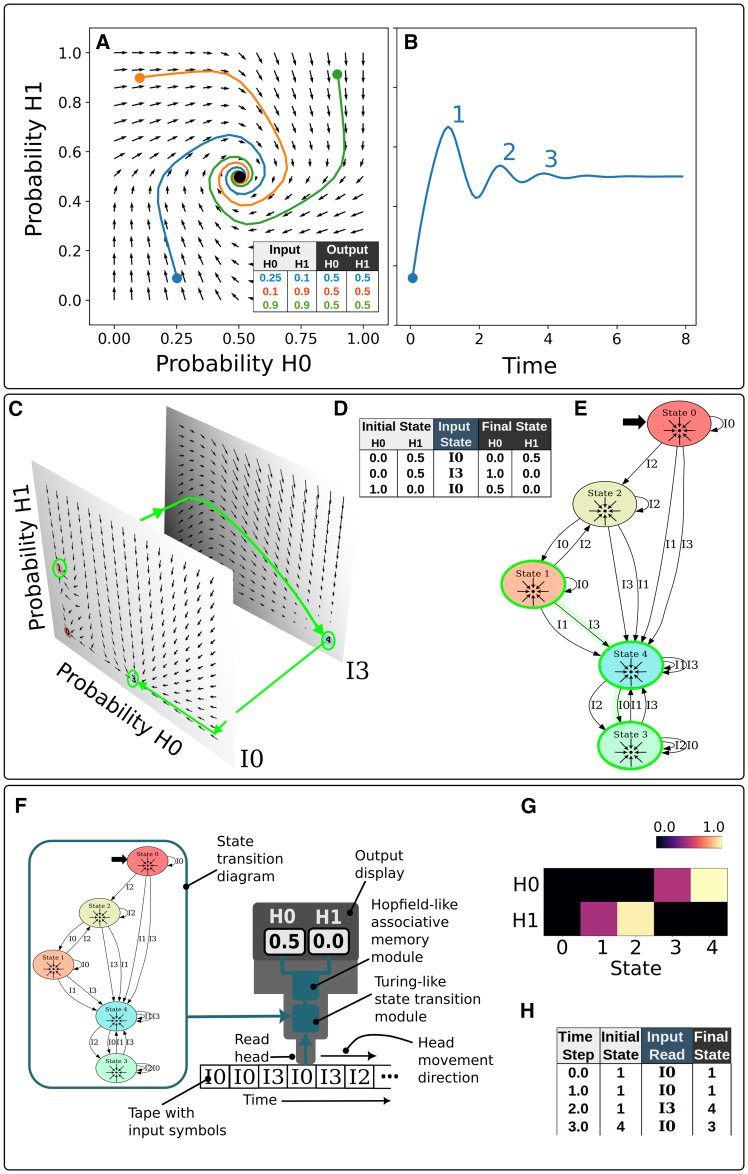
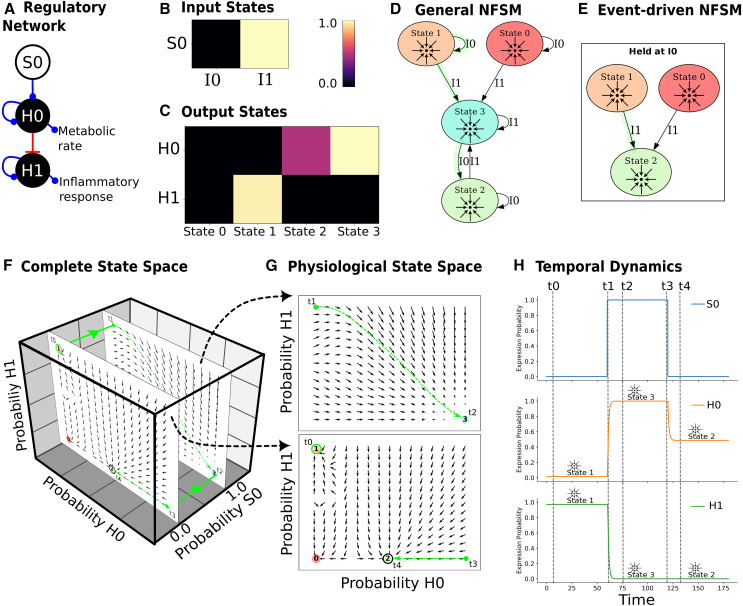
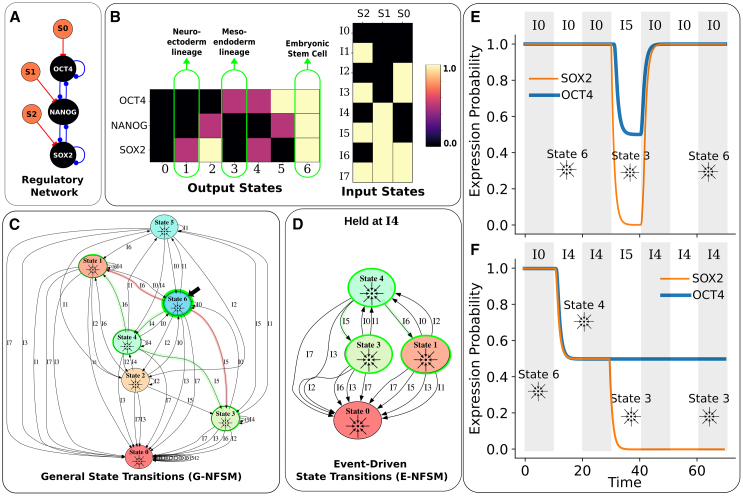
Gene regulatory networks (GRNs) are critically important for efforts in biomedicine and biotechnology. Here, we introduce the Regulatory Network Machine (RNM) framework, demonstrating how GRNs behave as analog computers capable of sophisticated information processing. Our RNM framework encapsulates: (1) a dissipative dynamic system with a focus on GRNs, (2) a set of inputs to the system, (3) system output states with identifiable relevance to biotechnological or biomedical objectives, and (4) Network Finite State Machines (NFSMs), which are maps detailing how the system changes equilibrium state in response to patterns of applied inputs. As an extension to attractor landscape analysis, the NFSMs map the sequential logic inherent in the GRN and, therefore, embody the "software-like" nature of the system, providing easy identification of specific applied interventions necessary to achieve desired, stable biological outcomes. We illustrate the use of our RNM framework in important biological examples, including in cancer renormalization.
基因调控网络(GRNs)对于生物医学和生物技术研究至关重要。在此,我们介绍调控网络机器(RNM)框架,展示GRNs如何作为能够进行复杂信息处理的模拟计算机运行。我们的RNM框架包括:(1)专注于GRNs的耗散动态系统,(2)系统的一组输入,(3)与生物技术或生物医学目标具有可识别相关性的系统输出状态,以及(4)网络有限状态机(NFSMs),它是详细描述系统如何响应所施加输入模式而改变平衡状态的映射。作为对吸引子景观分析的扩展,NFSMs映射GRN中固有的顺序逻辑,因此体现了系统的“软件般”性质,便于确定实现期望的稳定生物学结果所需的特定应用干预措施。我们通过重要的生物学实例,包括癌症重整化,来说明我们的RNM框架的应用。