Sadeghi-Bahmani Dena, Eisenhut Larina, Mikoteit Thorsten, Helfenstein Nico, Brühl Annette Beatrix, Dürsteler Kenneth M, Bizimana Jean-Marie, Becker Stephen P, Brand Serge
Department of Psychology, Stanford University, Stanford, CA 94305, USA.
Center for Affective, Stress and Sleep Disorders, Psychiatric Hospital of the University of Basel, 4002 Basel, Switzerland.
J Clin Med. 2025 Jul 21;14(14):5165. doi: 10.3390/jcm14145165.
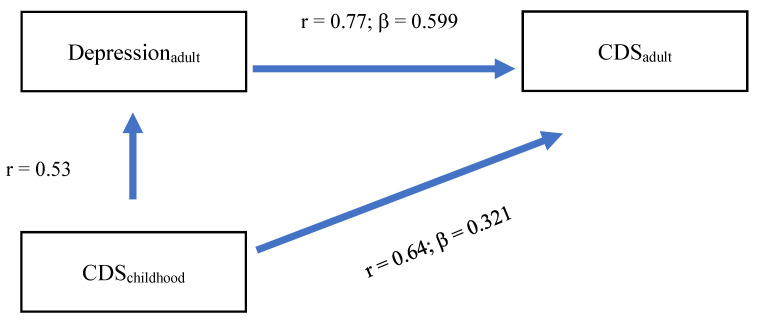
Longitudinal studies on cognitive disengagement syndrome (CDS) are scarce, and only one study has investigated the trajectory of CDS from childhood to early adulthood. Given this, the aims of the present study were to explore, with a quasi-longitudinal design, (1) whether scores for childhood CDS were associated with scores for CDS during early adulthood; (2) whether childhood CDS scores were associated with childhood and adult scores for depression, anxiety, stress, and insomnia; (3) whether childhood CDS, depression, anxiety, stress, and insomnia and adult depression, anxiety, stress, and insomnia were independently associated with adult scores for CDS, and (4) whether childhood CDS scores were directly and indirectly associated with adult CDS scores via adult depression and stress in two conditional effect models. A total of 246 young adult students (mean age = 22.62; 56.3% females) participated in a cross-sectional and quasi-longitudinal study. The participants completed questionnaires assessing CDS (Adult Concentration Inventory; ACI), depression, anxiety, stress, and insomnia for the following two developmental periods: for the present time point as young adults and for a past time point, when they were about eight years old. To enable retrospective past recall, the participants undertook a standardized imagination exercise. Childhood scores for CDS, depression, anxiety, stress, and insomnia were highly associated with adult scores for CDS, depression, anxiety, stress, and insomnia. In the regression model, higher childhood scores for CDS, depression, and anxiety and higher adult scores for depression, stress, and insomnia, but not adult anxiety, were strongly and independently associated with adult scores for CDS. In the two conditional effects models, childhood CDS was associated with adult CDS directly and indirectly via adult depression and adult stress. In this quasi-longitudinal study, childhood scores for CDS were associated with adult scores for CDS, suggesting a potentially stable trajectory of CDS from childhood to early adulthood. Further, the two conditional effects models suggested that childhood and adult CDS were both directly and indirectly associated via adult depression and stress. As such, symptoms of depression, anxiety, stress, and insomnia should be considered in conceptualizations of adult CDS. Next, given that standardized psychotherapeutic interventions for depression, stress, and insomnia are available, such interventions might also favorably impact CDS symptoms. These findings further underscore the importance of prospective longitudinal and intervention studies on adult CDS.
关于认知脱离综合征(CDS)的纵向研究很少,仅有一项研究调查了CDS从童年到成年早期的发展轨迹。鉴于此,本研究的目的是采用准纵向设计来探究:(1)童年期CDS得分是否与成年早期的CDS得分相关;(2)童年期CDS得分是否与童年期及成年期的抑郁、焦虑、压力和失眠得分相关;(3)童年期的CDS、抑郁、焦虑、压力和失眠以及成年期的抑郁、焦虑、压力和失眠是否与成年期CDS得分独立相关;以及(4)在两个条件效应模型中,童年期CDS得分是否通过成年期抑郁和压力与成年期CDS得分直接和间接相关。共有246名青年成年学生(平均年龄=22.62岁;56.3%为女性)参与了一项横断面和准纵向研究。参与者完成了针对以下两个发育阶段的评估CDS(成人注意力量表;ACI)、抑郁、焦虑、压力和失眠的问卷:当前作为青年成年人的时间点,以及过去大约八岁时的时间点。为了实现对过去的回顾性回忆,参与者进行了标准化的想象练习。童年期的CDS、抑郁、焦虑、压力和失眠得分与成年期的CDS、抑郁、焦虑、压力和失眠得分高度相关。在回归模型中,童年期较高的CDS、抑郁和焦虑得分以及成年期较高的抑郁、压力和失眠得分,但不包括成年期焦虑得分,与成年期CDS得分强烈且独立相关。在两个条件效应模型中,童年期CDS通过成年期抑郁和成年期压力与成年期CDS直接和间接相关。在这项准纵向研究中,童年期CDS得分与成年期CDS得分相关,这表明CDS从童年到成年早期可能存在稳定的发展轨迹。此外,两个条件效应模型表明,童年期和成年期CDS通过成年期抑郁和压力直接和间接相关。因此,在对成年期CDS的概念化中应考虑抑郁、焦虑、压力和失眠症状。接下来,鉴于有针对抑郁、压力和失眠的标准化心理治疗干预措施,此类干预措施可能也会对CDS症状产生有利影响。这些发现进一步强调了对成年期CDS进行前瞻性纵向研究和干预研究的重要性。