Chen Daji, Sun Lang, Wan Linlin, Chen Zhao, Peng LinLiu, Peng Jinzi, Ouyang Riwei, Long Xiafei, Du Kefang, Dong Xiao, Wu Xiaokang, Xiao Xinying, He Ruqing, Qiu Rong, Tang Beisha, Jiang Hong
Department of Neurology, Xiangya Hospital, Central South University, Changsha, 410008, China.
Department of Medical Microbiology, Xiangya School of Basic Medical Sciences, Central South University, Changsha, 410013, China.
NPJ Parkinsons Dis. 2025 Aug 23;11(1):257. doi: 10.1038/s41531-025-01121-w.
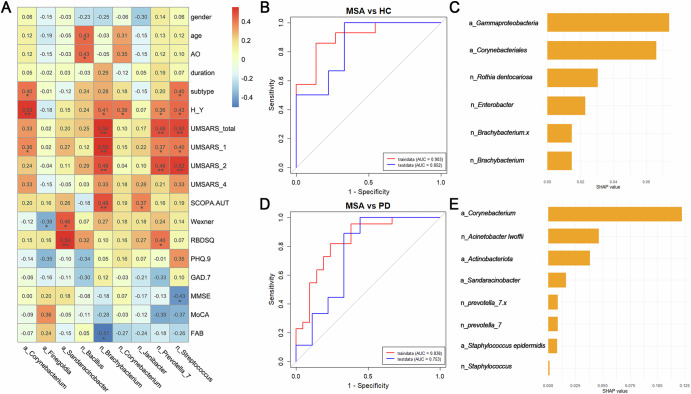
Multiple system atrophy (MSA) alters skin physiology, potentially impacting skin microbiota. This pilot study investigated whether skin microbiota differs in MSA and whether these differences relate to disease severity. Using 16S rRNA sequencing of cervical and axillary sites in MSA, Parkinson's disease, and controls, we identified distinct microbial patterns among groups. These patterns allowed cohort classification and showed strong associations with clinical symptoms, suggesting disease-related microbial alterations in MSA.
多系统萎缩(MSA)会改变皮肤生理,可能影响皮肤微生物群。这项初步研究调查了MSA患者的皮肤微生物群是否存在差异,以及这些差异是否与疾病严重程度相关。通过对MSA、帕金森病患者及对照组的颈部和腋窝部位进行16S rRNA测序,我们确定了不同组之间独特的微生物模式。这些模式能够对队列进行分类,并与临床症状表现出强烈关联,提示MSA中存在与疾病相关的微生物改变。