BaHammam Ahmed S
Department of Medicine, College of Medicine, University Sleep Disorders Center, King Saud University, Riyadh 11324, KSA.
The Strategic Technologies Program of the National Plan for Sciences and Technology and Innovation in the KSA, Riyadh, KSA.
J Taibah Univ Med Sci. 2025 Sep 5;20(5):596-611. doi: 10.1016/j.jtumed.2025.07.013. eCollection 2025 Oct.
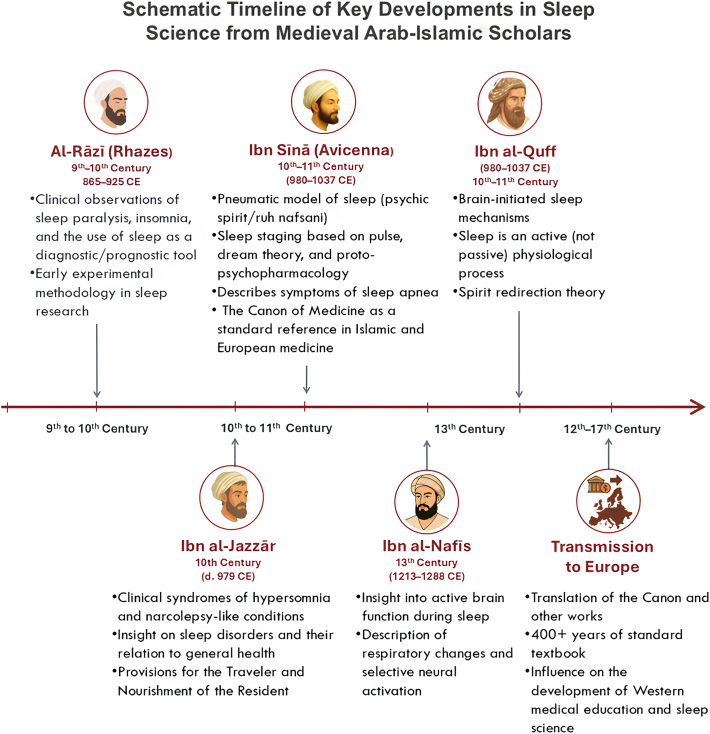
Medieval Arab-Islamic scholars (7th-13th centuries CE) made pivotal but underacknowledged contributions to sleep science, blending empirical observation with theological insight. This review examines primary texts, especially al-Rāzī's and Ibn Sīnā's , alongside secondary literature to illuminate their advanced understanding of sleep physiology, disorders, and dreams. Al-Rāzī pioneered early clinical methodologies, using comparative groups to evaluate treatments for sleep disorders. He offered detailed observations of (sleep paralysis), distinguishing between gastric and brain-centered types, and addressed conditions such as insomnia and nocturnal enuresis. His sleep hygiene recommendations, emphasizing diet, routine, and emotional balance, align strikingly with modern best practices. Ibn Sīnā's pneumatic theory of the (psychic spirit) provided a mechanistic explanation for sleep-wake transitions and proposed three sleep stages based on pulse changes. He also provided an early and clinically relevant description of symptoms consistent with obstructive sleep apnea, recommending positional therapy. His analyses of sleep posture, digestion, and pharmacology demonstrate a systemic approach that is still relevant today. Ibn al-Nafīs expanded sleep theory by arguing that internal faculties like imagination remain active during sleep, prefiguring modern understandings of selective neural activation. Ibn al-Jazzār described hypersomnia () and epilepsy-related collapse, hinting at early notions of narcolepsy. Islamic dream theory, grounded in the Qur'an and Prophetic traditions, recognizes dreams as both physiological phenomena and spiritual messages. Medieval Arab civilization scholars developed and refined classification systems that distinguished divine visions from psychologically and physically induced dreams, an approach that bridged theology, philosophy, and proto-psychology. Together, these contributions demonstrate that medieval Islamic scholars laid key foundations for sleep medicine, challenging Eurocentric histories and affirming the enduring value of diverse intellectual traditions.
中世纪阿拉伯 - 伊斯兰学者(公元7至13世纪)对睡眠科学做出了关键但未得到充分认可的贡献,他们将实证观察与神学见解相结合。本综述考察了原始文本,尤其是拉齐(al-Rāzī)和伊本·西那(Ibn Sīnā)的著作,以及二手文献,以阐明他们对睡眠生理学、睡眠障碍和梦境的先进理解。拉齐开创了早期临床方法,使用对照组来评估睡眠障碍的治疗方法。他对睡眠麻痹进行了详细观察,区分了胃部型和以脑为中心型,并探讨了失眠和夜间遗尿等病症。他的睡眠卫生建议强调饮食、日常作息和情绪平衡,与现代最佳实践惊人地一致。伊本·西那的灵魂气息理论为睡眠 - 觉醒转换提供了一种机械论解释,并根据脉搏变化提出了三个睡眠阶段。他还对与阻塞性睡眠呼吸暂停一致的症状进行了早期且与临床相关的描述,推荐了体位疗法。他对睡眠姿势、消化和药理学的分析展示了一种至今仍相关的系统方法。伊本·纳菲斯(Ibn al-Nafīs)通过论证像想象力这样的内部官能在睡眠期间仍然活跃,扩展了睡眠理论,预示了现代对选择性神经激活的理解。伊本·贾扎尔(Ibn al-Jazzār)描述了发作性睡病和与癫痫相关的虚脱,暗示了发作性睡病的早期概念。基于《古兰经》和先知传统的伊斯兰梦境理论认为梦境既是生理现象也是精神信息。中世纪阿拉伯文明的学者们发展并完善了分类系统,将神启幻象与心理和身体诱发的梦境区分开来,这种方法弥合了神学、哲学和原始心理学之间的差距。这些贡献共同表明,中世纪伊斯兰学者为睡眠医学奠定了关键基础,挑战了以欧洲为中心的历史,并肯定了多元知识传统的持久价值。