Nii S, Rosenkranz H S, Morgan C, Rose H M
J Virol. 1968 Oct;2(10):1163-71. doi: 10.1128/JVI.2.10.1163-1171.1968.
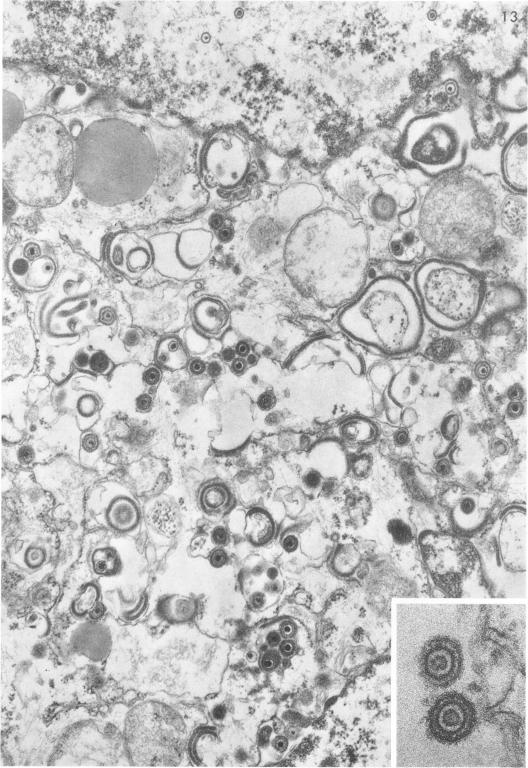
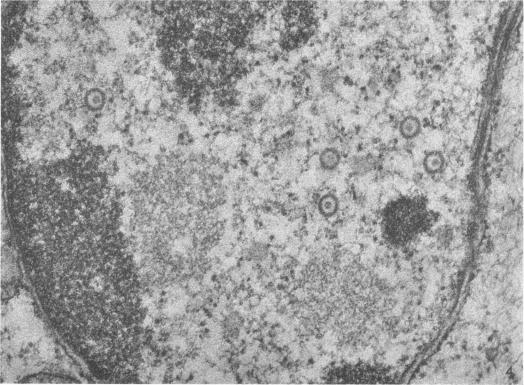
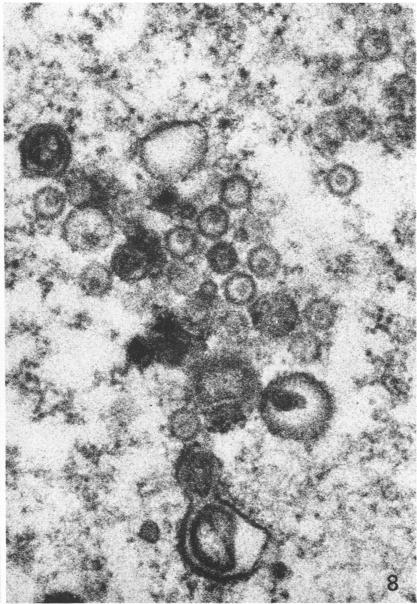
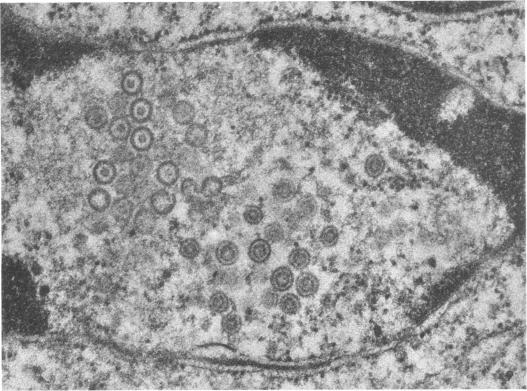
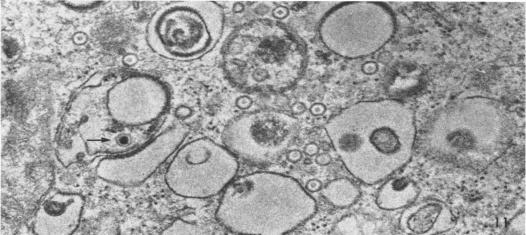
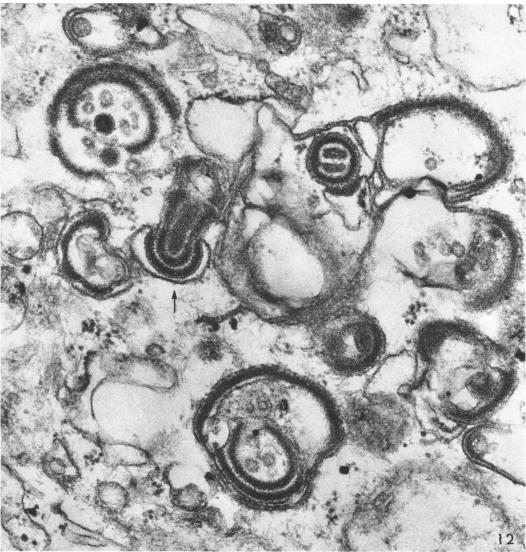
The effect of hydroxyurea on the development of herpes virus is mediated through its inhibitory action on deoxyribonucleic acid (DNA) synthesis. Concentrations of the drug that suppress the production of infectious virus cause typical developmental anomalies: failure in formation of the normally dense cores or "complete" viral particles, and either faulty or no envelopment of viral capsids by membranes. The synthesis of viral capsids and virus-stimulated nuclear and cytoplasmic membranes, however, is not interrupted. Combining these results with those of time sequence experiments, the following hypotheses can be presented regarding viral development. Protein synthesis, which is characterized by capsids enclosing cores of low density, precedes DNA synthesis, which is characterized by the appearance of dense cores. Capsids with dense cores are selectively transported to the cytoplasm. Envelopment generally takes place as capsids pass from the nucleus to the cytoplasm. The process of envelopment is also selective, with the result that the majority of particles that have an envelope contain a full quota of DNA.
羟基脲对疱疹病毒发育的影响是通过其对脱氧核糖核酸(DNA)合成的抑制作用介导的。抑制传染性病毒产生的药物浓度会导致典型的发育异常:无法形成正常致密的核心或“完整”病毒颗粒,病毒衣壳被膜包裹出现错误或未被包裹。然而,病毒衣壳以及病毒刺激产生的核膜和细胞质膜的合成并未中断。将这些结果与时间序列实验的结果相结合,可就病毒发育提出以下假说。以低密度核心被衣壳包裹为特征的蛋白质合成先于以致密核心出现为特征的DNA合成。带有致密核心的衣壳被选择性地转运到细胞质中。衣壳从细胞核进入细胞质时通常会发生包裹过程。包裹过程也是选择性的,结果是大多数有包膜的颗粒都含有足额的DNA。