
核糖体及具有生物活性的核糖体亚基颗粒的热稳定性研究。
A study of the thermal stability of ribosomes and biologically active subribosomal particles.
作者信息
Cox R A, Pratt H, Huvos P, Higginson B, Hirst W
出版信息
Biochem J. 1973 Jul;134(3):775-93. doi: 10.1042/bj1340775.
Abstract
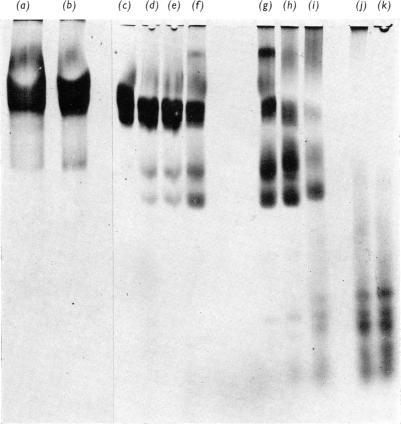
- The ability of Escherichia coli ribosomes to function in poly(U)-directed protein synthesis was measured at elevated temperatures by using thermostable supernatant factors from Bacillus stearothermophilus. The amount of polyphenylalanine synthesized at 55 degrees C was about the same as at 37 degrees C, but the rate of synthesis was increased approximately fivefold. At 60 degrees C the activity of the ribosomes was halved. 2. E. coli ribosomes can sustain the loss of approx. 10% of the double-helical secondary structure of RNA without losing activity. 3. Within the active ribosome the double-helical secondary structure of the rRNA moiety is stabilized compared with isolated rRNA, as judged by enzymic hydrolysis and by measurements of E(260). 4. The main products, over the range 0-55 degrees C, of ribonuclease T(1) digestion of the smaller subribosomal particle of E. coli were two fragments (s(0) (20,w) 15S and 25.3S) of approximately one-quarter and three-quarters of the size of the intact molecule, revealing the presence of a ;weak spot' where intramolecular bonds appear insufficient to hold the fragments together. 5. Subribosomal particles of B. stearothermophilus were more stable to heating, by approx. 10 degrees C, than those of E. coli, and the stabilization of double-helical secondary structure of the RNA moiety was more striking. 6. Rabbit reticulocyte ribosomes were active in poly(U)-directed protein synthesis at 45 degrees C, and half the activity was lost after heating to 53 degrees C. Active subribosomal particles of rabbit reticulocytes and of oocytes of Xenopus laevis, like the bacterial subribosomal particles, underwent a conformational change to a slower-sedimenting form on heating. The temperature range of the transition depended on the species. 7. Slower-sedimenting particles, whether produced by EDTA treatment or by heating, had different ;melting' profiles compared with active subribosomal particles, providing another indication of conformational differences. 8. Comparison of the properties of the various subribosomal particles revealed greater variation in the secondary structure of the protein moieties (judged by measurement of circular dichroism) than in the secondary structure of the RNA moieties, which appeared to have features in common.
摘要
- 通过使用嗜热脂肪芽孢杆菌的耐热上清因子,在升高的温度下测定了大肠杆菌核糖体在聚尿苷酸(poly(U))指导的蛋白质合成中的功能。在55℃合成的聚苯丙氨酸量与在37℃时大致相同,但合成速率提高了约五倍。在60℃时,核糖体的活性减半。2. 大肠杆菌核糖体能够承受RNA双螺旋二级结构约10%的损失而不丧失活性。3. 通过酶促水解和对E(260)的测量判断,在活性核糖体中,核糖体RNA(rRNA)部分的双螺旋二级结构与分离的rRNA相比更稳定。4. 在0至55℃范围内,核糖核酸酶T(1)消化大肠杆菌较小亚核糖体颗粒的主要产物是两个片段(沉降系数为s(0) (20,w) 15S和25.3S),大小分别约为完整分子的四分之一和四分之三,这表明存在一个“弱点”,分子内键似乎不足以将这些片段维系在一起。5. 嗜热脂肪芽孢杆菌的亚核糖体颗粒比大肠杆菌的亚核糖体颗粒对加热更稳定,约高10℃,并且RNA部分双螺旋二级结构的稳定更显著。6. 兔网织红细胞核糖体在45℃时在聚尿苷酸指导的蛋白质合成中具有活性,加热至53℃后活性丧失一半。兔网织红细胞和非洲爪蟾卵母细胞的活性亚核糖体颗粒,与细菌亚核糖体颗粒一样,加热后会发生构象变化,转变为沉降较慢的形式。转变的温度范围取决于物种。7. 沉降较慢的颗粒,无论是通过乙二胺四乙酸(EDTA)处理还是加热产生的,与活性亚核糖体颗粒相比具有不同的“解链”曲线,这提供了构象差异的另一个迹象。8. 对各种亚核糖体颗粒性质的比较表明,蛋白质部分二级结构(通过圆二色性测量判断)的变化比RNA部分二级结构的变化更大,RNA部分似乎具有共同特征。

 Zotero 插件