Suppr超能文献

冷藏对肠道平滑肌肾上腺素能机制的影响。

The effect of cold storage on the adrenergic mechanisms of intestinal smooth muscle.

作者信息

Hattori K, Kurahashi K, Mori J, Shibata S

出版信息

Br J Pharmacol. 1972 Nov;46(3):423-37. doi: 10.1111/j.1476-5381.1972.tb08140.x.

Abstract
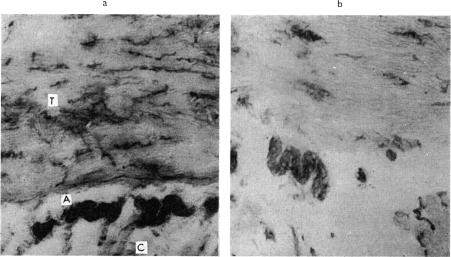
  1. In the guinea-pig taenia caecum, fluorescent adrenergic fibres terminate in both muscle layers. The density of these fibres is greater in the taenia than in the underlying circular muscle layer. The myenteric plexus and individual ganglion cells are also densely innervated by intensely fluorescent adrenergic nerve fibres.2. After three days of cold storage, the specific fluorescence disappeared from all tissue layers of the taenia caecum and smooth muscle fibres. In contrast, cholinesterase active substances were still demonstrable in all tissue layers even after seven days of cold storage but the density of these substances was decreased.3. Cold storage (3-7 days) decreased the tissue noradrenaline content and did not modify the cholinesterase enzyme activity (4 days).4. In cold stored strips, the inhibitory response to nicotine, 1,1-dimethyl-4-phenylpiperazinium iodide (DMPP) or electrical transmural stimulation was abolished and enhancement of the contractile response occurred. Cold storage also inhibited the inhibitory action of tyramine. Similar results were observed after reserpine treatment.5. In fresh taenia, the relaxation produced by nicotine, DMPP and electrical transmural stimulation was inhibited by adrenoceptor blocking agents and bretylium. In cold storage preparations, contraction produced by these stimuli was blocked by parasympathetic blocking agents and potentiated by anti-cholinesterase. These results indicate that the inhibitory response to these stimulants is mediated by stimulation of the adrenergic nerve system more than by non-adrenergic nerves; the excitatory effect is probably due to stimulation of cholinergic nerves.6. These results suggest that the adrenergic mechanisms of the taenia caecum are more labile in cold storage than the cholinergic mechanisms. Thus, the inhibitory action of cold storage on the relaxation produced by nicotine, DMPP, and transmural stimulation is probably explained by selective physical degeneration of the adrenergic nerve terminal. Also, enhancement of the contractile response to these stimulants in cold stored preparations is explained by the lack of adrenergic inhibitory mechanisms.
摘要
  1. 在豚鼠盲肠带中,荧光肾上腺素能纤维终止于两层肌肉。这些纤维在盲肠带中的密度高于其下方的环行肌层。肌间神经丛和单个神经节细胞也被强烈荧光的肾上腺素能神经纤维密集支配。

  2. 冷藏三天后,盲肠带所有组织层和平滑肌纤维中的特异性荧光消失。相比之下,即使冷藏七天后,胆碱酯酶活性物质在所有组织层中仍可检测到,但这些物质的密度降低。

  3. 冷藏(3 - 7天)降低了组织去甲肾上腺素含量,且未改变胆碱酯酶活性(4天)。

  4. 在冷藏的肠条中,对尼古丁、1,1 - 二甲基 - 4 - 苯基哌嗪碘化物(DMPP)或电跨壁刺激的抑制反应消失,收缩反应增强。冷藏也抑制了酪胺的抑制作用。利血平处理后观察到类似结果。

  5. 在新鲜的盲肠带中,尼古丁、DMPP和电跨壁刺激引起的舒张被肾上腺素能阻断剂和溴苄铵抑制。在冷藏制剂中,这些刺激引起的收缩被副交感神经阻断剂阻断,并被抗胆碱酯酶增强。这些结果表明,对这些刺激的抑制反应更多是由肾上腺素能神经系统的刺激介导,而非非肾上腺素能神经;兴奋作用可能是由于胆碱能神经的刺激。

  6. 这些结果表明,盲肠带的肾上腺素能机制在冷藏中比胆碱能机制更不稳定。因此,冷藏对尼古丁、DMPP和跨壁刺激引起的舒张的抑制作用可能是由于肾上腺素能神经末梢的选择性物理退化。此外,冷藏制剂中对这些刺激的收缩反应增强是由于缺乏肾上腺素能抑制机制。

https://cdn.ncbi.nlm.nih.gov/pmc/blobs/503c/1666557/4062cba961b6/brjpharm00479-0076-a.jpg

文献AI研究员

20分钟写一篇综述,助力文献阅读效率提升50倍。

立即体验

用中文搜PubMed

大模型驱动的PubMed中文搜索引擎

马上搜索

文档翻译

学术文献翻译模型,支持多种主流文档格式。

立即体验