van Rijswijk M H, van Heusden C W
Am J Pathol. 1979 Oct;97(1):43-58.
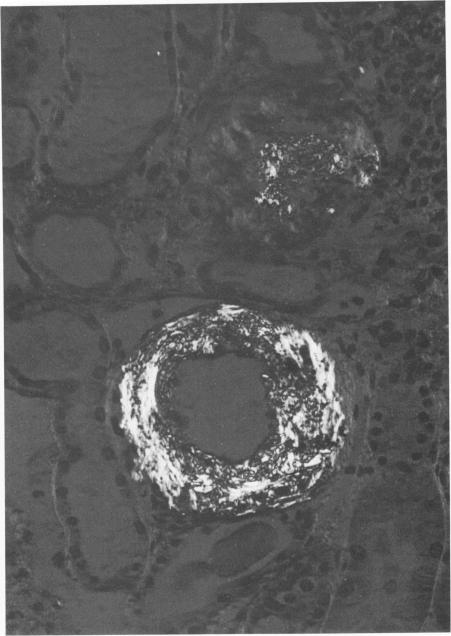
Alterations in affinity of amyloid for Congo red after incubation of tissue sections with potassium permanganate, as described by Wright el al, were studied. The affinity of amyloid for Congo red after incubation with potassium permanganate did not change in patients with myeloma-associated amyloidosis, familial amyloidotic polyneuropathy, medullary carcinoma of the thyroid, pancreatic island amyloid, and cerebral amyloidosis. Affinity for Congo red was lost after incubation with potassium permanganate in tissue sections from patients with secondary amyloidosis and amyloidosis complicating familial Mediterranean fever (consisting of amyloid AA). Patients with primary amyloidosis could be divided into two groups, one with potassium-permanganate--sensitive and one with potassium-permanganate--resistant amyloid deposits. These two groups correlated with the clinical classification in typical organ distribution (presenting with nephropathy) and atypical organ distribution (presenting with cardiomyopathy, nephropathy, and glossopathy) and the expected presence of amyloid AA or amyloid AL. Potassium permanganate sensitivity seems to be restricted to amyloid AA. The potassium permanganate method can be important in dividing the major forms of generalized amyloidosis in AA amyloid and non-AA amyloid. This can be used for differentiating early stages of the disease and cases otherwise difficult to classify. It is important to define patient groups properly, especially in evaluating the effect of therapeutic measures. (Am J Pathol 97:43--58, 1979).
如赖特等人所述,我们研究了用高锰酸钾处理组织切片后淀粉样物质与刚果红亲和力的变化。在骨髓瘤相关性淀粉样变性、家族性淀粉样多神经病、甲状腺髓样癌、胰岛淀粉样变和脑淀粉样变性患者中,用高锰酸钾处理后淀粉样物质与刚果红的亲和力没有改变。在继发性淀粉样变性和并发家族性地中海热(由淀粉样蛋白AA组成)的淀粉样变性患者的组织切片中,用高锰酸钾处理后刚果红亲和力丧失。原发性淀粉样变性患者可分为两组,一组淀粉样沉积物对高锰酸钾敏感,另一组则耐药。这两组与典型器官分布(以肾病表现)和非典型器官分布(以心肌病、肾病和舌病表现)的临床分类以及预期存在的淀粉样蛋白AA或淀粉样蛋白AL相关。高锰酸钾敏感性似乎仅限于淀粉样蛋白AA。高锰酸钾法对于区分AA淀粉样变和非AA淀粉样变这两种主要形式的全身性淀粉样变性可能很重要。这可用于鉴别疾病的早期阶段以及其他难以分类的病例。正确界定患者群体很重要,尤其是在评估治疗措施的效果时。(《美国病理学杂志》97:43 - 58,1979年)