Lombardi P S, Cole B C
Infect Immun. 1978 Apr;20(1):209-14. doi: 10.1128/iai.20.1.209-214.1978.
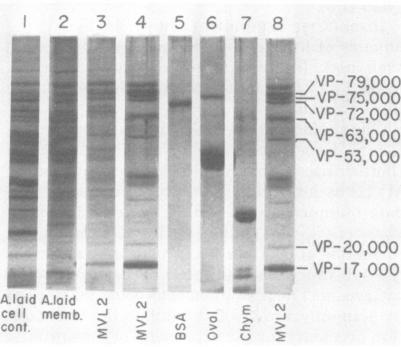
The data presented in this report show that the enveloped Mycoplasmatales virus MVL2 is capable of interferon induction in sheep peripheral blood lymphocytes. The phenomenon was dose dependent, requiring approximately 10(8) plaque-forming units of virus per 2 X 10(6) lymphocytes. The interferon was stable to pH 2.0 treatment, was produced in moderately high levels (greater than 1,000 units), and met many of the criteria for classification as a type I interferon. Heat-inactivated MLV2 lost its ability to induce interferon, whereas ultraviolet-inactivated virus retained its capacity to induce levels comparable to untreated virus. Whereas the MVL2 used in these studies was contaminated with several host cell proteins as determined by sodium dodecyl sulfate-containing polyacrylamide gel electrophoresis, the contaminants probably did not play a role in the induction because isolated cell membranes or soluble cell contents from Achoplasma laidlawii are inactive as inducers. Also presented in this report is a preliminary description of the structural polypeptides of MVL2.
本报告中呈现的数据表明,包膜支原体病毒MVL2能够在绵羊外周血淋巴细胞中诱导干扰素产生。这种现象呈剂量依赖性,每2×10⁶个淋巴细胞大约需要10⁸个病毒空斑形成单位。该干扰素对pH 2.0处理稳定,产生水平适中较高(大于1000单位),并且符合许多作为I型干扰素分类的标准。热灭活的MLV2失去了诱导干扰素的能力,而紫外线灭活的病毒保留了与未处理病毒相当的诱导水平的能力。尽管这些研究中使用的MVL2通过含十二烷基硫酸钠的聚丙烯酰胺凝胶电泳测定被几种宿主细胞蛋白污染,但这些污染物可能在诱导过程中不起作用,因为从莱氏无胆甾原体分离的细胞膜或可溶性细胞内容物作为诱导剂是无活性的。本报告还对MVL2的结构多肽进行了初步描述。