Selsing E, Miller J, Wilson R, Storb U
Proc Natl Acad Sci U S A. 1982 Aug;79(15):4681-5. doi: 10.1073/pnas.79.15.4681.
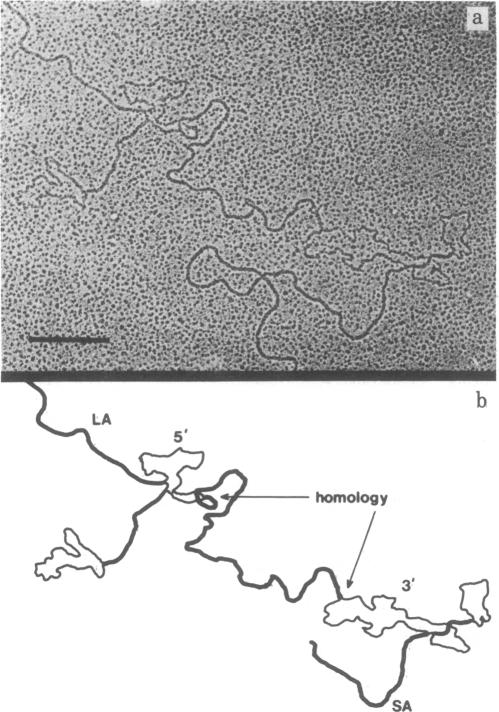
The mouse has four C lambda and two V lambda genes. We have isolated Charon 4A clones that contain all six lambda genes from a BALB/c germ-line library. We present here the DNA sequences of the C lambda 2, C lambda 3, and C lambda 4 genes and also correct what are apparently errors in previous reports of C lambda 1 protein and DNA sequences. In addition, we have analyzed cloned DNAs by restriction mapping and electron microscopy to determine the relationships among the various lambda genes. By heteroduplex analysis, two gene clusters containing JC lambda 3--JC lambda 1 and JC lambda 2--JC lambda 4 show homology extending from the J regions 5' of C lambda 3/C lambda 2 to just 3' of C lambda 1/C lambda 4. Other than the region between the genes, very little homology exists in the C lambda flanking regions. In contrast, V lambda 1 and V lambda 2 genes show considerable homology extending into the 5' flanking regions. Large inverted repeats are found in the 5' flanking regions of V lambda 1 and C lambda 3, as well as in the 3' flanking regions of both C lambda gene clusters. DNA sequence divergences between the C lambda genes indicate that an ancestral JC lambda x--JC lambda g gene cluster arose at about the time of the first mammals by duplication of a primordial JC lambda gene. The data further suggest that the JC lambda x--JC lambda gene cluster duplicated after the speciation of mouse and man and subsequently diverged into the present day JC lambda 3--JC lambda 1 and JC lambda 2--JC lambda 4 gene clusters. C lambda 4, a pseudogene, became inactive at about the time of duplication of the ancestral JC lambda x--JC lambda y cluster. Comparison of DNA sequence divergence between the V lambda 1 and V lambda 2 genes demonstrates an anomaly. The percentage of amino acid replacement changes is approximately the same for V lambda 1/V lambda 2 as for C lambda 3/C lambda 2, implying that the ancestral V lambda gene was duplicated at the same time, and possibly together with, the JC lambda x--JC lambda y cluster. However, there are fewer silent changes than amino acid replacement changes between the V lambda 1/V lambda 2 genes, suggesting either that a selective pressure acted on the silent sites or that V lambda genes have only recently been duplicated. We also consider the possibility of a gene conversion event subsequent ot a more ancient duplication.
小鼠有4个Cλ基因和2个Vλ基因。我们从BALB/c种系文库中分离出了包含所有6个λ基因的Charon 4A克隆。我们在此展示Cλ2、Cλ3和Cλ4基因的DNA序列,并纠正先前关于Cλ1蛋白和DNA序列报道中明显的错误。此外,我们通过限制性图谱分析和电子显微镜分析了克隆的DNA,以确定各种λ基因之间的关系。通过异源双链分析,包含JCλ3-JCλ1和JCλ2-JCλ4的两个基因簇显示出同源性,从Cλ3/Cλ2 5'端的J区域延伸到Cλ1/Cλ4 3'端附近。除了基因之间的区域外,Cλ侧翼区域几乎没有同源性。相比之下,Vλ1和Vλ2基因在5'侧翼区域显示出相当大的同源性。在Vλ1和Cλ3的5'侧翼区域以及两个Cλ基因簇的3'侧翼区域都发现了大的反向重复序列。Cλ基因之间的DNA序列差异表明,一个祖先JCλx-JCλg基因簇在第一批哺乳动物出现时通过一个原始JCλ基因的复制而产生。数据进一步表明,JCλx-JCλ基因簇在小鼠和人类物种形成后发生了复制,随后分化成了现今的JCλ3-JCλ1和JCλ2-JCλ4基因簇。假基因Cλ4在祖先JCλx-JCλy簇复制时大约失活。Vλ1和Vλ2基因之间DNA序列差异的比较显示出一个异常现象。Vλ1/Vλ2的氨基酸替换变化百分比与Cλ3/Cλ2大致相同,这意味着祖先Vλ基因是在同一时间,并且可能与JCλx-JCλy簇一起复制的。然而,Vλ1/Vλ2基因之间的沉默变化比氨基酸替换变化少,这表明要么是选择压力作用于沉默位点,要么是Vλ基因最近才被复制。我们还考虑了在更古老的复制之后发生基因转换事件的可能性。