• 文献检索
  • 文档翻译
  • 深度研究
  • 学术资讯
  • Suppr Zotero 插件Zotero 插件
  • 邀请有礼
  • 套餐&价格
  • 历史记录
应用&插件
Suppr Zotero 插件Zotero 插件浏览器插件Mac 客户端Windows 客户端微信小程序
定价
高级版会员购买积分包购买API积分包
服务
文献检索文档翻译深度研究API 文档MCP 服务
关于我们
关于 Suppr公司介绍联系我们用户协议隐私条款
关注我们

Suppr 超能文献

核心技术专利:CN118964589B侵权必究
粤ICP备2023148730 号-1Suppr @ 2026

文献检索

告别复杂PubMed语法,用中文像聊天一样搜索,搜遍4000万医学文献。AI智能推荐,让科研检索更轻松。

立即免费搜索

文件翻译

保留排版,准确专业,支持PDF/Word/PPT等文件格式,支持 12+语言互译。

免费翻译文档

深度研究

AI帮你快速写综述,25分钟生成高质量综述,智能提取关键信息,辅助科研写作。

立即免费体验

小鼠的呼吸道病毒感染引发持久的体液免疫反应。

Respiratory virus infection of mice provokes a permanent humoral immune response.

作者信息

Hyland L, Sangster M, Sealy R, Coleclough C

机构信息

Department of Immunology, St. Jude Children's Research Hospital, Memphis, Tennessee 38101.

出版信息

J Virol. 1994 Sep;68(9):6083-6. doi: 10.1128/JVI.68.9.6083-6086.1994.

DOI:10.1128/JVI.68.9.6083-6086.1994
PMID:8057487
原文链接:https://pmc.ncbi.nlm.nih.gov/articles/PMC237018/
Abstract

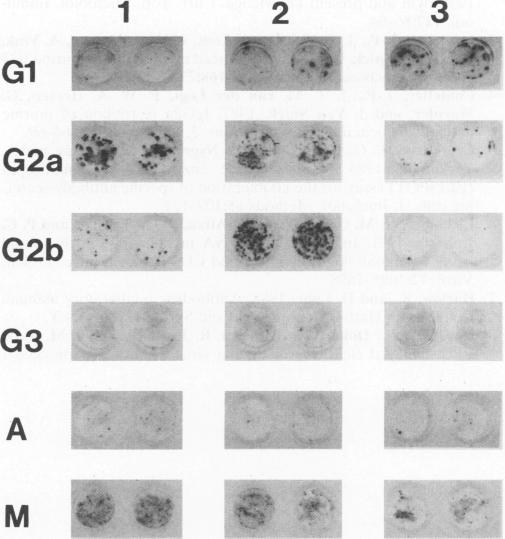
We have observed that respiratory virus infection of mice provokes an extremely persistent humoral immune reaction, due to a long-sustained population of antibody-secreting cells in the bone marrow. Theories of humoral immunity that strongly distinguish primary and secondary reactions thus may not adequately describe the immune response to respiratory viruses.

摘要

我们观察到,小鼠的呼吸道病毒感染会引发极其持久的体液免疫反应,这是由于骨髓中存在长期持续的抗体分泌细胞群体。因此,强烈区分初次反应和二次反应的体液免疫理论可能无法充分描述对呼吸道病毒的免疫反应。
https://cdn.ncbi.nlm.nih.gov/pmc/blobs/5f92/237018/2bbb328385f0/jvirol00018-0763-a.jpg

相似文献

1
Respiratory virus infection of mice provokes a permanent humoral immune response.小鼠的呼吸道病毒感染引发持久的体液免疫反应。
J Virol. 1994 Sep;68(9):6083-6. doi: 10.1128/JVI.68.9.6083-6086.1994.
2
Anatomical environment as a determinant in viral immunity.作为病毒免疫决定因素的解剖学环境。
J Immunol. 1995 Aug 1;155(3):1023-7.
3
Cell-mediated immunity to Sendai virus infection in mice.小鼠对仙台病毒感染的细胞介导免疫。
Infect Immun. 1977 Jan;15(1):239-44. doi: 10.1128/iai.15.1.239-244.1977.
4
Distinctive kinetics of the antibody-forming cell response to Sendai virus infection of mice in different anatomical compartments.小鼠不同解剖部位对仙台病毒感染产生抗体形成细胞反应的独特动力学。
Virology. 1995 Feb 20;207(1):287-91. doi: 10.1006/viro.1995.1079.
5
Antibody response to influenza infection of mice: different patterns for glycoprotein and nucleocapsid antigens.小鼠对流感感染的抗体反应:糖蛋白和核衣壳抗原的不同模式。
Immunology. 2003 Apr;108(4):431-9. doi: 10.1046/j.1365-2567.2003.01615.x.
6
An analysis of effector T cell generation and function in mice exposed to influenza A or Sendai viruses.对暴露于甲型流感病毒或仙台病毒的小鼠体内效应T细胞生成及功能的分析。
Immunol Rev. 1981;58:5-24. doi: 10.1111/j.1600-065x.1981.tb00347.x.
7
Mice lacking CD8+ T cells develop greater numbers of IgA-producing cells in response to a respiratory virus infection.缺乏CD8+ T细胞的小鼠在应对呼吸道病毒感染时会产生更多数量的产生IgA的细胞。
Virology. 1994 Oct;204(1):234-41. doi: 10.1006/viro.1994.1527.
8
Bone marrow is a major site of long-term antibody production after acute viral infection.骨髓是急性病毒感染后长期抗体产生的主要部位。
J Virol. 1995 Mar;69(3):1895-902. doi: 10.1128/JVI.69.3.1895-1902.1995.
9
Differential antigen burden modulates the gamma interferon but not the immunoglobulin response in mice that vary in susceptibility to Sendai virus pneumonia.在对仙台病毒肺炎易感性不同的小鼠中,差异抗原负荷调节γ干扰素反应,但不调节免疫球蛋白反应。
J Virol. 1995 Sep;69(9):5592-8. doi: 10.1128/JVI.69.9.5592-5598.1995.
10
The role of host responses in the recovery of mice from Sendai virus infection.
J Gen Virol. 1980 Feb;46(2):373-9. doi: 10.1099/0022-1317-46-2-373.

引用本文的文献

1
Mechanistic models of humoral kinetics following COVID-19 vaccination.新冠疫苗接种后体液动力学的机制模型。
J R Soc Interface. 2025 Jan;22(222):20240445. doi: 10.1098/rsif.2024.0445. Epub 2025 Jan 29.
2
Efficient Plasma Cell Differentiation by B Cell Receptor Activation and Cytokine Stimulation.通过B细胞受体激活和细胞因子刺激实现高效浆细胞分化
Immune Netw. 2024 Sep 26;24(5):e35. doi: 10.4110/in.2024.24.e35. eCollection 2024 Oct.
3
Single-cell BCR and transcriptome analysis after influenza infection reveals spatiotemporal dynamics of antigen-specific B cells.

本文引用的文献

1
Heterosubtypic immunity to influenza type A virus in mice. Effector mechanisms and their longevity.小鼠对甲型流感病毒的异源亚型免疫。效应机制及其持久性。
J Immunol. 1994 Feb 15;152(4):1653-61.
2
The bone marrow: the major source of serum immunoglobulins, but still a neglected site of antibody formation.骨髓:血清免疫球蛋白的主要来源,但仍是一个被忽视的抗体形成部位。
Clin Exp Immunol. 1981 Oct;46(1):1-8.
3
A solid-phase enzyme-linked immunospot (ELISPOT) assay for enumeration of specific antibody-secreting cells.一种用于计数特异性抗体分泌细胞的固相酶联免疫斑点(ELISPOT)检测法。
单细胞 BCR 和转录组分析流感感染后揭示了抗原特异性 B 细胞的时空动态。
Cell Rep. 2021 Jun 22;35(12):109286. doi: 10.1016/j.celrep.2021.109286.
4
Sendai Virus-Vectored Vaccines That Express Envelope Glycoproteins of Respiratory Viruses.表达呼吸道病毒包膜糖蛋白的仙台病毒载体疫苗。
Viruses. 2021 May 29;13(6):1023. doi: 10.3390/v13061023.
5
Harnessing Natural Mosaics: Antibody-Instructed, Multi-Envelope HIV-1 Vaccine Design.利用天然马赛克:抗体指导的、多包膜 HIV-1 疫苗设计。
Viruses. 2021 May 11;13(5):884. doi: 10.3390/v13050884.
6
Vaccine Design Informed by Virus-Induced Immunity.基于病毒诱导免疫的疫苗设计。
Viral Immunol. 2020 May;33(4):342-350. doi: 10.1089/vim.2019.0138. Epub 2020 May 5.
7
B Cell Activation and Response Regulation During Viral Infections.B 细胞激活与病毒感染中的应答调控
Viral Immunol. 2020 May;33(4):294-306. doi: 10.1089/vim.2019.0207. Epub 2020 Apr 23.
8
Multi-Envelope HIV-1 Vaccine Development: Two Targeted Immune Pathways, One Desired Protective Outcome.多包膜HIV-1疫苗研发:两条靶向免疫途径,一个预期的保护结果。
Viral Immunol. 2018 Mar;31(2):124-132. doi: 10.1089/vim.2017.0144. Epub 2018 Jan 9.
9
Antibody-secreting cells in respiratory tract tissues in the absence of eosinophils as supportive partners.呼吸道组织中缺乏嗜酸性粒细胞作为支持伙伴的抗体分泌细胞。
Int Immunol. 2016 Nov;28(11):559-564. doi: 10.1093/intimm/dxw035. Epub 2016 Jul 18.
10
Antigenic Fingerprinting following Primary RSV Infection in Young Children Identifies Novel Antigenic Sites and Reveals Unlinked Evolution of Human Antibody Repertoires to Fusion and Attachment Glycoproteins.幼儿初次感染呼吸道合胞病毒后的抗原指纹分析确定了新的抗原位点,并揭示了人类抗体库对融合糖蛋白和附着糖蛋白的非关联进化。
PLoS Pathog. 2016 Apr 21;12(4):e1005554. doi: 10.1371/journal.ppat.1005554. eCollection 2016 Apr.
J Immunol Methods. 1983 Dec 16;65(1-2):109-21. doi: 10.1016/0022-1759(83)90308-3.
4
A solid-phase immunoenzymatic technique for the enumeration of specific antibody-secreting cells.一种用于计数特异性抗体分泌细胞的固相免疫酶技术。
J Immunol Methods. 1983 Feb 25;57(1-3):301-9. doi: 10.1016/0022-1759(83)90091-1.
5
IgG2a restriction of murine antibodies elicited by viral infections.病毒感染引发的小鼠抗体的IgG2a限制
J Exp Med. 1987 Jan 1;165(1):64-9. doi: 10.1084/jem.165.1.64.
6
Influenza virus-specific antibody-secreting cells in the murine lung during primary influenza virus infection.初次感染流感病毒期间小鼠肺内流感病毒特异性抗体分泌细胞
J Virol. 1986 Nov;60(2):614-9. doi: 10.1128/JVI.60.2.614-619.1986.
7
Persistence of influenza virus-specific antibody-secreting cells and B-cell memory after primary murine influenza virus infection.初次小鼠流感病毒感染后流感病毒特异性抗体分泌细胞和B细胞记忆的持久性。
Cell Immunol. 1987 Oct 1;109(1):53-64. doi: 10.1016/0008-8749(87)90291-7.
8
Antigenic and structural characterization of multiple subpopulations of H3N2 influenza virus from an individual.来自个体的H3N2流感病毒多个亚群的抗原性和结构特征
Virology. 1988 Aug;165(2):446-56. doi: 10.1016/0042-6822(88)90588-0.
9
Virally induced modulation of murine IgG antibody subclasses.病毒诱导的小鼠IgG抗体亚类的调节
J Exp Med. 1988 Dec 1;168(6):2373-8. doi: 10.1084/jem.168.6.2373.
10
Influenza virus RNA in the lung and lymphoid tissue of immunologically intact and CD4-depleted mice.
J Gen Virol. 1991 Jul;72 ( Pt 7):1695-8. doi: 10.1099/0022-1317-72-7-1695.