Kuo T H, Kubota T, Watanabe M, Furukawa T, Teramoto T, Ishibiki K, Kitajima M, Moossa A R, Penman S, Hoffman R M
Department of Surgery, School of Medicine, Keio University, Tokyo, Japan.
Proc Natl Acad Sci U S A. 1995 Dec 19;92(26):12085-9. doi: 10.1073/pnas.92.26.12085.
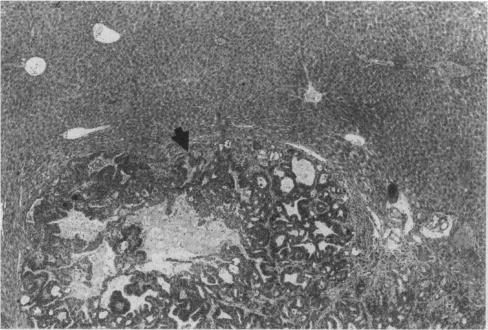
Tumors that metastasize do so to preferred target organs. To explain this apparent specificity, Paget, > 100 years ago, formulated his seed and soil hypothesis; i.e., the cells from a given tumor would "seed'' only favorable "soil'' offered by certain groups. The hypothesis implies that cancer cells must find a suitable "soil'' in a target organ--i.e., one that supports colonization--for metastasis to occur. We demonstrate in this report that ability of human colon cancer cells to colonize liver tissue governs whether a particular colon cancer is metastatic. In the model used in this study, human colon tumors are transplanted into the nude mouse colon as intact tissue blocks by surgical orthotopic implantation. These implanted tumors closely simulate the metastatic behavior of the original human patient tumor and are clearly metastatic or nonmetastatic to the liver. Both classes of tumors were equally invasive locally into tissues and blood vessels. However, the cells from each class of tumor behave very differently when directly injected into nude mouse livers. Only cells from metastasizing tumors are competent to colonize after direct intrahepatic injection. Also, tissue blocks from metastatic tumors af fixed directly to the liver resulted in colonization, whereas no colonization resulted from nonmetastatic tumor tissue blocks even though some growth occurred within the tissue block itself. Thus, local invasion (injection) and even adhesion to the metastatic target organ (blocks) are not sufficient for metastasis. The results suggest that the ability to colonize the liver is the governing step in the metastasis of human colon cancer.
发生转移的肿瘤会转移至特定的靶器官。为了解释这种明显的特异性,100多年前,佩吉特提出了他的种子与土壤假说;也就是说,特定肿瘤的细胞只会“播种”在某些组织提供的适宜“土壤”中。该假说意味着癌细胞必须在靶器官中找到合适的“土壤”——即支持其定植的土壤——才能发生转移。在本报告中,我们证明了人类结肠癌细胞在肝组织中定植的能力决定了某一特定结肠癌是否具有转移性。在本研究使用的模型中,通过手术原位植入将人类结肠肿瘤作为完整的组织块移植到裸鼠结肠中。这些植入的肿瘤紧密模拟了原始人类患者肿瘤的转移行为,并且对肝脏具有明显的转移性或非转移性。这两类肿瘤在局部对组织和血管的侵袭能力相同。然而,将每类肿瘤的细胞直接注射到裸鼠肝脏中时,它们的行为却大不相同。只有来自转移性肿瘤的细胞在直接肝内注射后才有定植能力。此外,将转移性肿瘤的组织块直接固定在肝脏上会导致定植,而非转移性肿瘤组织块即使在组织块本身内部有一些生长,也不会导致定植。因此,局部侵袭(注射)甚至与转移靶器官的黏附(组织块)对于转移来说并不充分。结果表明,在人类结肠癌转移过程中,在肝脏中定植的能力是关键步骤。