Koebnik R
Max-Planck-Institut für Biologie, Abteilung Mikrobiologie, Tübingen, Germany.
EMBO J. 1996 Jul 15;15(14):3529-37.
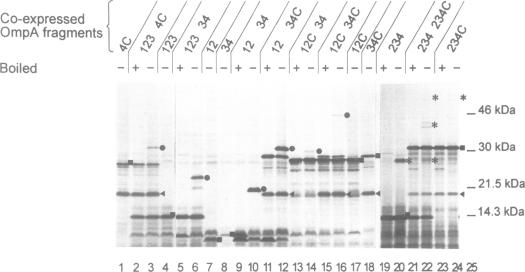
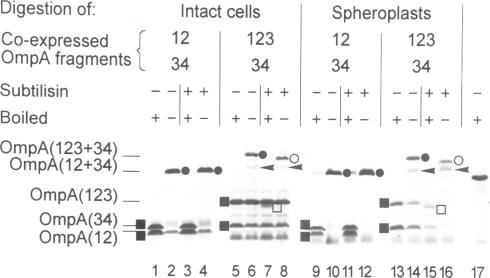
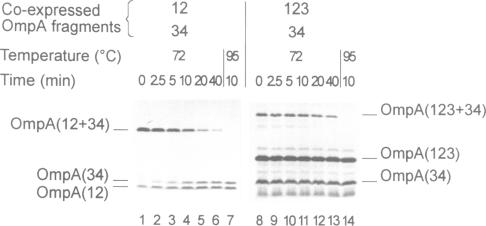
The two-domain, 325 residue outer membrane protein OmpA of Escherichia coli is a well-established model for the study of membrane assembly. The N-terminal domain, consisting of approximately 170 amino acid residues, is embedded in the membrane, presumably in the form of a beta-barrel consisting of eight antiparallel transmembrane beta-strands. A set of 16 gene variants carrying deletions in the membrane-embedded domain of OmpA was constructed. When pairs of these mutant genes were co-expressed in E.coli, it was found that a functional OmpA protein could be assembled efficiently from two complementary protein fragments. Assembly was found when the polypeptide chain was split at the second or third periplasmic turn. All four protein termini were located in the periplasmic space. Interestingly, duplication of transmembrane strands five and six led to a variant with an unusual topology: the N-terminus of one fragment and the C-terminus of the other fragment were exposed at the cell surface. This is the first demonstration of correct membrane assembly of split beta-structured membrane proteins. These findings are important for a better understanding of their folding/assembly pathway and may have implications for the development of artificial outer membrane proteins and for the cell surface display of heterologous peptides or proteins.
大肠杆菌的双结构域、325个氨基酸残基的外膜蛋白OmpA是研究膜组装的一个成熟模型。N端结构域由大约170个氨基酸残基组成,嵌入膜中,推测是以由八条反平行跨膜β链组成的β桶形式存在。构建了一组16个在OmpA膜嵌入结构域中带有缺失的基因变体。当这些突变基因对在大肠杆菌中共同表达时,发现功能性OmpA蛋白可以从两个互补的蛋白质片段高效组装而成。当多肽链在第二个或第三个周质转角处断裂时发现了组装现象。所有四个蛋白质末端都位于周质空间。有趣的是,跨膜链五和六的重复导致了一种具有异常拓扑结构的变体:一个片段的N端和另一个片段的C端暴露在细胞表面。这是分裂β结构膜蛋白正确膜组装的首次证明。这些发现对于更好地理解它们的折叠/组装途径很重要,并且可能对人工外膜蛋白的开发以及异源肽或蛋白质的细胞表面展示有影响。