Kuhl P K, Meltzoff A N
Department of Speech and Hearing Sciences, University of Washington, Seattle 98195, USA.
J Acoust Soc Am. 1996 Oct;100(4 Pt 1):2425-38. doi: 10.1121/1.417951.
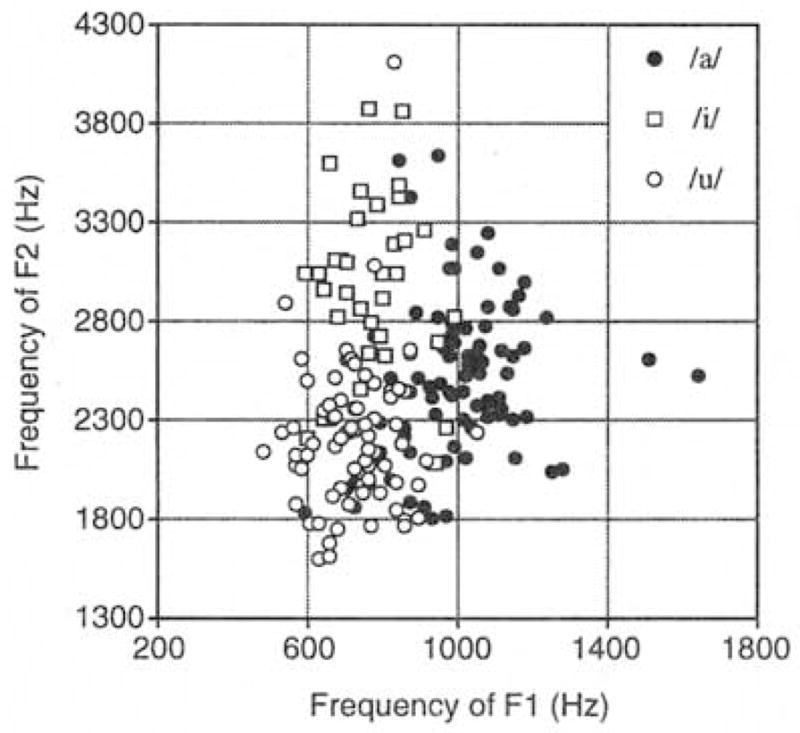
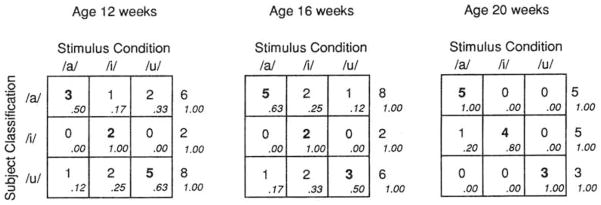
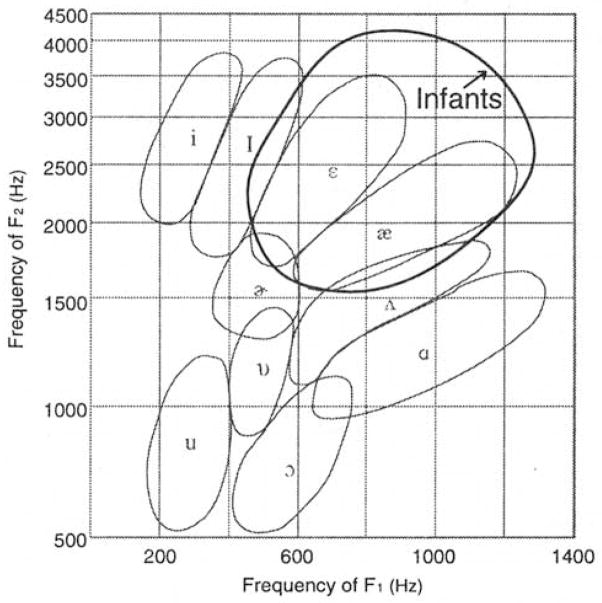
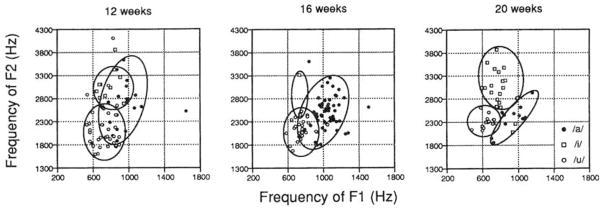
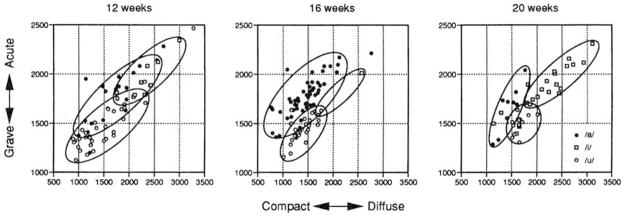
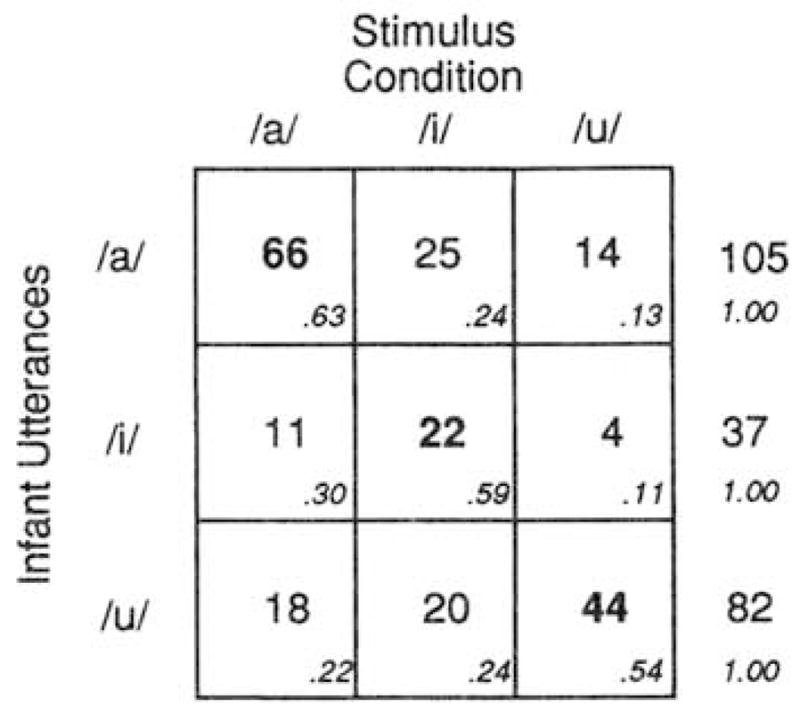
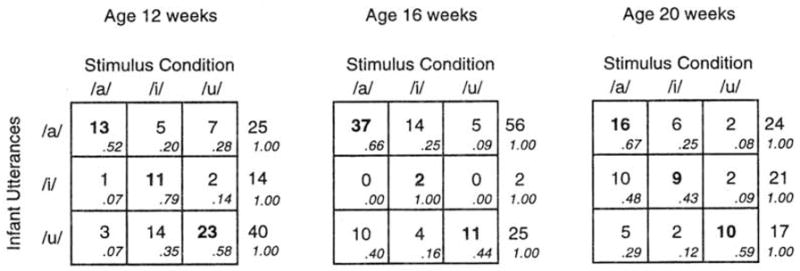
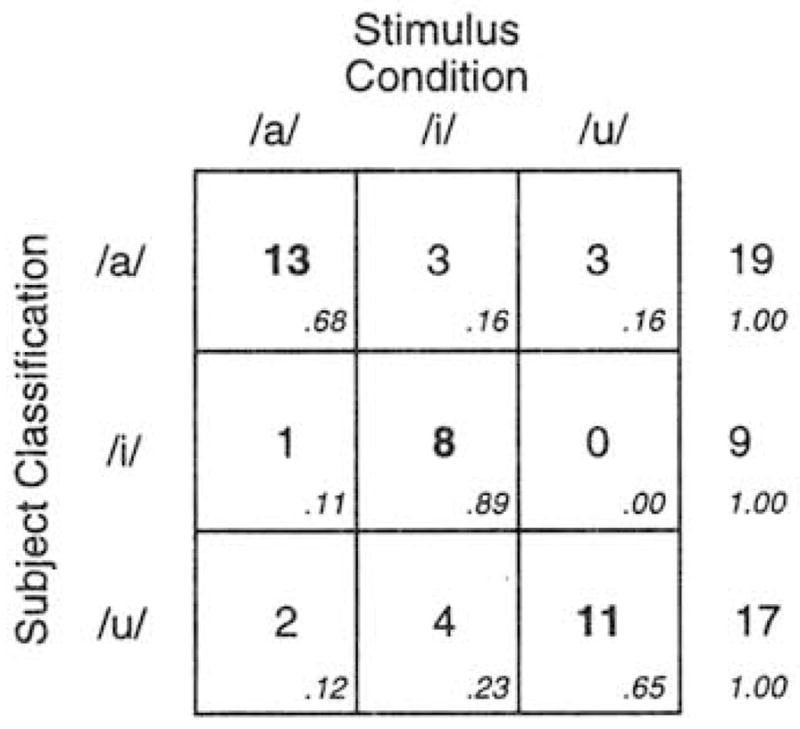
Infants' development of speech begins with a language-universal pattern of production that eventually becomes language specific. One mechanism contributing to this change is vocal imitation. The present study was undertaken to examine developmental change in infants' vocalizations in response to adults' vowels at 12, 16, and 20 weeks of age and test for vocal imitation. Two methodological aspects of the experiment are noteworthy: (a) three different vowel stimuli (/a/, /i/, and /u/) were videotaped and presented to infants by machine so that the adult model could not artifactually influence infant utterances, and (b) infants' vocalizations were analyzed both physically, using computerized spectrographic techniques, and perceptually by trained phoneticians who transcribed the utterances. The spectrographic analyses revealed a developmental change in the production of vowels. Infants' vowel categories become more separated in vowel space from 12 to 20 weeks of age. Moreover, vocal imitation was documented, infants listening to a particular vowel produced vocalizations resembling that vowel. A hypothesis is advanced extending Kuhl's native language magnet (NLM) model to encompass infants' speech production. It is hypothesized that infants listening to ambient language store perceptually derived representations of the speech sounds they hear which in turn serve as targets for the production of speech utterances. NLM unifies previous findings on the effects of ambient language experience on infants' speech perception and the findings reported here that short-term laboratory experience with speech is sufficient to influence infants' speech production.
婴儿言语发展始于一种通用的语言产出模式,这种模式最终会变得具有语言特异性。导致这种变化的一种机制是语音模仿。本研究旨在考察12周、16周和20周大的婴儿对成人元音发声的发育变化,并测试语音模仿情况。该实验有两个值得注意的方法学方面:(a)录制了三种不同的元音刺激(/a/、/i/和/u/),并通过机器呈现给婴儿,这样成人模型就不会人为地影响婴儿的发声;(b)使用计算机化的频谱技术对婴儿的发声进行物理分析,并由训练有素的语音学家进行感知分析,他们会对发声进行转录。频谱分析揭示了元音产出的发育变化。从12周到20周大,婴儿的元音类别在元音空间中变得更加分离。此外,还记录了语音模仿情况,即婴儿听到特定元音后发出类似于该元音的声音。提出了一个假设,将库尔的母语磁体(NLM)模型扩展到婴儿的言语产出。假设婴儿听到周围的语言后,会存储他们听到的语音的感知衍生表征,这些表征反过来又作为言语发声的目标。NLM统一了先前关于周围语言经验对婴儿语音感知影响的研究结果,以及这里报道的短期实验室语音经验足以影响婴儿言语产出的研究结果。