Pogozheva I D, Lomize A L, Mosberg H I
College of Pharmacy, University of Michigan, Ann Arbor 48109, USA.
Biophys J. 1997 May;72(5):1963-85. doi: 10.1016/S0006-3495(97)78842-8.
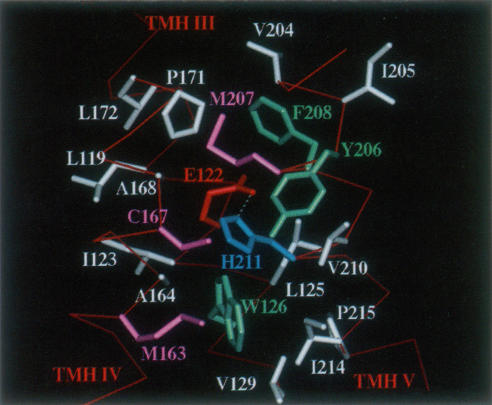
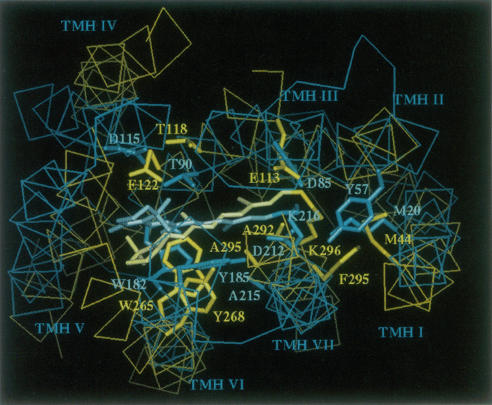
A 3D model of the transmembrane 7-alpha-bundle of rhodopsin-like G-protein-coupled receptors (GPCRs) was calculated using an iterative distance geometry refinement with an evolving system of hydrogen bonds, formed by intramembrane polar side chains in various proteins of the family and collectively applied as distance constraints. The alpha-bundle structure thus obtained provides H bonding of nearly all buried polar side chains simultaneously in the 410 GPCRs considered. Forty evolutionarily conserved GPCR residues form a single continuous domain, with an aliphatic "core" surrounded by six clusters of polar and aromatic side chains. The 7-alpha-bundle of a specific GPCR can be calculated using its own set of H bonds as distance constraints and the common "average" model to restrain positions of the helices. The bovine rhodopsin model thus determined is closely packed, but has a few small polar cavities, presumably filled by water, and has a binding pocket that is complementary to 11-cis (6-s-cis, 12-s-trans, C = N anti)-retinal or to all-trans-retinal, depending on conformations of the Lys296 and Trp265 side chains. A suggested mechanism of rhodopsin photoactivation, triggered by the cis-trans isomerization of retinal, involves rotations of Glu134, Tyr223, Trp265, Lys296, and Tyr306 side chains and rearrangement of their H bonds. The model is in agreement with published electron cryomicroscopy, mutagenesis, chemical modification, cross-linking, Fourier transform infrared spectroscopy, Raman spectroscopy, electron paramagnetic resonance spectroscopy, NMR, and optical spectroscopy data. The rhodopsin model and the published structure of bacteriorhodopsin have very similar retinal-binding pockets.
利用迭代距离几何优化方法,结合由该家族各种蛋白质中的膜内极性侧链形成并共同用作距离约束的不断演化的氢键系统,计算出了视紫红质样G蛋白偶联受体(GPCR)的跨膜7α束三维模型。由此获得的α束结构在考虑的410种GPCR中几乎同时为所有埋藏的极性侧链提供了氢键。40个进化保守的GPCR残基形成一个单一的连续结构域,其脂肪族“核心”被六簇极性和芳香族侧链包围。特定GPCR的7α束可以使用其自身的氢键集作为距离约束,并结合通用的“平均”模型来限制螺旋的位置。由此确定的牛视紫红质模型紧密堆积,但有一些小的极性腔,可能被水填充,并且有一个与11-顺式(6-s-顺式,12-s-反式,C = N反式)视黄醛或全反式视黄醛互补的结合口袋,这取决于Lys296和Trp265侧链的构象。视黄醛的顺反异构化引发视紫红质光激活的一种推测机制涉及Glu134、Tyr223、Trp265、Lys296和Tyr306侧链的旋转及其氢键的重排。该模型与已发表的电子冷冻显微镜、诱变、化学修饰、交联、傅里叶变换红外光谱、拉曼光谱、电子顺磁共振光谱、核磁共振和光学光谱数据一致。视紫红质模型和已发表的细菌视紫红质结构具有非常相似的视黄醛结合口袋。