Leman P
Accident and Emergency Department, St Thomas' Hospital, London, UK.
J Accid Emerg Med. 1997 Mar;14(2):98-100. doi: 10.1136/emj.14.2.98.
To determine the extent of communication problems that arose from patients whose primary language was non-English presenting to an inner city accident and emergency (A&E) department.
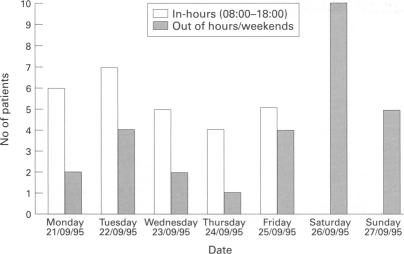
A prospective survey over seven consecutive days during September 1995. All adult patients other than those directly referred by their general practitioner to an inpatient team had a questionnaire completed by the A&E doctor first seeing the patient. The doctor recorded language ability and form of interpreter used, and estimated any prolongation of the consultation and ability to improve communication by the use of additional services.
103 patients (17%) did not speak English as their primary language; 55 patients (9.1% of the study population) had an English language ability rated as other than good, and 16 (29%) of these consultations could have been improved by the use of additional interpreter services; 28 patients overall (4.6% of the study population) required the use of an interpreter, who was usually a relative.
A significant number of patients presenting to A&E have difficulty in communicating in English. These consultations could often have been improved by the use of additional interpreter services. Telephone interpreter services may provide the answer for use in A&E departments because of their instant and 24 hour availability.
确定母语非英语的患者前往市中心急症室就诊时出现沟通问题的程度。
1995年9月连续七天进行前瞻性调查。除了由全科医生直接转诊至住院团队的患者外,所有成年患者均由首位接诊的急症室医生填写一份问卷。医生记录语言能力、所使用的口译形式,并估计会诊时间是否延长以及使用额外服务能否改善沟通。
103名患者(占17%)母语非英语;55名患者(占研究人群的9.1%)英语能力被评定为不佳,其中16例会诊(占29%)通过使用额外的口译服务本可得到改善;总体上有28名患者(占研究人群的4.6%)需要使用口译员,通常是亲属。
大量前往急症室就诊的患者在英语沟通方面存在困难。使用额外的口译服务往往可以改善这些会诊。电话口译服务可能是急症室的解决办法,因为其即时可用且全天候服务。