Higuchi T, Graham S H, Fernandez E J, Rooney W D, Gaspary H L, Weiner M W, Maudsley A A
Department of Radiology, University of California San Francisco, USA.
Magn Reson Med. 1997 Jun;37(6):851-7. doi: 10.1002/mrm.1910370608.
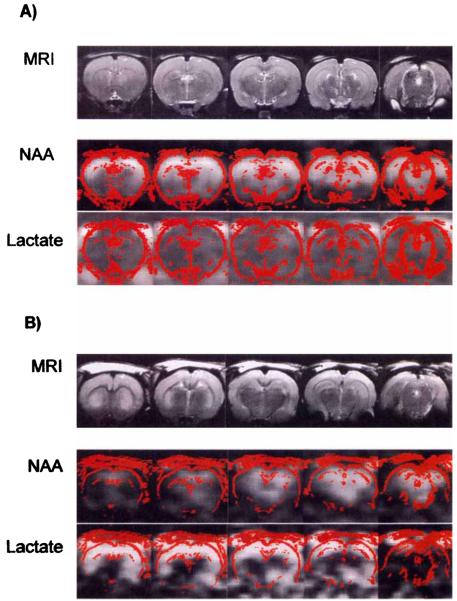
N-acetylaspartate (NAA) is found exclusively in neurons and their processes in the adult brain. Since the regional distribution of NAA may be imaged using magnetic resonance spectroscopic imaging (1H-MRSI), a regional measure of neuronal density may be noninvasively obtained. The technique may be particularly useful in the diagnosis of diseases where neurons are selectively injured, since these diseases do not result in definitive changes on conventional imaging studies. The goal of this study was to determine whether 1H-MRSI measurement of NAA defects neuronal loss following global ischemia. 1H-MRSI was performed in rats 24 h after global ischemia was induced by bilateral carotid occlusion plus hypotension. 1-H-MRSI showed that NAA was decreased by 28-74% in vulnerable regions, including the cortex, striatum, hippocampus, and, to a lesser extent, the thalamus. No change was observed in the brain stem or cerebellum. Regions where 1H-MRSI observed NAA was decreased also had histological evidence of selective neuronal necrosis and showed marked increase of lactate and alanine. These results show that 1H-MRSI detected loss of NAA in brain regions with selective neuronal loss, suggesting that 1H-MRSI measurements of NAA could detect neuronal loss in a variety of disease states where there is selective neuronal necrosis.
N-乙酰天门冬氨酸(NAA)仅存在于成人大脑的神经元及其突起中。由于可使用磁共振波谱成像(1H-MRSI)对NAA的区域分布进行成像,因此可以无创地获得神经元密度的区域测量值。该技术在诊断神经元选择性受损的疾病时可能特别有用,因为这些疾病在传统影像学研究中不会导致明确的变化。本研究的目的是确定1H-MRSI测量NAA是否能反映全脑缺血后神经元的丢失情况。在双侧颈动脉闭塞加低血压诱导全脑缺血24小时后的大鼠中进行1H-MRSI检查。1H-MRSI显示,在包括皮质、纹状体、海马体以及程度较轻的丘脑等易损区域,NAA降低了28%-74%。脑干或小脑未观察到变化。1H-MRSI观察到NAA降低的区域也有选择性神经元坏死的组织学证据,并显示乳酸和丙氨酸明显增加。这些结果表明,1H-MRSI可检测到存在选择性神经元丢失的脑区中NAA的减少,提示1H-MRSI测量NAA可在多种存在选择性神经元坏死的疾病状态下检测到神经元丢失。