Vickers A J
Integrative Medicine Service, Biostatistics Service, Memorial Sloan-Kettering Cancer Center, 1275 York Avenue, New York 10021, USA.
BMC Musculoskelet Disord. 2001;2:5. doi: 10.1186/1471-2474-2-5. Epub 2001 Oct 23.
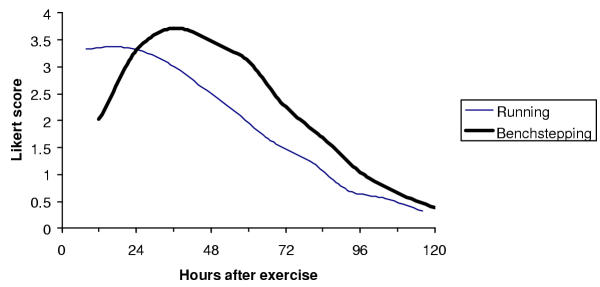
Post-exercise muscle soreness is a dull, aching sensation that follows unaccustomed muscular exertion. Primarily on the basis of previous laboratory-based research on eccentric exercise, soreness is usually said to follow an inverted U-shaped curve over time, peaking 24 - 48 hours after exercise. As such, it is often described as "delayed-onset" muscle soreness. In a study of long-distance runners, soreness seemed to peak immediately and then reduce gradually over time. The study is a secondary analysis of clinical trial data that aims to determine whether the time course of soreness following a natural exercise, long-distance running, is different from that following a laboratory-based exercise, bench-stepping.
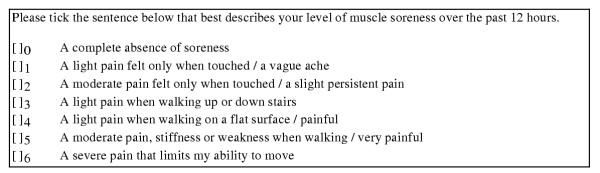
This is a reanalysis of data from three previous clinical trials. The trials included 400 runners taking part in long-distance races and 82 untrained volunteers performing a bench-stepping test. Subjects completed a Likert scale of muscle soreness every morning and evening for the five days following their exercise.
Interaction between trial and time is highly significant, suggesting a different time course of soreness following running and bench-stepping. 45% of subjects in the bench-stepping trial experienced peak soreness at the third or fourth follow-up (approximately 36 - 48 hours after exercise) compared to only 14% of those in the running trial. The difference between groups is robust to multivariate analysis incorporating possible confounding variables.
Soreness in runners following long-distance running follows a different time course to that in untrained individuals undertaking bench-stepping. Research on exercise taking place in the laboratory context does not necessarily generalize to exercise undertaken by trained athletes when engaged in their chosen sport.
运动后肌肉酸痛是一种在不习惯的肌肉运动后出现的钝痛、酸痛感。主要基于以往关于离心运动的实验室研究,通常认为酸痛随时间呈倒U形曲线,在运动后24至48小时达到峰值。因此,它常被描述为“延迟性”肌肉酸痛。在一项对长跑运动员的研究中,酸痛似乎立即达到峰值,然后随时间逐渐减轻。该研究是对临床试验数据的二次分析,旨在确定自然运动(长跑)后酸痛的时间进程是否与实验室运动(台阶试验)后不同。
这是对之前三项临床试验数据的重新分析。试验包括400名参加长跑比赛的跑步者和82名进行台阶试验的未受过训练的志愿者。受试者在运动后的五天里,每天早晚完成一份关于肌肉酸痛的李克特量表。
试验与时间之间的交互作用非常显著,表明跑步和台阶试验后酸痛的时间进程不同。在台阶试验组中,45%的受试者在第三次或第四次随访时(运动后约36至48小时)经历了酸痛峰值,而在跑步试验组中这一比例仅为14%。纳入可能的混杂变量后,多变量分析显示两组之间的差异依然显著。
长跑后跑步者的酸痛时间进程与进行台阶试验的未受过训练的个体不同。在实验室环境下进行的运动研究不一定能推广到训练有素的运动员在其选择的运动中的情况。