Leung Wai K, To Ka-Fai, Chan Paul K S, Chan Henry L Y, Wu Alan K L, Lee Nelson, Yuen Kwok Y, Sung Joseph J Y
Department of Medicine and Therapeutics, The Chinese University of Hong Kong, Prince of Wales Hospital, Shatin, Hong Kong.
Gastroenterology. 2003 Oct;125(4):1011-7. doi: 10.1016/s0016-5085(03)01215-0.
Severe acute respiratory syndrome (SARS) is a recently emerged infection from a novel coronavirus (CoV). Apart from fever and respiratory complications, gastrointestinal symptoms are frequently observed in patients with SARS but the significance remains undetermined. Herein, we describe the clinical, pathologic, and virologic features of the intestinal involvement of this new viral infection.
A retrospective analysis of the gastrointestinal symptoms and other clinical parameters of the first 138 patients with confirmed SARS admitted for a major outbreak in Hong Kong in March 2003 was performed. Intestinal specimens were obtained by colonoscopy or postmortem examination to detect the presence of coronavirus by electron microscopy, virus culture, and reverse-transcription polymerase chain reaction.
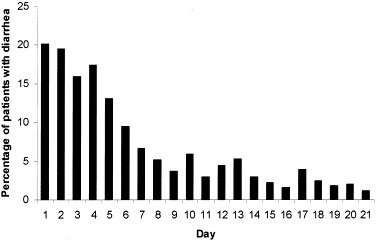
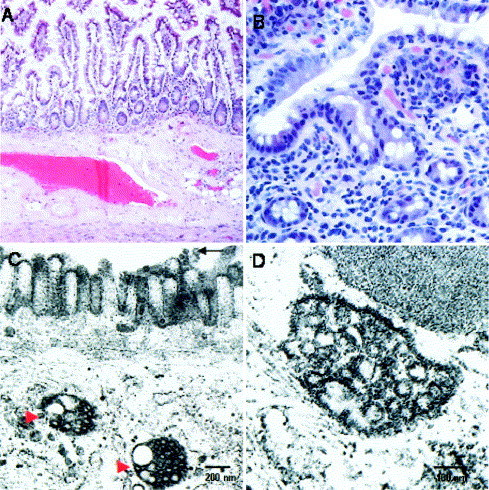
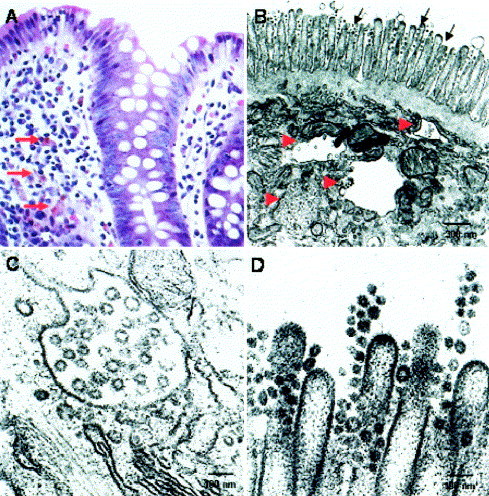
Among these 138 patients with SARS, 28 (20.3%) presented with watery diarrhea and up to 38.4% of patients had symptoms of diarrhea during the course of illness. Diarrhea was more frequently observed during the first week of illness. The mean number of days with diarrhea was 3.7 +/- 2.7, and most diarrhea was self-limiting. Intestinal biopsy specimens obtained by colonoscopy or autopsy showed minimal architectural disruption but the presence of active viral replication within both the small and large intestine. Coronavirus was also isolated by culture from these specimens, and SARS-CoV RNA can be detected in the stool of patients for more than 10 weeks after symptom onset.
Diarrhea is a common presenting symptom of SARS. The intestinal tropism of the SARS-CoV has major implications on clinical presentation and viral transmission.
严重急性呼吸综合征(SARS)是一种由新型冠状病毒(CoV)引起的新发感染性疾病。除发热和呼吸道并发症外,SARS患者常出现胃肠道症状,但其意义尚不确定。在此,我们描述了这种新型病毒感染肠道受累的临床、病理和病毒学特征。
对2003年3月香港一次重大疫情中收治的首批138例确诊SARS患者的胃肠道症状及其他临床参数进行回顾性分析。通过结肠镜检查或尸检获取肠道标本,采用电子显微镜、病毒培养及逆转录聚合酶链反应检测冠状病毒的存在。
在这138例SARS患者中,28例(20.3%)出现水样腹泻,高达38.4%的患者在病程中出现腹泻症状。腹泻在发病第一周更为常见。腹泻平均天数为3.7±2.7天,多数腹泻为自限性。通过结肠镜检查或尸检获取的肠道活检标本显示结构破坏轻微,但在小肠和大肠内均存在活跃的病毒复制。从这些标本中也培养出了冠状病毒,且在症状出现后10周以上的患者粪便中可检测到SARS-CoV RNA。
腹泻是SARS的常见症状。SARS-CoV的肠道嗜性对临床表现和病毒传播具有重要意义。