Tham Kum-Ying
Emergency Department, Tan Tock Seng Hospital, Singapore.
Ann Emerg Med. 2004 Jan;43(1):6-14. doi: 10.1016/j.annemergmed.2003.08.005.
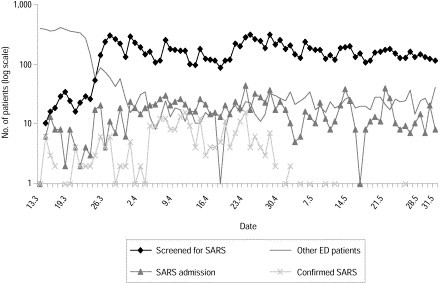
On March 13, 2003, Singapore physicians were alerted about an outbreak of atypical pneumonia that became known as severe acute respiratory syndrome (SARS). I describe the application of an emergency department (ED) disaster response plan to manage the SARS outbreak.
The ED implemented protection for staff, patients, and facility; infection control measures; and disaster-response workflow changes. The Ministry of Health, Singapore, centralized SARS cases in the hospital, and the ED became the national screening center. A screening questionnaire and a set of admission criteria were applied after assessment of clinical features and chest radiograph findings.
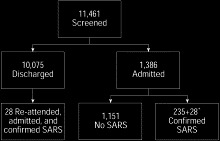
For the duration of the outbreak that ended on May 31, 2003, the ED screened 11,461 persons for SARS, of whom 1,386 (12.9%) were admitted to rule out SARS and 235 (17%) were confirmed to have SARS. Among 10,075 persons discharged from the ED, there were 28 reattending patients who were admitted and diagnosed with SARS, giving an undertriage rate of 0.3% (95% confidence interval [CI] 0.1% to 0.4%). The sensitivity of an ED admission for SARS was 89.4% (95% CI 85.6% to 93.1%), and specificity was 89.7% (95% CI 89.2% to 90.3%). The positive predictive value was 17% (95% CI 15.7% to 18.4%), and the negative predictive value was 99.7% (95% CI 99.6% to 99.8%). No patient contracted SARS as a result of an ED visit. After full implementation of protective measures, 1 ED nurse with undiagnosed diabetes mellitus was treated for suspected SARS.
Although the SARS outbreak was not a bioterrorism event, the ED disaster response was applicable in the outbreak's management. The use of a screening questionnaire and admission criteria enabled the ED to screen, treat, and safely discharge the majority of the patients.
2003年3月13日,新加坡医生收到关于一场非典型肺炎疫情爆发的警报,该疫情后来被称为严重急性呼吸综合征(SARS)。我描述了急诊科(ED)灾难应对计划在管理SARS疫情中的应用。
急诊科对工作人员、患者和设施实施了保护措施;采取了感染控制措施;并改变了灾难应对工作流程。新加坡卫生部将SARS病例集中在该医院,急诊科成为国家筛查中心。在评估临床特征和胸部X光检查结果后,应用了一份筛查问卷和一套入院标准。
在2003年5月31日结束的疫情期间,急诊科对11461人进行了SARS筛查,其中1386人(12.9%)因排除SARS而入院,235人(17%)被确诊感染SARS。在从急诊科出院的10075人中,有28名复诊患者入院并被诊断为SARS,漏诊率为0.3%(95%置信区间[CI]0.1%至0.4%)。急诊科收治SARS患者的敏感性为89.4%(95%CI 85.6%至93.1%),特异性为89.7%(95%CI 89.2%至90.3%)。阳性预测值为17%(95%CI 15.7%至18.4%),阴性预测值为99.7%(95%CI 99.6%至99.8%)。没有患者因到急诊科就诊而感染SARS。在全面实施保护措施后,1名患有未确诊糖尿病的急诊科护士因疑似感染SARS而接受治疗。
尽管SARS疫情不是生物恐怖主义事件,但急诊科的灾难应对措施适用于疫情管理。使用筛查问卷和入院标准使急诊科能够对大多数患者进行筛查、治疗并安全出院。