Tei H, Nihonmatsu I, Yokokura T, Ueda R, Sano Y, Okuda T, Sato K, Hirata K, Fujita S C, Yamamoto D
Mitsubishi Kasei Institute of Life Sciences, Tokyo, Japan.
Proc Natl Acad Sci U S A. 1992 Aug 1;89(15):6856-60. doi: 10.1073/pnas.89.15.6856.
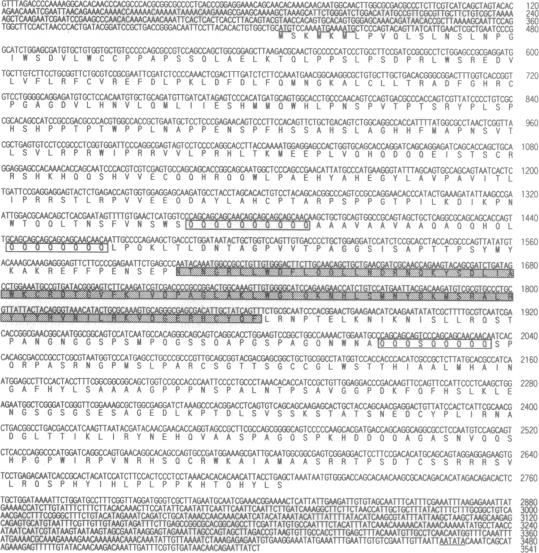
Studies on sevenless and bride of sevenless genes have revealed that the R8 cell plays a key role in the fate of the R7 photoreceptor cell, presenting on its surface an inductive cue to which R7 responds. sev-independent induction of R7 cells has been reported in the seven-up mutation, which appears to transform R1 and R6 cells to R7 cells. We have induced recessive mutations in a gene pokkuri (pok; pokkuri is a Japanese word that means "dropping dead") that lead to overproduction of R7 cells with rather minor effects on outer photoreceptors and R8 cells. Pok protein may function as a transcription factor, as the predicted amino acid sequence contains a region similar to the consensus established for the E-26-specific (Ets) domain.
对无七(sevenless)基因和七无新娘(bride of sevenless)基因的研究表明,R8细胞在R7光感受器细胞的命运中起关键作用,它在其表面呈现一种诱导信号,R7细胞对此作出反应。在七上(seven-up)突变中报道了R7细胞的七无(sev)非依赖性诱导,这种突变似乎将R1和R6细胞转化为R7细胞。我们在一个名为pokkuri(pok;pokkuri在日语中意为“突然死亡”)的基因中诱导了隐性突变,该突变导致R7细胞过度产生,对外侧光感受器和R8细胞的影响较小。Pok蛋白可能作为一种转录因子发挥作用,因为预测的氨基酸序列包含一个与E-26特异性(Ets)结构域所确立的共有序列相似的区域。