Battistuzzi Fabia U, Feijao Andreia, Hedges S Blair
NASA Astrobiology Institute and Department of Biology, 208 Mueller Laboratory, The Pennsylvania State University, University Park, PA 16802, USA.
BMC Evol Biol. 2004 Nov 9;4:44. doi: 10.1186/1471-2148-4-44.
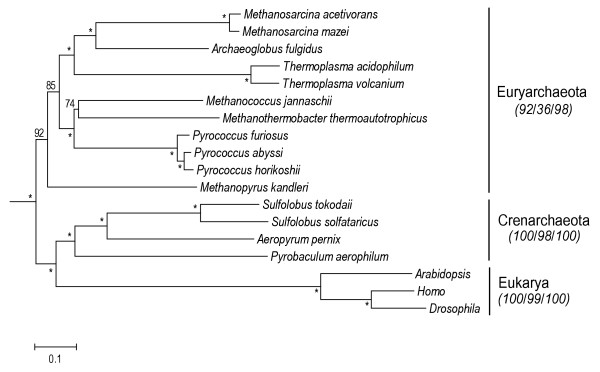
The timescale of prokaryote evolution has been difficult to reconstruct because of a limited fossil record and complexities associated with molecular clocks and deep divergences. However, the relatively large number of genome sequences currently available has provided a better opportunity to control for potential biases such as horizontal gene transfer and rate differences among lineages. We assembled a data set of sequences from 32 proteins (approximately 7600 amino acids) common to 72 species and estimated phylogenetic relationships and divergence times with a local clock method.
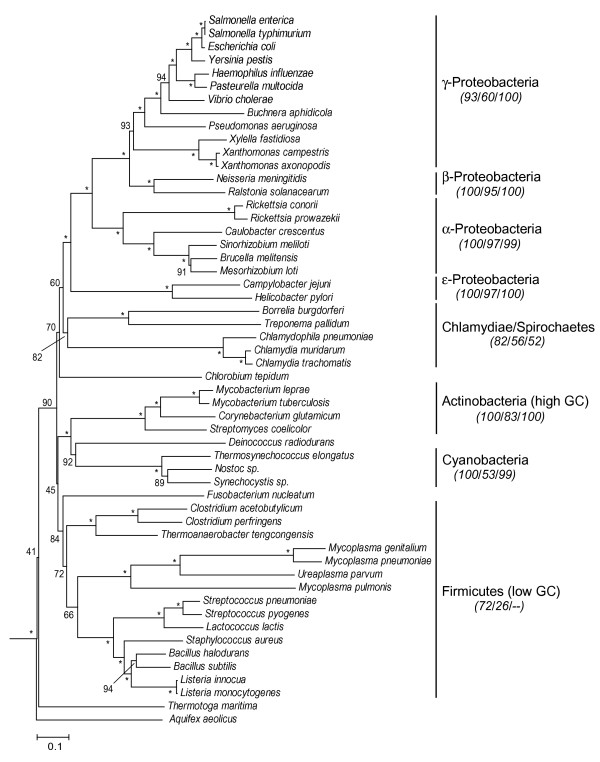
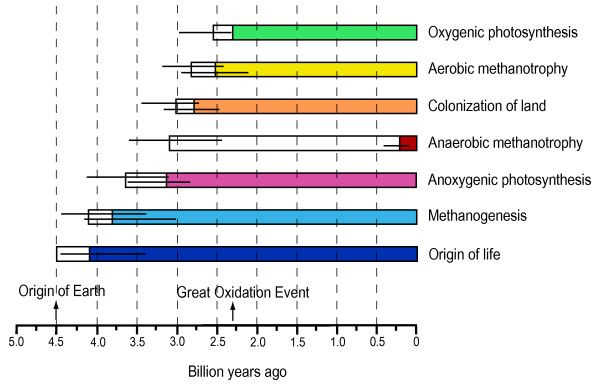
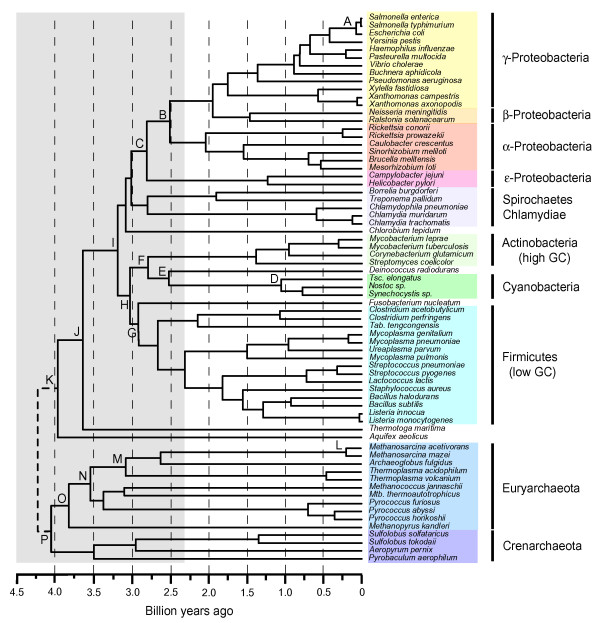
Our phylogenetic results support most of the currently recognized higher-level groupings of prokaryotes. Of particular interest is a well-supported group of three major lineages of eubacteria (Actinobacteria, Deinococcus, and Cyanobacteria) that we call Terrabacteria and associate with an early colonization of land. Divergence time estimates for the major groups of eubacteria are between 2.5-3.2 billion years ago (Ga) while those for archaebacteria are mostly between 3.1-4.1 Ga. The time estimates suggest a Hadean origin of life (prior to 4.1 Ga), an early origin of methanogenesis (3.8-4.1 Ga), an origin of anaerobic methanotrophy after 3.1 Ga, an origin of phototrophy prior to 3.2 Ga, an early colonization of land 2.8-3.1 Ga, and an origin of aerobic methanotrophy 2.5-2.8 Ga.
Our early time estimates for methanogenesis support the consideration of methane, in addition to carbon dioxide, as a greenhouse gas responsible for the early warming of the Earths' surface. Our divergence times for the origin of anaerobic methanotrophy are compatible with highly depleted carbon isotopic values found in rocks dated 2.8-2.6 Ga. An early origin of phototrophy is consistent with the earliest bacterial mats and structures identified as stromatolites, but a 2.6 Ga origin of cyanobacteria suggests that those Archean structures, if biologically produced, were made by anoxygenic photosynthesizers. The resistance to desiccation of Terrabacteria and their elaboration of photoprotective compounds suggests that the common ancestor of this group inhabited land. If true, then oxygenic photosynthesis may owe its origin to terrestrial adaptations.
由于化石记录有限以及与分子钟和深度分歧相关的复杂性,原核生物的进化时间尺度一直难以重建。然而,目前可获得的相对大量的基因组序列提供了一个更好的机会来控制潜在的偏差,如水平基因转移和不同谱系之间的速率差异。我们组装了一个由72个物种共有的32种蛋白质(约7600个氨基酸)的序列数据集,并使用局部时钟方法估计了系统发育关系和分歧时间。
我们的系统发育结果支持目前大多数公认的原核生物高级分类群。特别值得关注的是一组得到充分支持的真细菌的三个主要谱系(放线菌、嗜热放线菌和蓝细菌),我们将其称为陆地细菌,并将其与早期陆地定殖联系起来。真细菌主要类群的分歧时间估计在25亿至32亿年前(Ga),而古细菌的分歧时间大多在31亿至41亿年前。时间估计表明生命起源于冥古宙(41亿年前之前),甲烷生成起源较早(38亿至41亿年前),厌氧甲烷氧化在31亿年后起源,光合作用在32亿年前起源,陆地在28亿至31亿年前早期定殖,需氧甲烷氧化在25亿至28亿年前起源。
我们对甲烷生成的早期时间估计支持了除二氧化碳外,甲烷也应被视为导致地球表面早期变暖的温室气体这一观点。我们对厌氧甲烷氧化起源的分歧时间与在28亿至26亿年前的岩石中发现的高度贫化的碳同位素值相符。光合作用的早期起源与最早被鉴定为叠层石的细菌垫和结构一致,但蓝细菌在26亿年前起源表明,那些太古宙结构,如果是生物产生的,是由无氧光合生物形成的。陆地细菌对干燥的抗性及其光保护化合物的形成表明该类群的共同祖先栖息在陆地上。如果是这样,那么有氧光合作用可能起源于陆地适应。