
双谱指数与舒适评分用于确定儿科重症监护病房患者的镇静水平:一项前瞻性研究。
Bispectral index versus COMFORT score to determine the level of sedation in paediatric intensive care unit patients: a prospective study.
作者信息
Triltsch Andreas E, Nestmann Grit, Orawa Helmut, Moshirzadeh Maryam, Sander Michael, Grosse Joachim, Genähr Arka, Konertz Wolfgang, Spies Claudia D
机构信息
Department of Anesthesiology and Intensive Care Medicine [corrected], Campus Benjamin Franklin, Charité University Hospital Berlin, Berlin, Germany.
出版信息
Crit Care. 2005 Feb;9(1):R9-17. doi: 10.1186/cc2977. Epub 2004 Nov 10.
INTRODUCTION
Most clinicians give sedatives and analgesics according to their professional experience and the patient's estimated need for sedation. However, this approach is prone to error. Inadequate monitoring of sedation and analgesia may contribute to adverse outcomes and complications. With this in mind, data obtained continuously using nonstimulating methods such as bispectral index (BIS) may have benefits in comparison with clinical monitoring of sedation. The aim of this prospective observational trial was to evaluate the use of electroencephalographic (EEG) BIS for monitoring sedation in paediatric intensive care unit (PICU) patients.
METHODS
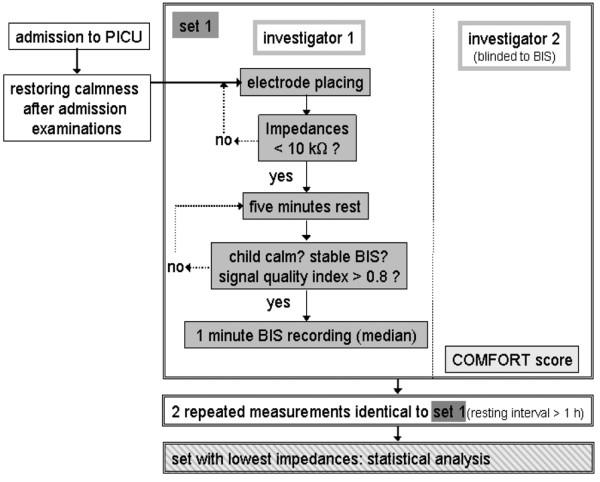
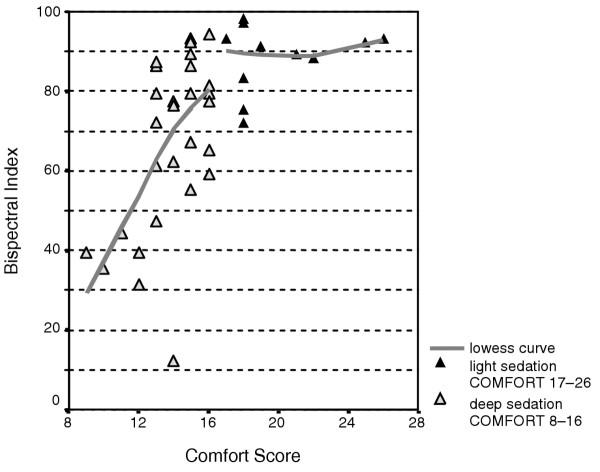
Forty paediatric patients (<18 years) were sedated for mechanical ventilation in a cardiac surgical and general PICU. In each paediatric patient BIS and COMFORT score were obtained. The study protocol did not influence ongoing PICU therapy. BIS and corresponding COMFORT score were collected three times for each patient. Measurements with the best starting EEG impedances were analyzed further. Deep sedation was defined as a COMFORT score between 8 and 16, and light sedation as a score between 17 and 26. Biometric and physiological data, and Pediatric Risk of Mortality III scores were also recorded.
RESULTS
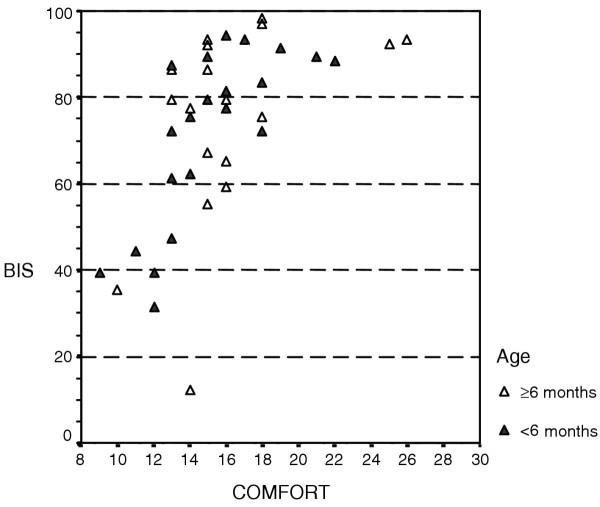
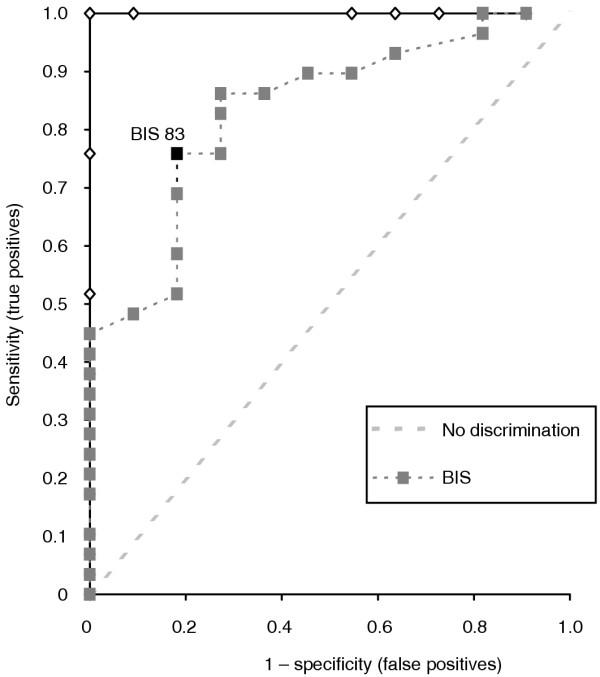
There was a good correlation (Spearman's rho 0.651; P = 0.001) between BIS and COMFORT score in the presence of deep sedation and low starting impedance. Receiver operating characteristic (ROC) analysis revealed best discrimination between deep and light sedation at a BIS level of 83.
CONCLUSION
In the presence of deep sedation, BIS correlated satisfactorily with COMFORT score results if low EEG impedances were guaranteed.
引言
大多数临床医生根据其专业经验和患者预计的镇静需求给予镇静剂和镇痛药。然而,这种方法容易出错。镇静和镇痛监测不足可能导致不良后果和并发症。考虑到这一点,与镇静的临床监测相比,使用如脑电双频指数(BIS)等非刺激方法持续获取的数据可能具有优势。这项前瞻性观察性试验的目的是评估脑电图(EEG)BIS在儿科重症监护病房(PICU)患者镇静监测中的应用。
方法
40例18岁以下儿科患者在心脏外科和综合PICU接受机械通气时进行镇静。在每位儿科患者中获取BIS和舒适度评分。研究方案不影响正在进行的PICU治疗。每位患者收集三次BIS及相应的舒适度评分。对具有最佳起始脑电图阻抗的测量结果进行进一步分析。深度镇静定义为舒适度评分为8至16分,轻度镇静定义为评分为17至26分。还记录了生物统计学和生理学数据以及儿科死亡风险Ⅲ评分。
结果
在深度镇静且起始阻抗较低的情况下,BIS与舒适度评分之间存在良好的相关性(Spearman秩相关系数0.651;P = 0.001)。受试者工作特征(ROC)分析显示,在BIS水平为83时,深度和轻度镇静之间的区分效果最佳。
结论
在深度镇静的情况下,如果能保证低脑电图阻抗,BIS与舒适度评分结果的相关性良好。
 Zotero 插件