Austin S Bryn, Fung Teresa, Cohen-Bearak Adena, Wardle Kacey, Cheung Lilian W Y
Division of Adolescent Medicine, Children's Hospital, 300 Longwood Ave, Boston, MA 02115, USA.
Prev Chronic Dis. 2006 Apr;3(2):A35. Epub 2006 Mar 15.
As school-based efforts increase to address the epidemic of childhood obesity, a priority for health professionals and educators will be to identify effective tools appropriate for use in schools to help guide health promotion programs and policies. This article describes the results of a qualitative research study examining school staff and community members' experiences working with the Centers for Disease Control and Prevention's School Health Index, a self-assessment and planning tool that addresses nutrition and physical activity.
In-depth interviews were carried out with faculty, staff, and community collaborators in nine public schools that were using the School Health Index to develop nutrition and physical activity initiatives for students. Interviews were conducted twice: once after a school had completed the School Health Index and once approximately 1 year later. Transcript data from interviews with 34 participants were analyzed using thematic analysis.
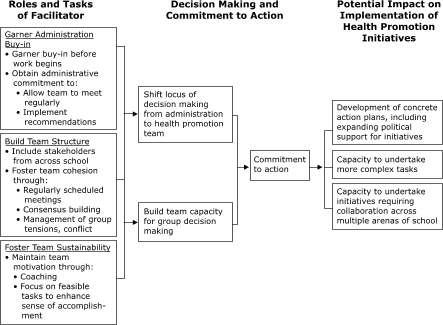
Findings indicated that school experiences differed markedly depending on whether they received help from an outside facilitator to work with the School Health Index. Unlike staff in schools working on their own, school staff working with outside facilitators described completing the School Health Index in a collaborative way, creating action plans, and working as a team to implement health promotion initiatives. In addition, the involvement of an outside facilitator supported schools in undertaking more complex tasks with a greater degree of collaboration across the school and local communities in order to achieve goals.
Outside facilitators may significantly enhance schools' efforts to work with the School Health Index and influence the organizational strategies they use to implement health promotion initiatives.
随着以学校为基础应对儿童肥胖流行问题的努力不断增加,卫生专业人员和教育工作者的一项首要任务将是确定适合在学校使用的有效工具,以帮助指导健康促进计划和政策。本文介绍了一项定性研究的结果,该研究考察了学校工作人员和社区成员使用疾病控制与预防中心的学校健康指数(一种涉及营养和体育活动的自我评估与规划工具)的工作经历。
对九所公立学校的教师、工作人员和社区合作者进行了深入访谈,这些学校正在使用学校健康指数为学生制定营养和体育活动倡议。访谈进行了两次:一次在学校完成学校健康指数之后,另一次在大约一年后。使用主题分析法对来自34名参与者的访谈转录数据进行了分析。
研究结果表明,学校的经历因是否得到外部协助者帮助使用学校健康指数而有显著差异。与自行开展工作的学校工作人员不同,与外部协助者合作的学校工作人员描述了以协作方式完成学校健康指数、制定行动计划以及作为一个团队实施健康促进倡议的过程。此外,外部协助者的参与支持学校承担更复杂的任务,并在学校和当地社区之间进行更大程度的协作以实现目标。
外部协助者可能会显著增强学校使用学校健康指数的努力,并影响其实施健康促进倡议所采用的组织策略。