Brundage John F
Army Medical Surveillance Activity, Washington, DC 20307-5001, USA.
Lancet Infect Dis. 2006 May;6(5):303-12. doi: 10.1016/S1473-3099(06)70466-2.
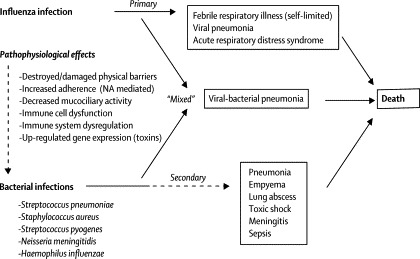
It is commonly believed that the clinical and epidemiological characteristics of the next influenza pandemic will mimic those of the 1918 pandemic. Determinative beliefs regarding the 1918 pandemic include that infections were expressed as primary viral pneumonias and/or acute respiratory distress syndrome, that pandemic-related deaths were the end states of the natural progression of disease caused by the pandemic strain, and that bacterial superinfections caused relatively fewer deaths in 1918 than in subsequent pandemics. In turn, response plans are focused on developing and/or increasing inventories of a strain-specific vaccine, antivirals, intensive care beds, mechanical ventilators, and so on. Yet, there is strong and consistent evidence of epidemiologically and clinically important interactions between influenza and secondary bacterial respiratory pathogens, including during the 1918 pandemic. Countermeasures (eg, vaccination against pneumococcal and meningococcal disease before a pandemic; mass uses of antibiotic(s) with broad spectrums of activity against common bacterial respiratory pathogens during local epidemics) designed to prevent or mitigate the effects of influenza-bacterial interactions should be major focuses of pandemic-related research, prevention, and response planning.
人们普遍认为,下一次流感大流行的临床和流行病学特征将与1918年大流行相似。关于1918年大流行的决定性观点包括:感染表现为原发性病毒性肺炎和/或急性呼吸窘迫综合征;与大流行相关的死亡是由大流行毒株引起的疾病自然进展的最终状态;1918年细菌性二重感染导致的死亡比随后的大流行相对较少。相应地,应对计划的重点是研发和/或增加特定毒株疫苗、抗病毒药物、重症监护床位、机械呼吸机等的储备。然而,有强有力且一致的证据表明,流感与继发性细菌性呼吸道病原体之间存在流行病学和临床上重要的相互作用,包括在1918年大流行期间。旨在预防或减轻流感-细菌相互作用影响的对策(例如,在大流行前接种肺炎球菌和脑膜炎球菌疾病疫苗;在局部流行期间大量使用对常见细菌性呼吸道病原体具有广谱活性的抗生素)应成为与大流行相关的研究、预防和应对计划的主要重点。