Wang Shu-Li, Chang Yu-Chen, Chao How-Ran, Li Chien-Ming, Li Lih-Ann, Lin Long-Yau, Päpke Olaf
Division of Environmental Health and Occupational Medicine, National Health Research Institutes, Miaoli, and Graduate Institute of Occupational and Industrial Health, Kaohsiung Medical University, Kaohsiung, Taiwan.
Environ Health Perspect. 2006 May;114(5):740-5. doi: 10.1289/ehp.8809.
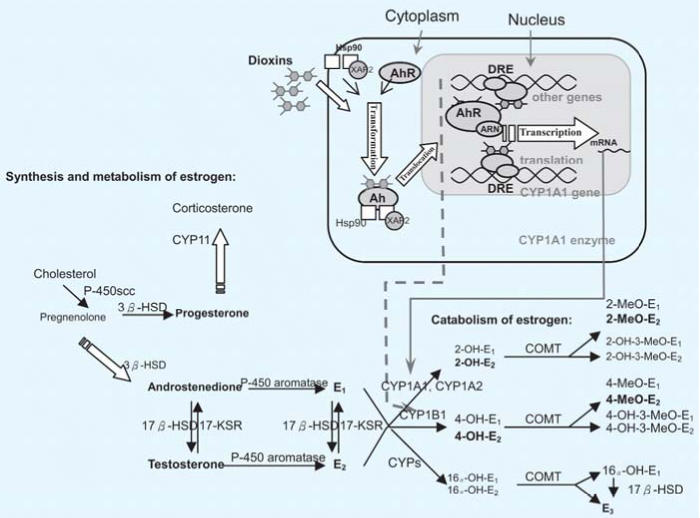
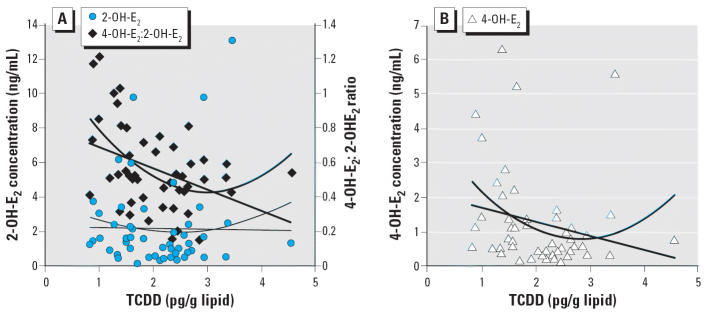
Polychlorinated dibenzo-p-dioxins (PCDDs, dioxins), polychlorinated dibenzofurans (PCDFs), and polychlorinated biphenyls (PCBs) are environmental endocrine disruptors that have half-lives of 7-10 years in the human body and have toxicities that probably include carcinogenesis. A high ratio of 4-hydroxyl estradiol (4-OH-E2) to 2-hydroxyl estradiol (2-OH-E2) has been suggested as a potential biomarker for estrogen-dependent neoplasms. In this cohort study of maternal-fetal pairs, we examined the relationship of PCDD/PCDF and PCB exposure to levels of estrogen metabolites in the sera of 50 pregnant women 25-34 years of age from central Taiwan. Maternal blood was collected during the third trimester, and the placenta was collected at delivery. We measured 17 dioxin congeners, 12 dioxin-like PCBs, and 6 indicator PCBs in placenta using gas chromatography coupled with high-resolution mass spectrometry. Estrogen metabolites in maternal serum were analyzed by liquid chromatography tandem mass spectrometry. The ratio of 4-OH-E2:2-OH-E2 decreased with increasing exposure to 2,3,7,8-tetrachlorodibenzo-p-dioxin (beta=-0.124, p=0.004 by the general linear regression model, R=0.4). Meanwhile, serum levels of 4-OH-E2 increased with increasing concentrations of high-chlorinated PCDFs (i.e., 1,2,3,4,6,7,8-hepta-CDF: beta=0.454, p=0.03, R=0.30). Altered estrogen catabolism might be associated with body burdens of PCDDs/PCDFs. Our study suggests that exposure to PCDDs/PCDFs significantly affects estrogen metabolism. Therefore, PCDD/PCDF exposure must be considered when using the OH-E2 ratio as a breast cancer marker.
多氯代二苯并 - 对 - 二恶英(PCDDs,二恶英)、多氯代二苯并呋喃(PCDFs)和多氯联苯(PCBs)是环境内分泌干扰物,在人体中的半衰期为7至10年,其毒性可能包括致癌作用。4 - 羟基雌二醇(4 - OH - E2)与2 - 羟基雌二醇(2 - OH - E2)的高比例已被认为是雌激素依赖性肿瘤的潜在生物标志物。在这项母婴对列研究中,我们调查了台湾中部50名25至34岁孕妇血清中PCDD/PCDF和PCB暴露与雌激素代谢物水平之间的关系。在孕晚期采集孕妇血液,分娩时采集胎盘。我们使用气相色谱 - 高分辨率质谱联用仪测量胎盘中的17种二恶英同系物、12种类二恶英多氯联苯和6种指示性多氯联苯。通过液相色谱串联质谱法分析孕妇血清中的雌激素代谢物。随着2,3,7,8 - 四氯二苯并 - 对 - 二恶英暴露增加,4 - OH - E2:2 - OH - E2的比例下降(通过一般线性回归模型,β = -0.124,p = 0.004,R = 0.4)。同时,血清中4 - OH - E2的水平随着高氯代PCDFs浓度的增加而升高(即1,2,3,4,6,7,8 - 七氯二苯并呋喃:β = 0.454,p = 0.03,R = 0.30)。雌激素分解代谢的改变可能与PCDDs/PCDFs的体内负荷有关。我们的研究表明,PCDDs/PCDFs暴露会显著影响雌激素代谢。因此,在将OH - E2比例用作乳腺癌标志物时,必须考虑PCDD/PCDF暴露情况。