Ngaile Justin E, Msaki Peter K
Radiation Control Directorate, Tanzania Atomic Energy Commission, Arusha, Tanzania.
J Appl Clin Med Phys. 2006 Aug 24;7(3):80-94. doi: 10.1120/jacmp.v7i3.2200.
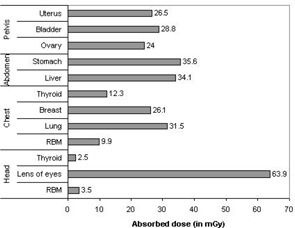
Although the use of computed tomography (CT) in medical diagnosis delivers relatively higher radiation doses to patients than other radiological procedures, lack of optimized protocols could be an additional source of increased dose in developing countries. The aim of this study was to determine the magnitude of radiation doses received by selected radiosensitive organs of patients from CT examinations. The study was further carried out in order to assess the influence of existing CT scanning protocols on patient organ doses. In order to achieve these objectives, patient organ doses from five common CT examinations were obtained from eight hospitals in Tanzania. The patient organ doses were estimated using measurements of CTDI, exposure-related parameters and the NRPB conversion factors. Large variation of mean organ doses among hospitals was observed for similar CT examinations. These variations were largely originated from different CT scanning protocols employed in different hospitals and scanner type. The mean organ doses in this study for the lens of the eyes (for head), thyroid (for chest), breast (for chest), stomach (for abdomen), and ovary (for pelvis), were 63.9 mGy, 12.3 mGy, 26.1 mGy, 35.6 mGy, and 24.0 mGy, respectively. These values were mostly comparable and slightly higher than the values of organ doses reported from literature for the UK, Japan, Germany, Norway and the Netherlands. It was concluded that patient organ doses could substantially minimized through careful selection of scanning parameters based on clinical indications of study, patient size, and body region being examined. Additional dose reduction to superficial organs would require the use of shielding materials.
尽管在医学诊断中使用计算机断层扫描(CT)给患者带来的辐射剂量比其他放射学检查相对更高,但在发展中国家,缺乏优化的方案可能是剂量增加的另一个来源。本研究的目的是确定接受CT检查的患者选定的辐射敏感器官所接受的辐射剂量大小。进一步开展该研究是为了评估现有CT扫描方案对患者器官剂量的影响。为了实现这些目标,从坦桑尼亚的八家医院获取了五种常见CT检查的患者器官剂量。使用CTDI测量值、与曝光相关的参数和NRPB转换因子来估计患者器官剂量。对于类似的CT检查,观察到不同医院之间平均器官剂量存在很大差异。这些差异主要源于不同医院采用的不同CT扫描方案和扫描仪类型。本研究中,眼睛晶状体(头部检查)、甲状腺(胸部检查)、乳房(胸部检查)、胃(腹部检查)和卵巢(骨盆检查)的平均器官剂量分别为63.9毫戈瑞、12.3毫戈瑞、26.1毫戈瑞、35.6毫戈瑞和24.0毫戈瑞。这些值大多具有可比性,且略高于英国、日本、德国、挪威和荷兰文献报道的器官剂量值。得出的结论是,通过根据研究的临床指征、患者体型和被检查的身体部位仔细选择扫描参数,可以大幅降低患者器官剂量。对浅表器官进一步降低剂量将需要使用屏蔽材料。