Wilting Andreas, Buckley-Beason Valerie A, Feldhaar Heike, Gadau Jürgen, O'Brien Stephen J, Linsenmair K Eduard
University of Würzburg, Biocentre, Department of Animal Ecology and Tropical Biology, 97074 Würzburg, Germany.
Laboratory of Genomic Diversity, National Cancer Institute, Frederick, Maryland, USA.
Front Zool. 2007 May 29;4:15. doi: 10.1186/1742-9994-4-15.
The clouded leopard (Neofelis nebulosa) is one of the least known cat species and depletion of their forested habitats puts it under heavy pressure. Recently reclassification of Bornean clouded leopards (N. nebulosa diardi) to species level (N.diardi) was suggested based on molecular and morphological evidence. Since the genetic results were based solely on three Bornean samples we re-evaluated this partition using additional samples of Bornean clouded leopards (N = 7) and we were also able to include specimens from Sumatra (N = 3), which were lacking in previous analysis.
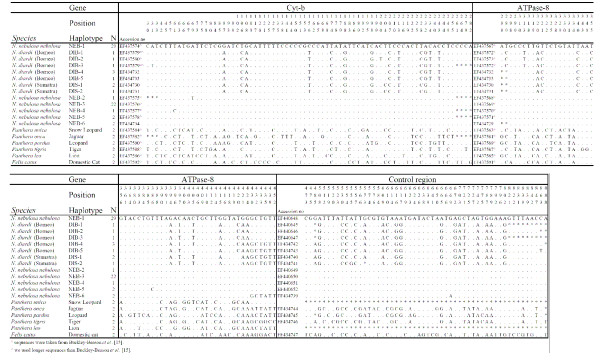
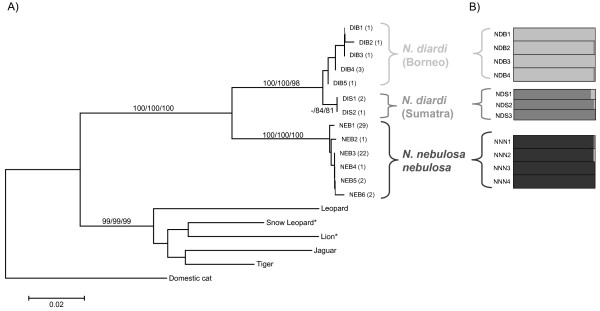
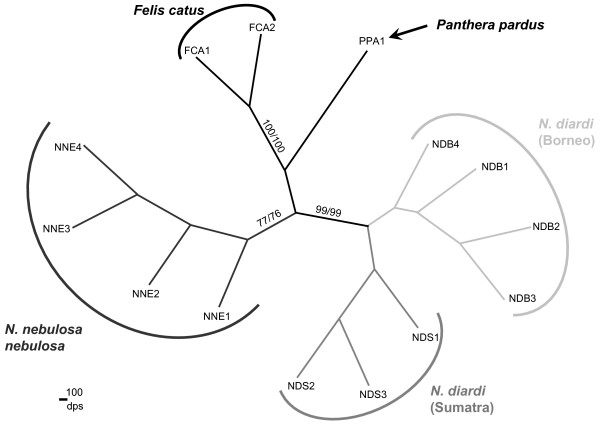
We found strong support for the distinction between N. nebulosa and N. diardi based on three fragments of mtDNA (900 bp) and 18 microsatellites. Forty-one fixed mitochondrial nucleotide differences and non-overlapping allele sizes in 8 of 18 microsatellite loci distinguished N. nebulosa and N. diardi. This is equivalent to the genetic divergence among recognized species in the genus Panthera. Sumatran clouded leopards clustered with specimens from Borneo, suggesting that Sumatran individuals also belong to N. diardi. Additionally, a significant population subdivision was apparent among N. diardi from Sumatra and Borneo based on mtDNA and microsatellite data.
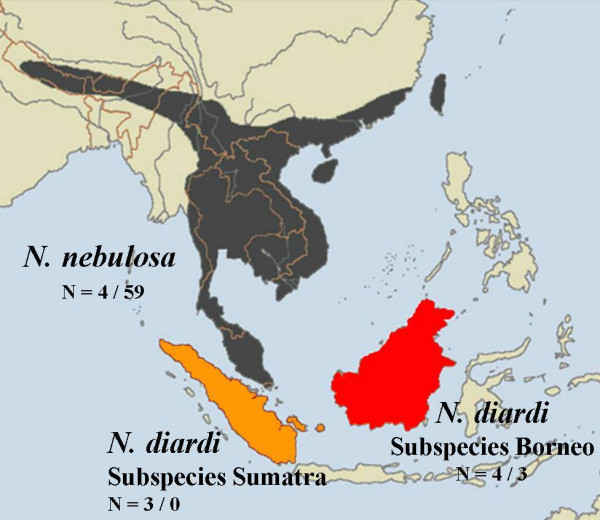
Referring to their origin on two Sunda Islands we propose to give N. diardi the common name "Sundaland clouded leopard". The reduced gene flow between Borneo and Sumatra might suggest the recognition of two subspecies of N. diardi. Based on this reclassification of clouded leopards not only species, but also the populations on Borneo and Sumatra should be managed separately and a higher priority should be placed to protect the different populations from extinction.
云豹(Neofelis nebulosa)是人们了解最少的猫科动物之一,其森林栖息地的减少使其面临巨大压力。最近,基于分子和形态学证据,有人建议将婆罗洲云豹(N. nebulosa diardi)重新分类为独立物种(N. diardi)。由于之前的基因研究结果仅基于三个婆罗洲样本,我们使用更多的婆罗洲云豹样本(N = 7)重新评估了这种分类,并且还纳入了之前分析中缺少的苏门答腊样本(N = 3)。
基于线粒体DNA的三个片段(900 bp)和18个微卫星,我们发现有力证据支持区分云豹指名亚种(N. nebulosa)和婆罗洲云豹(N. diardi)。41个固定的线粒体核苷酸差异以及18个微卫星位点中的8个位点上不重叠的等位基因大小区分了云豹指名亚种和婆罗洲云豹。这相当于豹属中已确认物种之间的遗传差异。苏门答腊云豹与婆罗洲的样本聚类在一起,这表明苏门答腊的个体也属于婆罗洲云豹。此外,基于线粒体DNA和微卫星数据,来自苏门答腊和婆罗洲的婆罗洲云豹之间存在明显的种群细分。
考虑到它们起源于两个巽他群岛,我们建议给婆罗洲云豹一个通用名称“Sundaland clouded leopard”(巽他云豹)。婆罗洲和苏门答腊之间基因流动的减少可能意味着承认婆罗洲云豹存在两个亚种。基于云豹的这种重新分类,不仅物种,而且婆罗洲和苏门答腊的种群都应该分开管理,并且应该给予更高的优先级来保护不同的种群免于灭绝。