Kunkel Stefan, Rosenqvist Urban, Westerling Ragnar
Department of Public Health and Caring Sciences, Uppsala University, Uppsala, Sweden.
BMC Health Serv Res. 2007 Jul 9;7:104. doi: 10.1186/1472-6963-7-104.
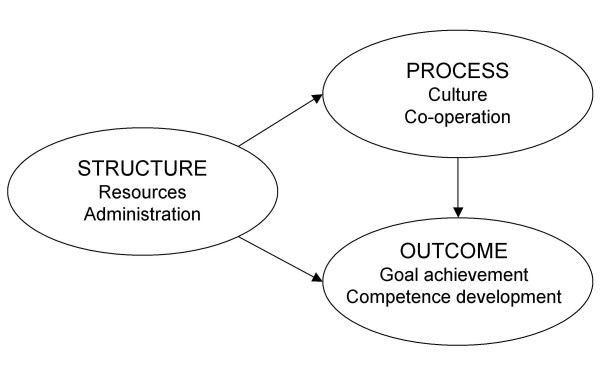
Clinicians, nurses, and managers in hospitals are continuously confronted by new technologies and methods that require changes to working practice. Quality systems can help to manage change while maintaining a high quality of care. A new model of quality systems inspired by the works of Donabedian has three factors: structure (resources and administration), process (culture and professional co-operation), and outcome (competence development and goal achievement). The objectives of this study were to analyse whether structure, process, and outcome can be used to describe quality systems, to analyse whether these components are related, and to discuss implications.
A questionnaire was developed and sent to a random sample of 600 hospital departments in Sweden. The adjusted response rate was 75%. The data were analysed with confirmatory factor analysis and structural equation modeling in LISREL. This is to our knowledge the first large quantitative study that applies Donabedian's model to quality systems.
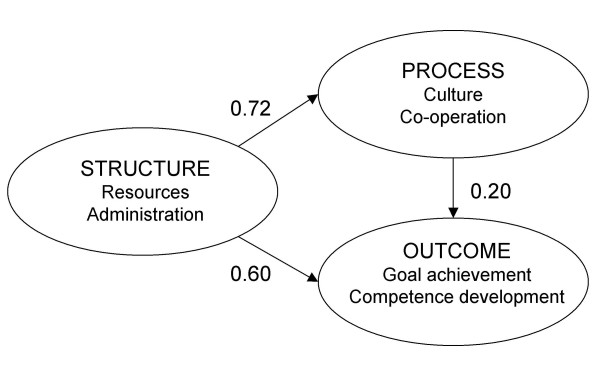
The model with relationships between structure, process, and outcome was found to be a reasonable representation of quality systems at hospital departments (p = 0.095, indicating no significant differences between the model and the data set). Structure correlated strongly with process (0.72) and outcome (0.60). Given structure, process also correlated with outcome (0.20).
The model could be used to describe and evaluate single quality systems or to compare different quality systems. It could also be an aid to implement a systematic and evidence-based system for working with quality improvements in hospital departments.
医院的临床医生、护士和管理人员不断面临需要改变工作实践的新技术和方法。质量体系有助于在维持高质量护理的同时管理变革。受唐纳贝迪安著作启发的一种新的质量体系模型有三个要素:结构(资源与管理)、过程(文化与专业合作)和结果(能力发展与目标达成)。本研究的目的是分析结构、过程和结果是否可用于描述质量体系,分析这些组成部分是否相关,并探讨其意义。
设计了一份问卷,并发送给瑞典600个医院科室的随机样本。调整后的回复率为75%。使用LISREL软件中的验证性因素分析和结构方程模型对数据进行分析。据我们所知,这是第一项将唐纳贝迪安模型应用于质量体系的大型定量研究。
发现具有结构、过程和结果之间关系的模型是医院科室质量体系的合理代表(p = 0.095,表明模型与数据集之间无显著差异)。结构与过程(0.72)和结果(0.60)密切相关。给定结构后,过程也与结果相关(0.20)。
该模型可用于描述和评估单个质量体系或比较不同的质量体系。它也有助于在医院科室实施一个用于质量改进工作的系统且基于证据的体系。