Van Duyn Mary Ann S, McCrae Tarsha, Wingrove Barbara K, Henderson Kimberly M, Boyd Jamie K, Kagawa-Singer Marjorie, Ramirez Amelie G, Scarinci-Searles Isabel, Wolff Lisa S, Penalosa Tricia L, Maibach Edward W
National Cancer Institute, Center to Reduce Cancer Health Disparities, 6116 Executive Blvd., Suite 602, Rockville, MD 20852, USA.
Prev Chronic Dis. 2007 Oct;4(4):A102. Epub 2007 Sep 15.
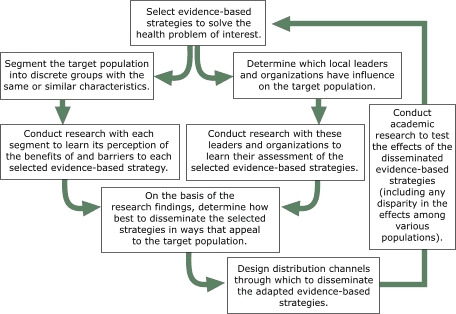
Using a social marketing approach, we studied how best to adapt proven, evidence-based strategies to increase physical activity for use with underserved racial or ethnic groups.
We conducted focus groups with low-income Hispanic women in Texas, Hmong parents and their children in California, low-income African American women and men in the Mississippi Delta, and Native Hawaiian college students in Hawaii. We also interviewed key leaders of these communities. Topics of discussion were participants' perceptions about 1) the benefits of engaging in physical activity, 2) the proposed evidence-based strategies for increasing each community's level of physical activity, and 3) the benefits and barriers to following the proposed interventions for increasing physical activity. A total of 292 individuals participated in the study.
All groups considered that being physically active was part of their culture, and participants found culturally relevant suggestions for physical activities appealing. Overwhelmingly, strategies that aimed to create or improve social support and increase access to physical activity venues received the most positive feedback from all groups. Barriers to physical activity were not culturally specific; they are common to all underserved people (lack of time, transportation, access, neighborhood safety, or economic resources).
Results indicate that evidence-based strategies to increase physical activity need to be adapted for cultural relevance for each racial or ethnic group. Our research shows that members of four underserved populations are likely to respond to strategies that increase social support for physical activity and improve access to venues where they can be physically active. Further research is needed to test how to implement such strategies in ways that are embraced by community members.
我们采用社会营销方法,研究如何最好地调整经过验证的循证策略,以增加身体活动,供服务不足的种族或族裔群体使用。
我们在得克萨斯州对低收入西班牙裔女性、在加利福尼亚州对苗族父母及其子女、在密西西比三角洲对低收入非裔美国女性和男性,以及在夏威夷对夏威夷原住民大学生进行了焦点小组访谈。我们还采访了这些社区的关键领导人。讨论的主题包括参与者对以下方面的看法:1)进行身体活动的益处;2)为提高每个社区身体活动水平而提出的循证策略;3)遵循拟议的增加身体活动干预措施的益处和障碍。共有292人参与了这项研究。
所有群体都认为身体活动是其文化的一部分,参与者发现与文化相关的身体活动建议很有吸引力。绝大多数旨在建立或改善社会支持并增加身体活动场所可达性的策略,得到了所有群体最积极的反馈。身体活动的障碍并非特定于文化;它们是所有服务不足人群共有的(缺乏时间、交通、可达性、社区安全或经济资源)。
结果表明,增加身体活动的循证策略需要根据每个种族或族裔群体的文化相关性进行调整。我们的研究表明,四个服务不足人群的成员可能会对增加身体活动社会支持并改善其进行身体活动场所可达性的策略做出反应。需要进一步研究如何以社区成员接受的方式实施此类策略。