Department of Movement and Sports Sciences, Ghent University, Watersportlaan 2, 9000 Ghent, Belgium.
Int J Behav Nutr Phys Act. 2007 Sep 19;4:39. doi: 10.1186/1479-5868-4-39.
Today, more and more health professionals use the Internet to deliver behavioral change interventions, because of its advantage to reach a wide variety of people at low costs. However, little is known about who is interested in and actually participates in such website-delivered programs. Therefore, the purpose of this manuscript was to examine the characteristics of participants and non-participants (parents recruited through schools) in a computer-tailored physical activity intervention delivered through the Internet.
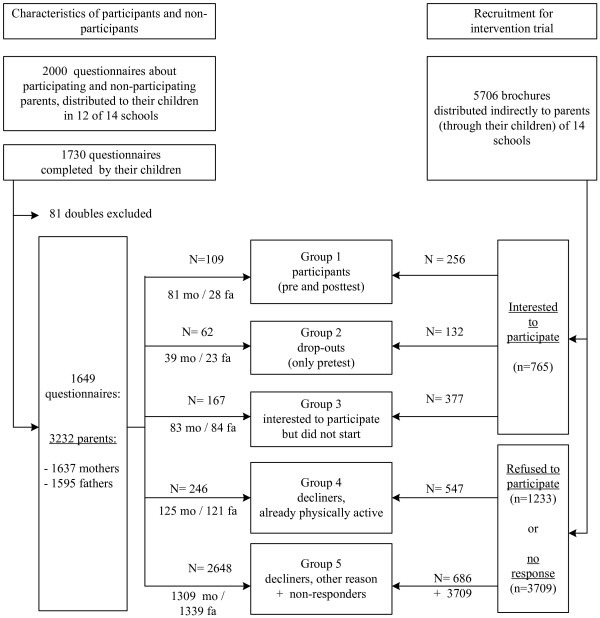
Data was collected in two ways. First, 5706 brochures with a call to participate in a physical activity program, with as key element a website-delivered tailored physical activity advice, were distributed indirectly (through their children) to parents of all pupils in 14 primary and secondary schools in Belgium. Parents were asked to return the reply card mentioning if they wanted to participate or not. Second, characteristics of participating and non-participating parents were collected by distributing 2000 short questionnaires to pupils between 10-18 years of age, in 12 of the 14 schools. Chi-square analysis and binary logistic regressions were used to compare characteristics of those parents who showed interest (i.e. positive response on reply card) or actually participated (completed online assessment) in a website-delivered physical activity intervention with the characteristics of those parents who showed no interest or did not participate.
In total 1730 pupils (87% respondents), completed the short questionnaire concerning their parents' age, occupation (to derive the socio-economic status) and physical activity habits. The results of the binary logistic regression showed that mothers were more likely to show interest (Odds Ratio (OR) = 1.68, p < 0.001) and participate (OR = 2.27, p < 0.005) in the program than fathers. High socioeconomic status (OR = 3.42, p < 0.001) and being employed (OR = 3.03, p < 0.001) were also significant predictors for showing interest but not for participation. Age and physical activity level did neither predict interest nor participation.
Both younger and older adults as well as physically active and inactive people participated in our online computer-tailored physical activity program when recruitment was done through schools. However, other health-education programs are still needed to reach all segments of the population equally.
如今,越来越多的健康专业人士利用互联网提供行为改变干预措施,因为这种方式可以以低成本接触到各种人群。然而,对于谁对这些网站提供的项目感兴趣并实际参与其中,我们知之甚少。因此,本文的目的是研究通过互联网提供的个性化身体活动干预项目中参与者和非参与者(通过学校招募的家长)的特征。
数据通过两种方式收集。首先,将 5706 份小册子分发给 14 所中小学的所有学生家长,其中包含参加身体活动计划的号召,其关键元素是网站提供的个性化身体活动建议。家长们被要求返回回复卡,说明他们是否愿意参加。其次,通过向 14 所学校中的 12 所学校的 10-18 岁的学生分发 2000 份简短问卷,收集参与和不参与家长的特征。使用卡方分析和二项逻辑回归比较对回复卡表示有兴趣(即回复卡上的正面回应)或实际参与(完成在线评估)网站提供的身体活动干预的父母的特征与表示没有兴趣或不参与的父母的特征。
共有 1730 名学生(87%的应答者)完成了有关其父母年龄、职业(以确定社会经济地位)和身体活动习惯的简短问卷。二项逻辑回归的结果表明,母亲比父亲更有可能对该计划表现出兴趣(优势比(OR)=1.68,p <0.001)并参与(OR = 2.27,p <0.005)。高社会经济地位(OR = 3.42,p <0.001)和就业(OR = 3.03,p <0.001)也是表现出兴趣的重要预测因素,但不是参与的预测因素。年龄和身体活动水平既不能预测兴趣,也不能预测参与。
在通过学校进行招募时,年轻和年长的成年人以及活跃和不活跃的人都参与了我们的在线个性化身体活动计划。然而,仍然需要其他健康教育计划来平等地覆盖所有人群。