Qin Chao, Farber Jay P, Linderoth Bengt, Shahid Abdul, Foreman R D
Department of Physiology, University of Oklahoma Health Sciences Center, Oklahoma City, Oklahoma 73910, USA.
J Pain. 2008 Jan;9(1):71-8. doi: 10.1016/j.jpain.2007.08.007. Epub 2007 Nov 5.
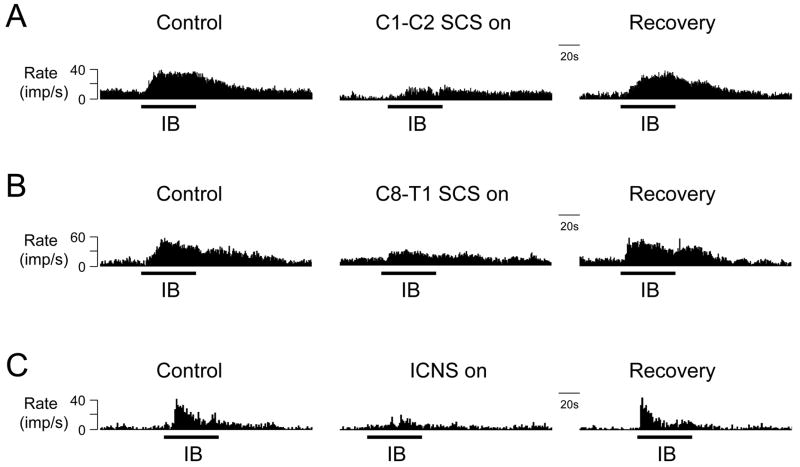
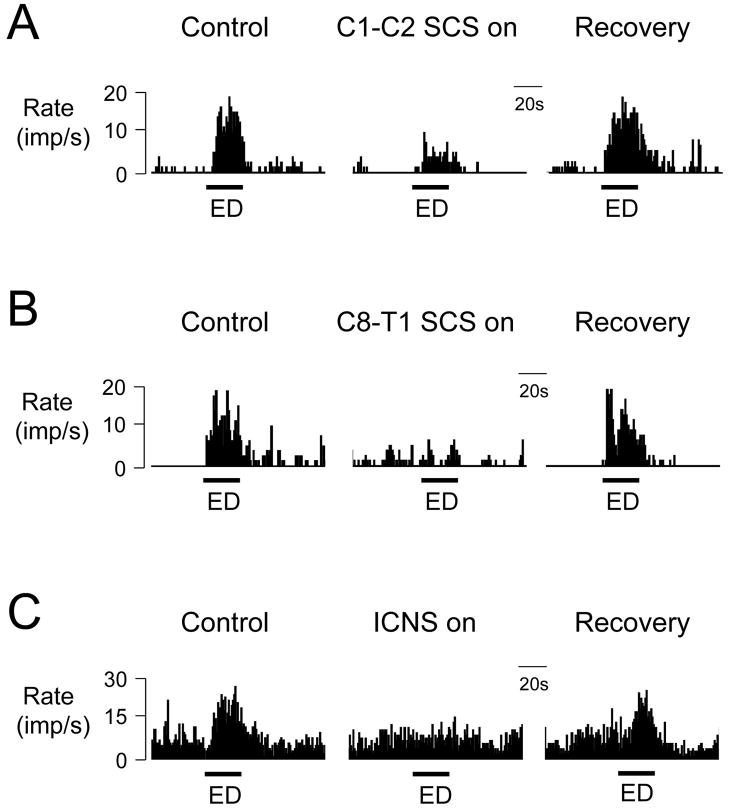
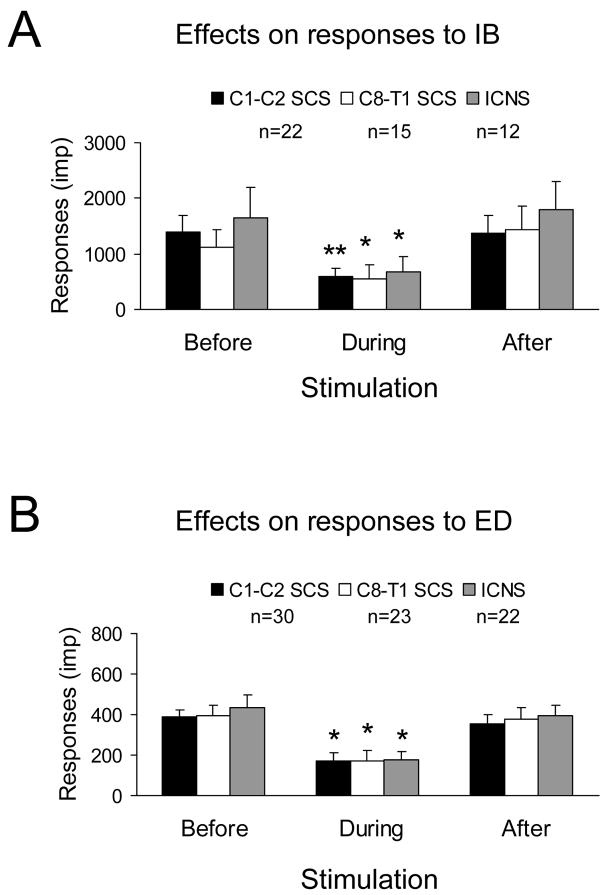
Clinical studies have shown that neuromodulation therapies, such as spinal cord stimulation (SCS) and transcutaneous electrical nerve stimulation (TENS), reduce symptoms of chronic neuropathic and visceral pain. The neural mechanisms underlying SCS and TENS therapy are poorly understood. The present study was designed to compare the effects of SCS and TENS on spinal neuronal responses to noxious stimuli applied to the heart and esophagus. Direct stimulation of an intercostal nerve (ICNS) was used to simulate the effects of TENS. Extracellular potentials of left thoracic (T3) spinal neurons were recorded in pentobarbital anesthetized, paralyzed, and ventilated male rats. SCS (50 Hz, 0.2 ms, 3-5 minutes) at a clinical relevant intensity (90% of motor threshold) was applied on the C1-C2 or C8-T1 ipsilateral spinal segments. Intercostal nerve stimulation (ICNS) at T3 spinal level was performed using the same parameters as SCS. Intrapericardial injection of bradykinin (IB, 10 microg/mL, 0.2 mL, 1 minute) was used as the noxious cardiac stimulus. Noxious thoracic esophageal distension (ED, 0.4 mL, 20 seconds) was produced by water inflation of a latex balloon. C1-C2 SCS suppressed excitatory responses of 16/22 T3 spinal neurons to IB and 25/30 neurons to ED. C8-T1 SCS suppressed excitatory responses of 10/15 spinal neurons to IB and 17/23 neurons to ED. ICNS suppressed excitatory responses of 9/12 spinal neurons to IB and 17/22 neurons to ED. These data showed that SCS and ICNS modulated excitatory responses of T3 spinal neurons to noxious stimulation of the heart and esophagus.
Neuromodulation of noxious cardiac and esophageal inputs onto thoracic spinal neurons by spinal cord and intercostal nerves stimulation observed in the present study may help account for therapeutic effects on thoracic visceral pain by activating the spinal dorsal column or somatic afferents.
临床研究表明,神经调节疗法,如脊髓刺激(SCS)和经皮电刺激神经疗法(TENS),可减轻慢性神经性疼痛和内脏疼痛的症状。人们对SCS和TENS疗法背后的神经机制了解甚少。本研究旨在比较SCS和TENS对脊髓神经元对施加于心脏和食管的有害刺激的反应的影响。使用直接刺激肋间神经(ICNS)来模拟TENS的效果。在戊巴比妥麻醉、麻痹并通气的雄性大鼠中记录左胸段(T3)脊髓神经元的细胞外电位。在临床相关强度(运动阈值的90%)下,在C1-C2或C8-T1同侧脊髓节段施加SCS(50Hz,0.2ms,3-5分钟)。在T3脊髓水平进行肋间神经刺激(ICNS),使用与SCS相同的参数。心包内注射缓激肽(IB,10μg/mL,0.2mL,1分钟)用作有害心脏刺激。通过乳胶气球注水产生有害的胸段食管扩张(ED,0.4mL,20秒)。C1-C2 SCS抑制了16/22个T3脊髓神经元对IB的兴奋性反应和25/30个神经元对ED的兴奋性反应。C8-T1 SCS抑制了10/15个脊髓神经元对IB的兴奋性反应和17/23个神经元对ED的兴奋性反应。ICNS抑制了9/12个脊髓神经元对IB的兴奋性反应和17/22个神经元对ED的兴奋性反应。这些数据表明,SCS和ICNS调节了T3脊髓神经元对心脏和食管有害刺激的兴奋性反应。
本研究中观察到的脊髓和肋间神经刺激对胸段脊髓神经元上有害心脏和食管传入神经的神经调节作用,可能有助于解释通过激活脊髓背柱或躯体传入神经对胸段内脏疼痛的治疗效果。