Friedlaender Jonathan S, Friedlaender Françoise R, Reed Floyd A, Kidd Kenneth K, Kidd Judith R, Chambers Geoffrey K, Lea Rodney A, Loo Jun-Hun, Koki George, Hodgson Jason A, Merriwether D Andrew, Weber James L
Anthropology Department, Temple University, Philadelphia, Pennsylvania, United States of America.
PLoS Genet. 2008 Jan;4(1):e19. doi: 10.1371/journal.pgen.0040019.
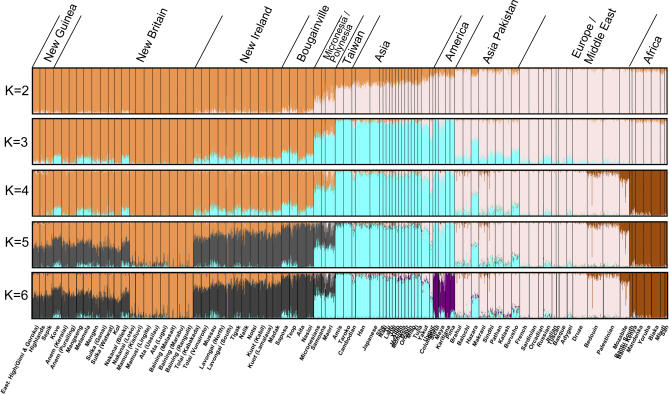
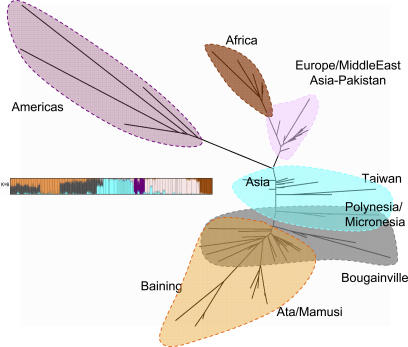
Human genetic diversity in the Pacific has not been adequately sampled, particularly in Melanesia. As a result, population relationships there have been open to debate. A genome scan of autosomal markers (687 microsatellites and 203 insertions/deletions) on 952 individuals from 41 Pacific populations now provides the basis for understanding the remarkable nature of Melanesian variation, and for a more accurate comparison of these Pacific populations with previously studied groups from other regions. It also shows how textured human population variation can be in particular circumstances. Genetic diversity within individual Pacific populations is shown to be very low, while differentiation among Melanesian groups is high. Melanesian differentiation varies not only between islands, but also by island size and topographical complexity. The greatest distinctions are among the isolated groups in large island interiors, which are also the most internally homogeneous. The pattern loosely tracks language distinctions. Papuan-speaking groups are the most differentiated, and Austronesian or Oceanic-speaking groups, which tend to live along the coastlines, are more intermixed. A small "Austronesian" genetic signature (always <20%) was detected in less than half the Melanesian groups that speak Austronesian languages, and is entirely lacking in Papuan-speaking groups. Although the Polynesians are also distinctive, they tend to cluster with Micronesians, Taiwan Aborigines, and East Asians, and not Melanesians. These findings contribute to a resolution to the debates over Polynesian origins and their past interactions with Melanesians. With regard to genetics, the earlier studies had heavily relied on the evidence from single locus mitochondrial DNA or Y chromosome variation. Neither of these provided an unequivocal signal of phylogenetic relations or population intermixture proportions in the Pacific. Our analysis indicates the ancestors of Polynesians moved through Melanesia relatively rapidly and only intermixed to a very modest degree with the indigenous populations there.
太平洋地区的人类遗传多样性尚未得到充分采样,尤其是在美拉尼西亚。因此,该地区的人群关系一直存在争议。对来自41个太平洋人群的952个人进行的常染色体标记(687个微卫星和203个插入/缺失)基因组扫描,为理解美拉尼西亚变异的显著特征以及将这些太平洋人群与其他地区先前研究的群体进行更准确的比较提供了基础。它还展示了在特定情况下人类群体变异可以多么复杂。单个太平洋人群内部的遗传多样性非常低,而美拉尼西亚群体之间的分化程度很高。美拉尼西亚群体之间的分化不仅因岛屿而异,还因岛屿大小和地形复杂性而异。最大的差异存在于大岛内陆的孤立群体之间,这些群体内部也是最同质化的。这种模式大致与语言差异相符。说巴布亚语的群体分化程度最高,而倾向于居住在沿海地区的说南岛语或大洋洲语的群体则更为混杂。在不到一半的说南岛语的美拉尼西亚群体中检测到了少量的“南岛语系”基因特征(始终<20%),而说巴布亚语的群体中则完全没有。尽管波利尼西亚人也很独特,但他们往往与密克罗尼西亚人、台湾原住民和东亚人聚在一起,而不是与美拉尼西亚人聚在一起。这些发现有助于解决关于波利尼西亚起源及其过去与美拉尼西亚人互动的争论。在遗传学方面,早期研究严重依赖单基因座线粒体DNA或Y染色体变异的证据。这两者都没有提供太平洋地区系统发育关系或群体混合比例的确切信号。我们的分析表明,波利尼西亚人的祖先相对迅速地穿过美拉尼西亚,并且只与当地居民有非常有限的混合。