Hundertmark Michaela, Hincha Dirk K
Max-Planck-Institut für Molekulare Pflanzenphysiologie, Am Mühlenberg 1, D-14476 Potsdam, Germany.
BMC Genomics. 2008 Mar 4;9:118. doi: 10.1186/1471-2164-9-118.
LEA (late embryogenesis abundant) proteins have first been described about 25 years ago as accumulating late in plant seed development. They were later found in vegetative plant tissues following environmental stress and also in desiccation tolerant bacteria and invertebrates. Although they are widely assumed to play crucial roles in cellular dehydration tolerance, their physiological and biochemical functions are largely unknown.
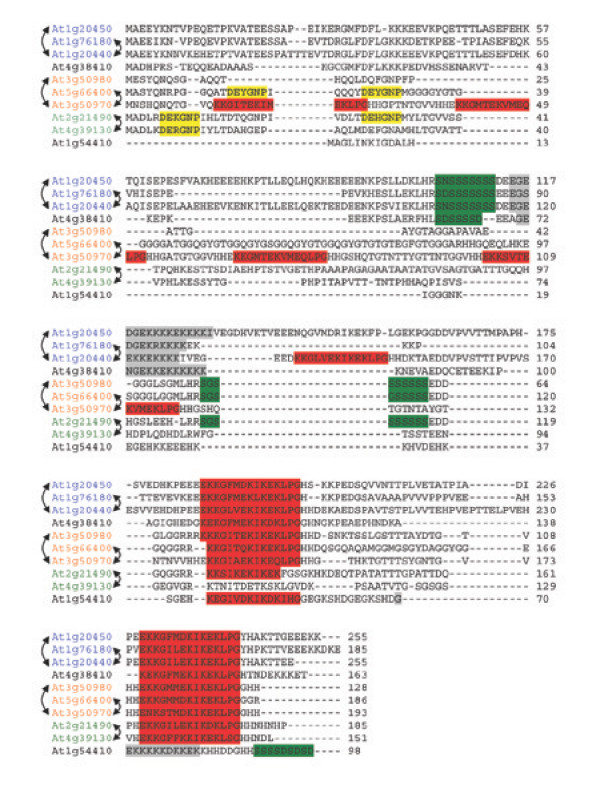
We present a genome-wide analysis of LEA proteins and their encoding genes in Arabidopsis thaliana. We identified 51 LEA protein encoding genes in the Arabidopsis genome that could be classified into nine distinct groups. Expression studies were performed on all genes at different developmental stages, in different plant organs and under different stress and hormone treatments using quantitative RT-PCR. We found evidence of expression for all 51 genes. There was only little overlap between genes expressed in vegetative tissues and in seeds and expression levels were generally higher in seeds. Most genes encoding LEA proteins had abscisic acid response (ABRE) and/or low temperature response (LTRE) elements in their promoters and many genes containing the respective promoter elements were induced by abscisic acid, cold or drought. We also found that 33% of all Arabidopsis LEA protein encoding genes are arranged in tandem repeats and that 43% are part of homeologous pairs. The majority of LEA proteins were predicted to be highly hydrophilic and natively unstructured, but some were predicted to be folded.
The analyses indicate a wide range of sequence diversity, intracellular localizations, and expression patterns. The high fraction of retained duplicate genes and the inferred functional diversification indicate that they confer an evolutionary advantage for an organism under varying stressful environmental conditions. This comprehensive analysis will be an important starting point for future efforts to elucidate the functional role of these enigmatic proteins.
胚胎后期丰富(LEA)蛋白大约在25年前首次被描述为在植物种子发育后期积累。后来在环境胁迫后的植物营养组织中以及耐干燥细菌和无脊椎动物中也发现了它们。尽管普遍认为它们在细胞耐脱水方面发挥关键作用,但其生理和生化功能在很大程度上仍不清楚。
我们对拟南芥中的LEA蛋白及其编码基因进行了全基因组分析。我们在拟南芥基因组中鉴定出51个编码LEA蛋白的基因,这些基因可分为九个不同的组。使用定量RT-PCR对所有基因在不同发育阶段、不同植物器官以及不同胁迫和激素处理下进行了表达研究。我们发现了所有51个基因的表达证据。营养组织和种子中表达的基因之间只有很少的重叠,并且种子中的表达水平通常更高。大多数编码LEA蛋白的基因在其启动子中具有脱落酸响应(ABRE)和/或低温响应(LTRE)元件,许多含有相应启动子元件的基因被脱落酸、寒冷或干旱诱导。我们还发现,拟南芥中所有编码LEA蛋白的基因中有33%排列成串联重复,43%是同源对的一部分。大多数LEA蛋白被预测为高度亲水且天然无结构,但有些被预测为折叠的。
分析表明LEA蛋白具有广泛多样的序列、细胞内定位和表达模式。保留的重复基因的高比例以及推断的功能多样化表明,它们在不同的应激环境条件下为生物体赋予了进化优势。这种全面分析将是未来阐明这些神秘蛋白功能作用的重要起点。