Chambaere Kenneth, Bilsen Johan, Cohen Joachim, Pousset Geert, Onwuteaka-Philipsen Bregje, Mortier Freddy, Deliens Luc
End-of-Life Care Research Group, Vrije Universiteit Brussel, Belgium.
BMC Public Health. 2008 Aug 27;8:299. doi: 10.1186/1471-2458-8-299.
Reliable studies of the incidence and characteristics of medical end-of-life decisions with a certain or possible life shortening effect (ELDs) are indispensable for an evidence-based medical and societal debate on this issue. This article presents the protocol drafted for the 2007 ELD Study in Flanders, Belgium, and outlines how the main aims and challenges of the study (i.e. making reliable incidence estimates of end-of-life decisions, even rare ones, and describing their characteristics; allowing comparability with past ELD studies; guaranteeing strict anonymity given the sensitive nature of the research topic; and attaining a sufficient response rate) are addressed in a post-mortem survey using a representative sample of death certificates.
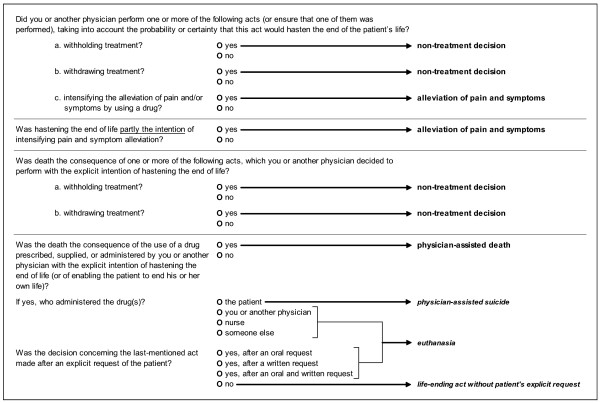
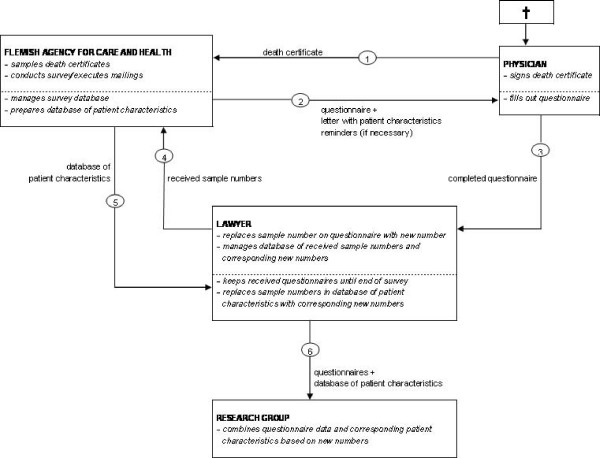
Reliable incidence estimates are achievable by using large at random samples of death certificates of deceased persons in Flanders (aged one year or older). This entails the cooperation of the appropriate administrative authorities. To further ensure the reliability of the estimates and descriptions, especially of less prevalent end-of-life decisions (e.g. euthanasia), a stratified sample is drawn. A questionnaire is sent out to the certifying physician of each death sampled. The questionnaire, tested thoroughly and avoiding emotionally charged terms is based largely on questions that have been validated in previous national and European ELD studies. Anonymity of both patient and physician is guaranteed through a rigorous procedure, involving a lawyer as intermediary between responding physicians and researchers. To increase response we follow the Total Design Method (TDM) with a maximum of three follow-up mailings. Also, a non-response survey is conducted to gain insight into the reasons for lack of response.
The protocol of the 2007 ELD Study in Flanders, Belgium, is appropriate for achieving the objectives of the study; as past studies in Belgium, the Netherlands, and other European countries have shown, strictly anonymous and thorough surveys among physicians using a large, stratified, and representative death certificate sample are most suitable in nationwide studies of incidence and characteristics of end-of-life decisions. There are however also some limitations to the study design.
对于医学临终决策(ELDs)的发生率及特征进行可靠研究(这些决策具有确定或可能缩短生命的效果),对于基于证据的医学及社会对此问题的辩论而言必不可少。本文介绍了为2007年比利时弗拉芒地区ELD研究起草的方案,并概述了该研究的主要目标及挑战(即对临终决策,甚至是罕见的决策,进行可靠的发生率估计,并描述其特征;使研究结果能够与以往的ELD研究进行比较;鉴于研究主题的敏感性,确保严格的匿名性;以及获得足够的回复率)是如何在一项使用具有代表性的死亡证明样本的事后调查中得以解决的。
通过随机抽取弗拉芒地区(年龄在一岁及以上)死者的大量死亡证明样本,可以实现可靠的发生率估计。这需要相关行政部门的合作。为了进一步确保估计和描述的可靠性,特别是对于不太常见的临终决策(如安乐死),抽取分层样本。向每个抽样死亡案例的认证医生发送一份问卷。该问卷经过了充分测试,避免使用带有情感色彩的术语,主要基于在以往国家和欧洲ELD研究中已得到验证的问题。通过严格的程序确保患者和医生的匿名性,程序中涉及一名律师作为回复医生与研究人员之间的中间人。为了提高回复率,我们采用全面设计方法(TDM),最多进行三次跟进邮寄。此外,还进行了无回复调查,以深入了解无回复的原因。
2007年比利时弗拉芒地区ELD研究的方案适合实现该研究的目标;正如比利时、荷兰及其他欧洲国家以往的研究所示,在全国范围内对临终决策的发生率和特征进行研究时,对医生进行严格匿名且全面的调查,使用大量、分层且具有代表性的死亡证明样本最为合适。然而,该研究设计也存在一些局限性。