Mason Craig A, Tu Shihfen
College of Education and Human Development, University of Maine, Orono, ME, USA.
Epidemiol Perspect Innov. 2008 Oct 2;5:5. doi: 10.1186/1742-5573-5-5.
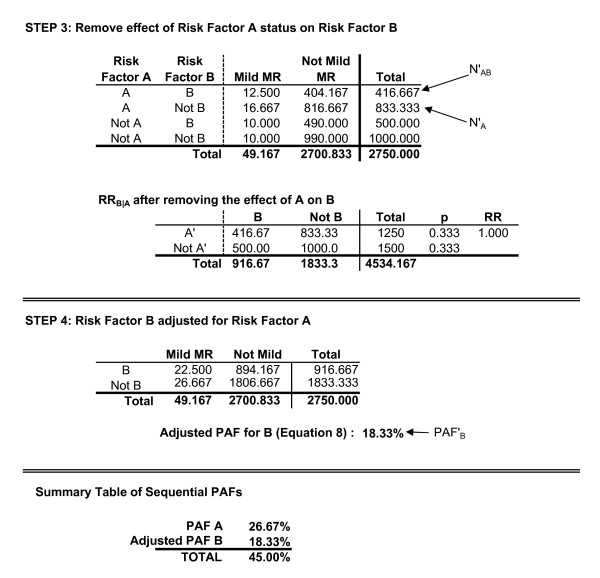
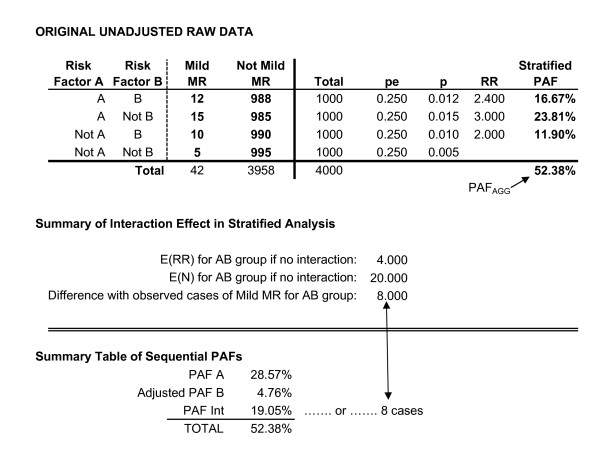
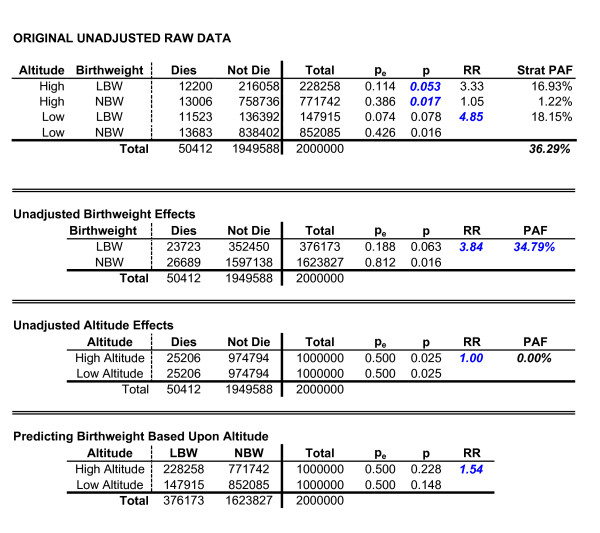
While the population attributable fraction (PAF) provides potentially valuable information regarding the community-level effect of risk factors, significant limitations exist with current strategies for estimating a PAF in multiple risk factor models. These strategies can result in paradoxical or ambiguous measures of effect, or require unrealistic assumptions regarding variables in the model. A method is proposed in which an overall or total PAF across multiple risk factors is partitioned into components based upon a sequential ordering of effects. This method is applied to several hypothetical data sets in order to demonstrate its application and interpretation in diverse analytic situations.
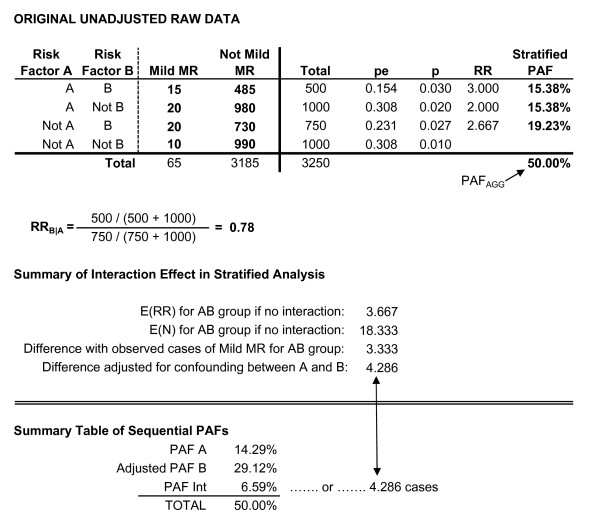
The proposed method is demonstrated to provide clear and interpretable measures of effect, even when risk factors are related/correlated and/or when risk factors interact. Furthermore, this strategy not only addresses, but also quantifies issues raised by other researchers who have noted the potential impact of population-shifts on population-level effects in multiple risk factor models.
Combined with simple, unadjusted PAF estimates and an aggregate PAF based on all risk factors under consideration, the sequentially partitioned PAF provides valuable additional information regarding the process through which population rates of a disorder may be impacted. In addition, the approach can also be used to statistically control for confounding by other variables, while avoiding the potential pitfalls of attempting to separately differentiate direct and indirect effects.
虽然人群归因分数(PAF)提供了有关危险因素社区层面影响的潜在有价值信息,但当前在多危险因素模型中估计PAF的策略存在重大局限性。这些策略可能导致矛盾或模糊的效应测量,或者需要对模型中的变量做出不切实际的假设。本文提出了一种方法,其中基于效应的顺序排序将多个危险因素的总体或总PAF划分为各个组成部分。该方法应用于几个假设数据集,以展示其在不同分析情况下的应用和解释。
即使危险因素相关/存在相关性和/或危险因素相互作用,所提出的方法也能提供清晰且可解释的效应测量。此外,该策略不仅解决了其他研究人员提出的问题,还对这些问题进行了量化,这些研究人员指出了人口结构变化对多危险因素模型中人群水平效应的潜在影响。
结合简单的、未调整的PAF估计值以及基于所有考虑的危险因素的综合PAF,顺序划分的PAF提供了有关疾病人群发病率可能受到影响的过程的有价值的额外信息。此外,该方法还可用于对其他变量的混杂进行统计控制,同时避免试图分别区分直接和间接效应的潜在陷阱。