• 文献检索
  • 文档翻译
  • 深度研究
  • 学术资讯
  • Suppr Zotero 插件Zotero 插件
  • 邀请有礼
  • 套餐&价格
  • 历史记录
应用&插件
Suppr Zotero 插件Zotero 插件浏览器插件Mac 客户端Windows 客户端微信小程序
定价
高级版会员购买积分包购买API积分包
服务
文献检索文档翻译深度研究API 文档MCP 服务
关于我们
关于 Suppr公司介绍联系我们用户协议隐私条款
关注我们

Suppr 超能文献

核心技术专利:CN118964589B侵权必究
粤ICP备2023148730 号-1Suppr @ 2026

文献检索

告别复杂PubMed语法,用中文像聊天一样搜索,搜遍4000万医学文献。AI智能推荐,让科研检索更轻松。

立即免费搜索

文件翻译

保留排版,准确专业,支持PDF/Word/PPT等文件格式,支持 12+语言互译。

免费翻译文档

深度研究

AI帮你快速写综述,25分钟生成高质量综述,智能提取关键信息,辅助科研写作。

立即免费体验

家庭结构与传染病传播。

Household structure and infectious disease transmission.

作者信息

House T, Keeling M J

机构信息

Department of Biological Sciences, University of Warwick, Coventry, UK.

出版信息

Epidemiol Infect. 2009 May;137(5):654-61. doi: 10.1017/S0950268808001416. Epub 2008 Oct 8.

DOI:10.1017/S0950268808001416
PMID:18840319
原文链接:https://pmc.ncbi.nlm.nih.gov/articles/PMC2829934/
Abstract

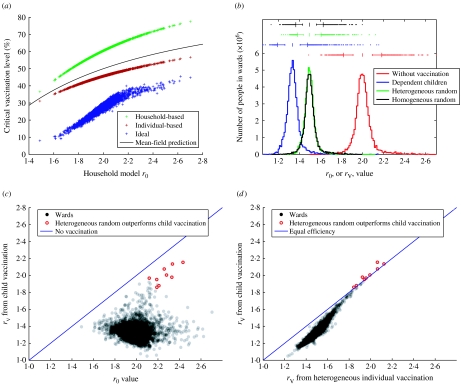
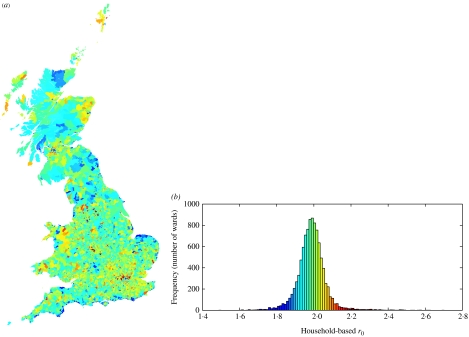
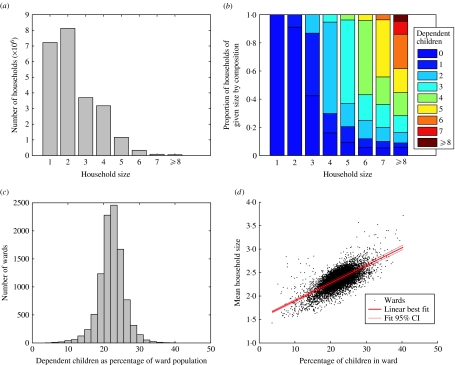
One of the central tenets of modern infectious disease epidemiology is that an understanding of heterogeneities, both in host demography and transmission, allows control to be efficiently optimized. Due to the strong interactions present, households are one of the most important heterogeneities to consider, both in terms of predicting epidemic severity and as a target for intervention. We consider these effects in the context of pandemic influenza in Great Britain, and find that there is significant local (ward-level) variation in the basic reproductive ratio, with some regions predicted to suffer 50% faster growth rate of infection than the mean. Childhood vaccination was shown to be highly effective at controlling an epidemic, generally outperforming random vaccination and substantially reducing the variation between regions; only nine out of over 10 000 wards did not obey this rule and these can be identified as demographically atypical regions. Since these benefits of childhood vaccination are a product of correlations between household size and number of dependent children in the household, our results are qualitatively robust for a variety of disease scenarios.

摘要

现代传染病流行病学的核心原则之一是,了解宿主人口统计学和传播方面的异质性有助于有效优化防控措施。由于存在强烈的相互作用,家庭是在预测疫情严重程度和作为干预目标方面需要考虑的最重要的异质性因素之一。我们在英国大流行性流感的背景下考虑这些影响,发现基本再生数存在显著的局部(病房级别)差异,一些地区预计感染增长率比平均水平快50%。儿童疫苗接种在控制疫情方面显示出高度有效性,总体上优于随机接种,并大幅减少了地区间的差异;在一万多个病房中只有九个不遵循这一规律,这些病房可被确定为人口统计学上的非典型地区。由于儿童疫苗接种的这些益处是家庭规模与家庭中受抚养子女数量之间相关性的产物,我们的结果在各种疾病情况下在定性上是稳健的。
https://cdn.ncbi.nlm.nih.gov/pmc/blobs/72ad/2829934/e2ef452fd1df/S0950268808001416_fig3.jpg
https://cdn.ncbi.nlm.nih.gov/pmc/blobs/72ad/2829934/10fbe699f2a4/S0950268808001416_fig1.jpg
https://cdn.ncbi.nlm.nih.gov/pmc/blobs/72ad/2829934/4a729462a1d0/S0950268808001416_fig2.jpg
https://cdn.ncbi.nlm.nih.gov/pmc/blobs/72ad/2829934/e2ef452fd1df/S0950268808001416_fig3.jpg
https://cdn.ncbi.nlm.nih.gov/pmc/blobs/72ad/2829934/10fbe699f2a4/S0950268808001416_fig1.jpg
https://cdn.ncbi.nlm.nih.gov/pmc/blobs/72ad/2829934/4a729462a1d0/S0950268808001416_fig2.jpg
https://cdn.ncbi.nlm.nih.gov/pmc/blobs/72ad/2829934/e2ef452fd1df/S0950268808001416_fig3.jpg

相似文献

1
Household structure and infectious disease transmission.家庭结构与传染病传播。
Epidemiol Infect. 2009 May;137(5):654-61. doi: 10.1017/S0950268808001416. Epub 2008 Oct 8.
2
Control of transmission with two types of infection.两种感染类型的传播控制
Math Biosci. 2006 Apr;200(2):170-87. doi: 10.1016/j.mbs.2005.12.024. Epub 2006 Feb 21.
3
Deterministic epidemic models with explicit household structure.具有明确家庭结构的确定性流行病模型。
Math Biosci. 2008 May;213(1):29-39. doi: 10.1016/j.mbs.2008.01.011. Epub 2008 Feb 26.
4
Incorporating population dynamics into household models of infectious disease transmission.将人口动态纳入传染病传播的家庭模型中。
Epidemics. 2011 Sep;3(3-4):152-8. doi: 10.1016/j.epidem.2011.05.001. Epub 2011 Jun 1.
5
Estimating individual and household reproduction numbers in an emerging epidemic.估算新兴传染病中的个体和家庭繁殖数。
PLoS One. 2007 Aug 22;2(8):e758. doi: 10.1371/journal.pone.0000758.
6
Reproductive numbers, epidemic spread and control in a community of households.家庭社区中的繁殖数、疫情传播与控制
Math Biosci. 2009 Sep;221(1):11-25. doi: 10.1016/j.mbs.2009.06.002. Epub 2009 Jun 25.
7
The effect of household distribution on transmission and control of highly infectious diseases.家庭分布对高传染性疾病传播与控制的影响。
Math Biosci. 1995 Jun;127(2):207-19. doi: 10.1016/0025-5564(94)00055-5.
8
Large-scale spatial-transmission models of infectious disease.传染病的大规模空间传播模型。
Science. 2007 Jun 1;316(5829):1298-301. doi: 10.1126/science.1134695.
9
The SEIRS model for infectious disease dynamics.传染病动力学的SEIRS模型。
Nat Methods. 2020 Jun;17(6):557-558. doi: 10.1038/s41592-020-0856-2.
10
Vaccination ethics.疫苗接种伦理
Vaccine. 2014 Dec 12;32(52):7161-2. doi: 10.1016/j.vaccine.2014.10.032. Epub 2014 Oct 29.

引用本文的文献

1
Spatio-temporal forecasting of COVID-19 cases in the Netherlands for source and contact tracing.荷兰新冠病毒疾病病例的时空预测,用于源头追踪和接触者追踪。
Int J Popul Data Sci. 2025 May 7;10(1):2703. doi: 10.23889/ijpds.v10i1.2703. eCollection 2025.
2
The role of place-based factors and other social determinants of health on adverse post-sepsis outcomes: a review of the literature.基于地点的因素及其他健康社会决定因素对脓毒症后不良结局的作用:文献综述
Front Disaster Emerg Med. 2024;2. doi: 10.3389/femer.2024.1357806. Epub 2024 Feb 29.
3
Synthetic population generation with public health characteristics for spatial agent-based models.

本文引用的文献

1
Deterministic epidemic models with explicit household structure.具有明确家庭结构的确定性流行病模型。
Math Biosci. 2008 May;213(1):29-39. doi: 10.1016/j.mbs.2008.01.011. Epub 2008 Feb 26.
2
Estimating individual and household reproduction numbers in an emerging epidemic.估算新兴传染病中的个体和家庭繁殖数。
PLoS One. 2007 Aug 22;2(8):e758. doi: 10.1371/journal.pone.0000758.
3
Approximate disease dynamics in household-structured populations.家庭结构人群中的近似疾病动态。
用于基于空间智能体模型的具有公共卫生特征的合成人口生成。
PLoS Comput Biol. 2025 Mar 17;21(3):e1012439. doi: 10.1371/journal.pcbi.1012439. eCollection 2025 Mar.
4
Reconstructed influenza A/H3N2 infection histories reveal variation in incidence and antibody dynamics over the life course.重建的甲型流感 H3N2 感染史揭示了一生中发病率和抗体动态的变化。
PLoS Biol. 2024 Nov 7;22(11):e3002864. doi: 10.1371/journal.pbio.3002864. eCollection 2024 Nov.
5
Quantifying age-specific household contacts in Aotearoa New Zealand for infectious disease modelling.为传染病建模量化新西兰奥塔哥地区特定年龄段的家庭接触情况。
R Soc Open Sci. 2024 Oct 2;11(10):240550. doi: 10.1098/rsos.240550. eCollection 2024 Oct.
6
The impact of household size on measles transmission: A long-term perspective.家庭规模对麻疹传播的影响:长期视角
Epidemics. 2024 Dec;49:100791. doi: 10.1016/j.epidem.2024.100791. Epub 2024 Sep 6.
7
Reconstructed influenza A/H3N2 infection histories reveal variation in incidence and antibody dynamics over the life course.重建的甲型H3N2流感感染史揭示了一生中发病率和抗体动态的变化。
medRxiv. 2024 Apr 5:2024.03.18.24304371. doi: 10.1101/2024.03.18.24304371.
8
Estimating household contact matrices structure from easily collectable metadata.从易于收集的元数据中估计家庭接触矩阵结构。
PLoS One. 2024 Mar 14;19(3):e0296810. doi: 10.1371/journal.pone.0296810. eCollection 2024.
9
Systematic Review of Household Transmission of Strep A: A Potential Site for Prevention That Has Eluded Attention.系统综述:A 组链球菌的家庭传播:一个潜在的预防场所,但一直被忽视。
J Infect Dis. 2024 Oct 16;230(4):e798-e806. doi: 10.1093/infdis/jiae136.
10
Generating synthetic population for simulating the spatiotemporal dynamics of epidemics.生成用于模拟传染病时空动态的合成人群。
PLoS Comput Biol. 2024 Feb 12;20(2):e1011810. doi: 10.1371/journal.pcbi.1011810. eCollection 2024 Feb.
J R Soc Interface. 2007 Dec 22;4(17):1103-6. doi: 10.1098/rsif.2007.0231.
4
The impact of contact structure on infectious disease control: influenza and antiviral agents.接触结构对传染病控制的影响:流感与抗病毒药物
Epidemiol Infect. 2007 Oct;135(7):1124-32. doi: 10.1017/S0950268807007959. Epub 2007 Feb 9.
5
Comparative estimation of the reproduction number for pandemic influenza from daily case notification data.基于每日病例通报数据对大流行性流感繁殖数的比较估计。
J R Soc Interface. 2007 Feb 22;4(12):155-66. doi: 10.1098/rsif.2006.0161.
6
A model for the spread and control of pandemic influenza in an isolated geographical region.一个孤立地理区域内大流行性流感传播与控制的模型。
J R Soc Interface. 2007 Apr 22;4(13):325-30. doi: 10.1098/rsif.2006.0176.
7
Optimal vaccination schemes for epidemics among a population of households, with application to variola minor in Brazil.家庭群体中流行病的最佳疫苗接种方案及其在巴西轻型天花中的应用。
Stat Methods Med Res. 2006 Oct;15(5):481-97. doi: 10.1177/0962280206071643.
8
Reducing the impact of the next influenza pandemic using household-based public health interventions.利用基于家庭的公共卫生干预措施减轻下一次流感大流行的影响。
PLoS Med. 2006 Sep;3(9):e361. doi: 10.1371/journal.pmed.0030361.
9
Strategies for mitigating an influenza pandemic.缓解流感大流行的策略。
Nature. 2006 Jul 27;442(7101):448-52. doi: 10.1038/nature04795. Epub 2006 Apr 26.
10
Mitigation strategies for pandemic influenza in the United States.美国大流行性流感的缓解策略。
Proc Natl Acad Sci U S A. 2006 Apr 11;103(15):5935-40. doi: 10.1073/pnas.0601266103. Epub 2006 Apr 3.