Ostroumova E, Preston D L, Ron E, Krestinina L, Davis F G, Kossenko M, Akleyev A
Radiation Epidemiology Branch, Division of Cancer Epidemiology and Genetics, National Cancer Institute, NIH, MS 7238, 6120 Executive Boulevard, Bethesda, MD 20892-7238, USA.
Br J Cancer. 2008 Dec 2;99(11):1940-5. doi: 10.1038/sj.bjc.6604775. Epub 2008 Nov 11.
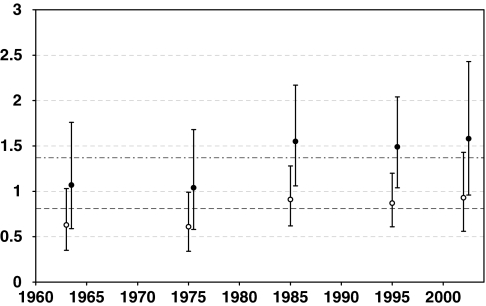
In the 1950s, the Mayak nuclear weapons facility in Russia discharged liquid radioactive wastes into the Techa River causing exposure of riverside residents to protracted low-to-moderate doses of radiation. Almost 10,000 women received estimated doses to the stomach of up to 0.47 Gray (Gy) (mean dose=0.04 Gy) from external gamma-exposure and (137)Cs incorporation. We have been following this population for cancer incidence and mortality and as in the general Russian population, we found a significant temporal trend of breast cancer incidence. A significant linear radiation dose-response relationship was observed (P=0.01) with an estimated excess relative risk per Gray (ERR/Gy) of 5.00 (95% confidence interval (CI), 0.80, 12.76). We estimated that approximately 12% of the 109 observed cases could be attributed to radiation.
20世纪50年代,俄罗斯的玛雅克核武器工厂向捷恰河排放液态放射性废物,导致河边居民长期暴露于低至中等剂量的辐射中。近10000名女性因外部伽马辐射和铯-137摄入,胃部估计接受了高达0.47戈瑞(Gy)的剂量(平均剂量=0.04 Gy)。我们一直在跟踪这一人群的癌症发病率和死亡率,与俄罗斯普通人群一样,我们发现乳腺癌发病率存在显著的时间趋势。观察到显著的线性辐射剂量-反应关系(P=0.01),每戈瑞的估计超额相对危险度(ERR/Gy)为5.00(95%置信区间(CI),0.80,12.76)。我们估计,在观察到的109例病例中,约12%可归因于辐射。