Ford Alexander C, Talley Nicholas J, Spiegel Brennan M R, Foxx-Orenstein Amy E, Schiller Lawrence, Quigley Eamonn M M, Moayyedi Paul
Gastroenterology Division, McMaster University, Health Sciences Centre, 1200 Main Street West, Hamilton, ON, L8N 3Z5, Canada.
BMJ. 2008 Nov 13;337:a2313. doi: 10.1136/bmj.a2313.
To determine the effect of fibre, antispasmodics, and peppermint oil in the treatment of irritable bowel syndrome.
Systematic review and meta-analysis of randomised controlled trials.
Medline, Embase, and the Cochrane controlled trials register up to April 2008. Review methods Randomised controlled trials comparing fibre, antispasmodics, and peppermint oil with placebo or no treatment in adults with irritable bowel syndrome were eligible for inclusion. The minimum duration of therapy considered was one week, and studies had to report either a global assessment of cure or improvement in symptoms, or cure of or improvement in abdominal pain, after treatment. A random effects model was used to pool data on symptoms, and the effect of therapy compared with placebo or no treatment was reported as the relative risk (95% confidence interval) of symptoms persisting.
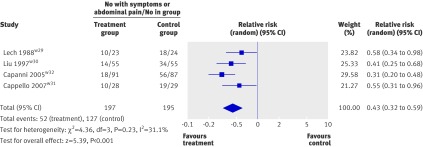
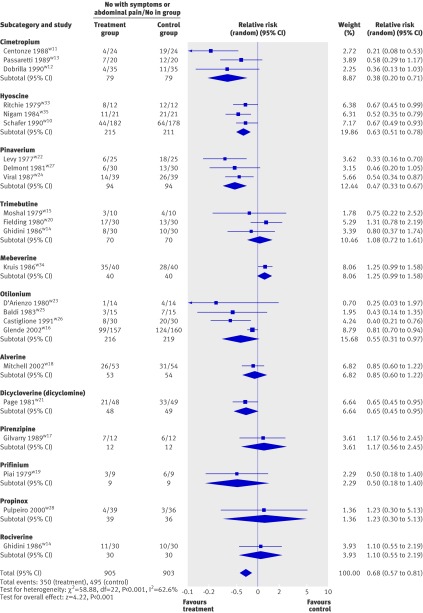
12 studies compared fibre with placebo or no treatment in 591 patients (relative risk of persistent symptoms 0.87, 95% confidence interval 0.76 to 1.00). This effect was limited to ispaghula (0.78, 0.63 to 0.96). Twenty two trials compared antispasmodics with placebo in 1778 patients (0.68, 0.57 to 0.81). Various antispasmodics were studied, but otilonium (four trials, 435 patients, relative risk of persistent symptoms 0.55, 0.31 to 0.97) and hyoscine (three trials, 426 patients, 0.63, 0.51 to 0.78) showed consistent evidence of efficacy. Four trials compared peppermint oil with placebo in 392 patients (0.43, 0.32 to 0.59).
Fibre, antispasmodics, and peppermint oil were all more effective than placebo in the treatment of irritable bowel syndrome.
确定纤维、抗痉挛药和薄荷油对肠易激综合征的治疗效果。
对随机对照试验进行系统评价和荟萃分析。
截至2008年4月的Medline、Embase和Cochrane对照试验注册库。综述方法纳入比较纤维、抗痉挛药和薄荷油与安慰剂或不治疗对成人肠易激综合征疗效的随机对照试验。治疗的最短持续时间为1周,研究必须报告治疗后症状治愈或改善的总体评估,或腹痛的治愈或改善情况。采用随机效应模型汇总症状数据,与安慰剂或不治疗相比的治疗效果以症状持续的相对风险(95%置信区间)表示。
12项研究比较了591例患者中纤维与安慰剂或不治疗的效果(持续症状的相对风险为0.87,95%置信区间为0.76至1.00)。这种效果仅限于卵叶车前(0.78,0.63至0.96)。22项试验比较了1778例患者中抗痉挛药与安慰剂的效果(0.68,0.57至0.81)。研究了各种抗痉挛药,但奥替溴铵(4项试验,435例患者,持续症状的相对风险为0.55,0.31至0.97)和东莨菪碱(3项试验,426例患者,0.63,0.51至0.78)显示出一致的疗效证据。4项试验比较了392例患者中薄荷油与安慰剂的效果(0.43,0.32至0.59)。
纤维、抗痉挛药和薄荷油在治疗肠易激综合征方面均比安慰剂更有效。